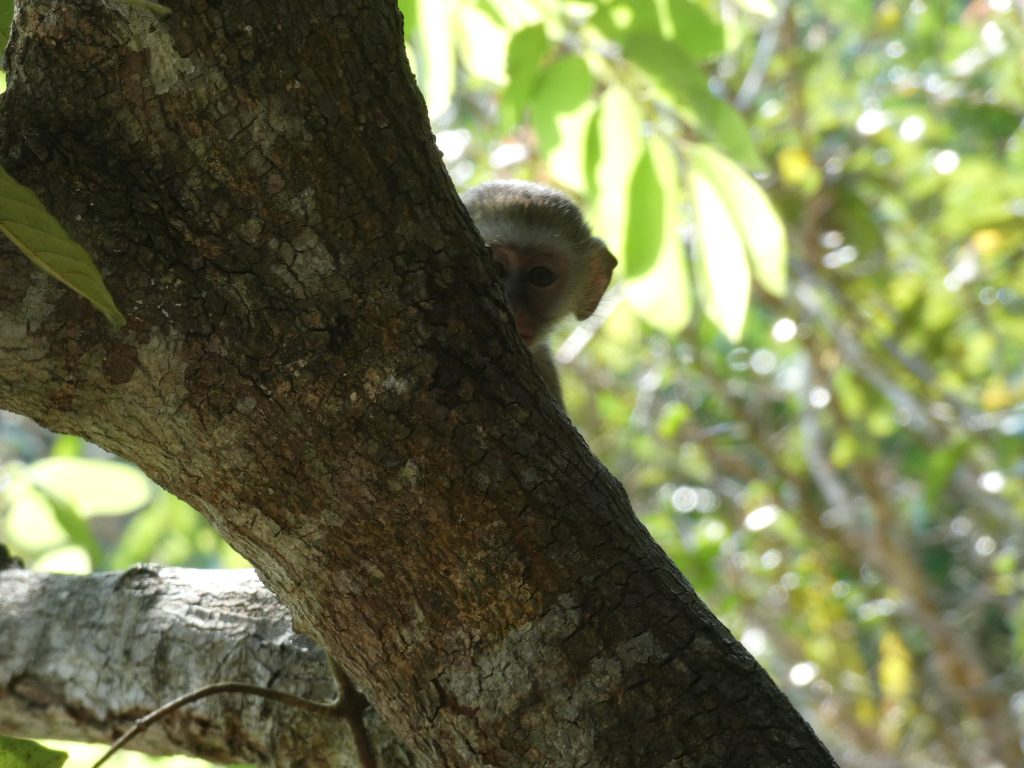
Forest Primate Spotting in Mahale National Park
Forest primate spotting in Mahale National Park means finding the eight or nine species that share the forest with the chimpanzees, on guided walks through the valley gullies behind the camp beaches, with red colobus, red-tailed monkeys, blue monkeys and baboons the most regular. Walks are included in the lakeside camp rates. Mahale Mountains National Park in western Tanzania holds one of the densest primate communities in the country.
Everyone books the chimpanzee trekking. Far fewer ask what else is up there, which is a shame, because on a slow morning in a Mahale gully something is almost always moving overhead.
How Primate Spotting Differs From Chimpanzee Trekking
The activities look similar and work completely differently.
A chimpanzee trek follows one habituated community wherever the trackers found them that morning, moves at the trackers’ pace, and can run from forty minutes to most of a day. Stopping to work a colobus troop is rarely an option once the party is moving towards a known target.
A guided forest walk pitched at primates goes where the guide expects animals to be, at a pace you set, for an agreed two or three hours. That difference is everything. You stop, you wait, you listen, and the canopy gives up what it has.
Camps include these walks in their rates. What they do not do is offer them unless you ask, because nearly every guest requests chimpanzee trekking by default.
Say what you want at the briefing. Guides here know the forest thoroughly and will pitch a morning entirely differently if they know you are after colobus and guenons rather than chimps. Tell them, and bring binoculars, because the canopy is high and the light is poor.
Red Colobus in the Valley Forest
The species most people hope to find after the chimpanzees, and among the more reliable.
Red colobus live in the lower valley forest near the camps and move in noisy troops through the middle and upper canopy. Large, russet and long-tailed, they are leaf eaters with the complex stomachs that group requires, and they announce themselves through sound long before you see them.
Taxonomy in this region is contested. The Mahale and Gombe populations are variously assigned to the ashy or Ugandan red colobus, or treated as a Central African form whose range reaches the eastern shore of Lake Tanganyika. Whichever label applies, they are the same animal in the tree above you.
They also occupy an uncomfortable position here: the chimpanzees hunt them, and the hunting and meat sharing documented at Mahale is among the best studied anywhere. Watching a troop fall silent when chimp calls carry through the forest is one of the moments that stays with people.
Angolan Black and White Colobus Higher Up
The park’s quiet claim to something found nowhere else.
Mahale supports an undescribed subspecies of the Angola colobus, recognised in the literature as a distinct form occurring only in these mountains. They live in the montane forest band on the middle slopes rather than down at beach level, so finding them usually means walking a fair way up.
Long white shoulder mantles, a white-tipped tail and a habit of launching between trees rather than climbing make them unmistakable once seen. They are a regular sighting for anyone on the middle sections of the Mount Nkungwe route, and rather less regular on a short morning walk from camp.
Guides describe them as needing more effort than the other species. The trade-off is that a walk deliberately pitched into the montane band usually produces them.
Red-Tailed and Blue Monkeys
The two guenons are the most frequently recorded primates on guided walks, and the hardest to photograph.
Red-tailed monkeys are small, fast and constantly in motion, with a white spot on a dark face and chestnut showing beneath the tail when they move through light. They forage across the mid canopy and drop lower into the understorey than the colobus do, which gives you better viewing when they do.
Blue monkeys share much of the same forest and are easily confused with red-tails at a glance, being similar in size and speed. The colouring separates them: grizzled grey-blue through the body, dark cap, no white nose spot. They favour the wetter valley forest and the taller closed canopy.
Both are heard before they are seen. A sudden crash and shake overhead is usually one of these two, and a good guide will call the species from the sound before anyone spots the animal.
Yellow baboon
The easiest primate in the park. Terrestrial, used to people, working the beaches and rocks in the late afternoon. No walk required.
Lower valley forest near the camps, in noisy troops through the canopy. Regular on a guided walk and hunted by the chimpanzees.
Red-tailed and blue monkeys
Mid canopy through the valley forest, fast and rarely still. The most frequently recorded species on forest walks.
Angolan black and white colobus
Montane band on the middle slopes, in a race found only in these mountains. Needs a longer walk uphill to find reliably.
Vervet monkey
Forest margins, clearings and the ground between habitats. The most familiar species here to anyone who has done a northern circuit safari.
Galagos
Nocturnal bushbabies are on the park list and account for some of the variation in species counts. Rarely seen by visitors on a daytime walk.
How Many Primate Species Live Here
Counts vary between eight and ten depending on the source, and the discrepancy is worth explaining.
Tanzania National Parks cites eight and possibly nine species. Frankfurt Zoological Society gives ten. The difference usually comes down to whether nocturnal galagos are included and how contested taxonomic splits, particularly among the red colobus, are treated.
Either way, this is one of the densest primate communities in Tanzania, and specialist operators describe the park as holding the country’s densest population of primates. On any guided walk in the valley forest, something is usually moving in the canopy.
Reading the Forest
Most primate spotting here is done by ear, which surprises people.
The canopy is closed, the light is poor and animals hear a walking party coming. What gives them away is sound: a crash in branches overhead, the running commentary of a colobus troop, an alarm call as something moves. Guides stop, listen, and change direction on evidence nobody else registered.
They also read sign constantly. Chimpanzee nests overhead, chewed wadges, dropped fruit, tool marks on arboreal ant nests. Even on a walk with no chimpanzee sighting, the traces are there and worth having pointed out.
Standing still for a full minute is one of the more productive things you can do in a Mahale gully.
Nine or ten primate species in one forest, and most people spend three days looking at only one of them.
Who Primate Spotting Suits
Anyone who would rather look than chase, and several groups for whom it is the better option outright.
Visitors who find steep open-ended walking a genuine problem get the same forest at a manageable scale, since a guided walk has an agreed length while a chimpanzee trek does not. Travellers on rest days between hard trekking mornings fill the day without a third climb.
Photographers and birders benefit from a pace that allows stopping. And families with children below the chimpanzee trekking age minimum, cited as twelve years by Mahale camps and fifteen by several national sources, can often join a forest walk instead. Confirm with your camp.
Photographing the Other Primates
Harder than the chimpanzees in some ways, easier in others.
Baboons are the cooperative subject: terrestrial, habituated and working the beaches in warm late afternoon light, which gives eye-level frames with a lake background. Everything else lives in a canopy and is usually backlit against a bright sky, which is the losing scenario for exposure.
Reposition where you can so the animal sits against foliage rather than sky. Expose for the animal and let the background go. Fast glass and high ISO performance matter more than extreme reach, since the problem is light rather than distance. Flash is prohibited around chimpanzees and is poor practice around any primate here.
Binoculars are worth more than a longer lens for actually enjoying the walk.
Best Time for Forest Primate Spotting
Mornings, in any month, when primates feed early and the forest is cooler and more active.
Seasonally, June to October gives the easiest walking, thinner undergrowth and better visibility through the forest, alongside the strongest chimpanzee sightings. November to February brings greener forest, more butterflies and better birding at the cost of slippery ground and longer walks. Most camps close from March to May during the long rains.
Altitude matters as much as season for the species mix. Lower valley forest holds the colobus, guenons and baboons; the montane band holds the black and white colobus.
Getting to Mahale
Access is by air or water only, since the park has no roads. Scheduled charters run from Arusha and the northern circuit on set days in season, typically Mondays and Thursdays, often calling at Katavi, landing at an airstrip near the boundary followed by a boat transfer of around ninety minutes to the camp beaches. Travellers who want both chimpanzee parks usually look at our 6 day Mahale and Gombe chimp safari.
The alternative flies Dar es Salaam to Kigoma in roughly three hours, then continues south by light aircraft in forty five minutes or by speedboat in four to six hours. From the beach, the primate forest starts immediately behind you.
Forest Primate Spotting: Frequently Asked Questions
Does primate spotting cost extra at Mahale?
Normally no. Guided forest walks are usually part of the inclusive rate at the lakeside camps, which start from around US$1,500 per person per night at the premium end. Park charges apply separately at roughly US$80 to US$95 per non-resident adult per day depending on VAT treatment and about US$35 per adult per night concession levy, though camps usually fold these in. The US$150 chimpanzee trekking permit applies only to chimp treks.
How many primate species can you see?
Between eight and ten live in the park depending on the source, with Tanzania National Parks citing eight and possibly nine and Frankfurt Zoological Society giving ten. On a guided walk you can realistically expect red colobus, red-tailed monkeys, blue monkeys and baboons, with Angolan black and white colobus higher up and vervets on the forest edges.
Which primates are easiest to see?
Yellow baboons by a wide margin, since they work the beaches and rocks in the late afternoon and need no walk at all. Red-tailed monkeys near the camps come next. The Angolan black and white colobus is the hardest of the regular species, living in the montane band on the middle slopes rather than down at lake level.
Can I do a primate walk instead of a chimpanzee trek?
Yes, and for some visitors it is the better choice. Forest walks have an agreed length of two to three hours at a pace you set, whereas chimpanzee treks follow the animals and can run from forty minutes to most of a day on steep humid ground. Tell your camp what you want at the briefing.
Do I need binoculars?
Very much so. Most Mahale primates sit high in a closed canopy in poor light, and the difference between a grey shape and an identified species is entirely optical. Camps do not supply binoculars, so bring your own.
Do chimpanzees really hunt the other primates?
Yes. Red colobus are among the prey species, and the hunting and meat sharing behaviour documented at Mahale is among the best studied anywhere. Witnessing a hunt is rare, but the relationship is part of why the forest sounds the way it does when chimpanzee calls carry through it.
When is the best time for primate walks?
Mornings in any month, since primates feed early and the forest is more active. Seasonally, June to October gives easier walking and better visibility through thinner undergrowth. Most camps close from March to May during the long rains.
Booking Your Mahale Trip
The safari companies and tour operators listed on this website put trips like this together for a living and know which camps, guides and routes actually deliver. We are an independent guide to Mahale; we do not book or sell tours ourselves.
When you are ready, arrange your safari, tour or holiday with one of the recognised operators listed here. Tell them your dates and what matters most, and a real person, not a form, will handle the itinerary, park bookings and logistics for you.