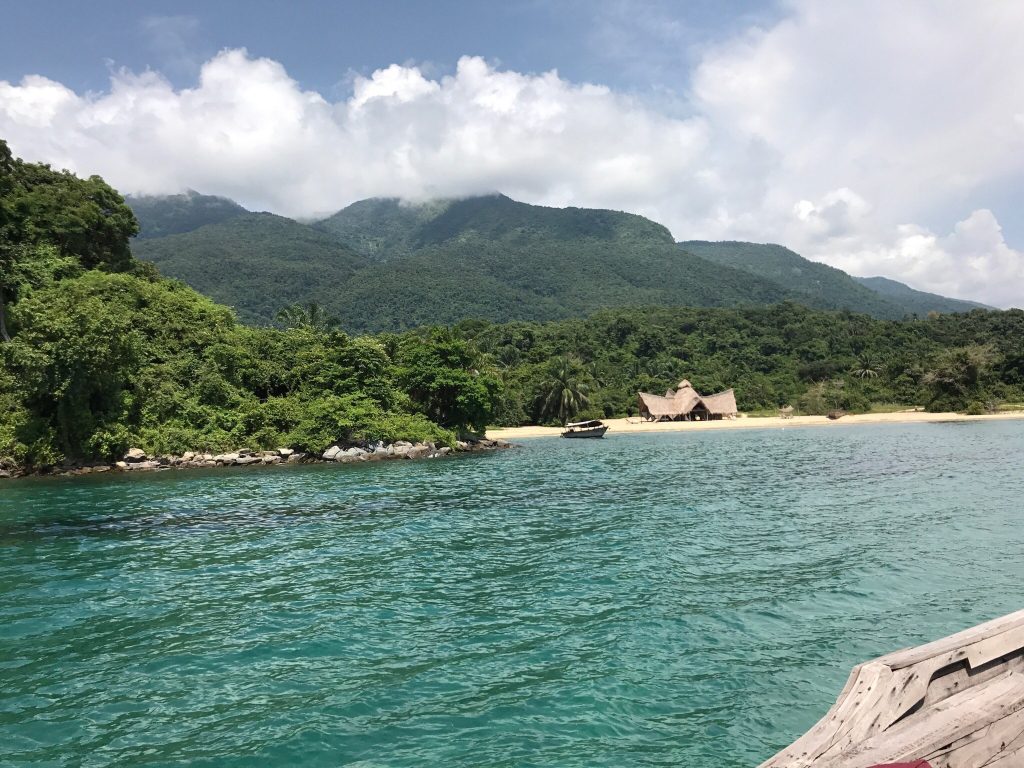
Kungwe Bay & White-Sand Beaches
Kungwe Bay and the white sand beaches along Mahale’s shoreline are where the park’s forest meets Lake Tanganyika, and they are the base for swimming, snorkelling, kayaking and dhow trips between chimpanzee treks. Visitors stay at lakeside camps built directly on the sand and book these as part of a Mahale beach and chimpanzee safari. The bay lies on the eastern shore of Lake Tanganyika in western Tanzania, backed by forested mountains rising to over 2,400 metres.
The combination is the reason people come back. There are plenty of places in Africa to walk after primates and plenty of places to swim in clear water. Doing both before lunch, in the same square kilometre, is close to unique.
Beach Days and Swimming Tours at Kungwe Bay
Days at Mahale settle into a rhythm quickly. Trekking happens in the morning, when the chimps are active and the forest is cooler. By early afternoon most guests are back at the beach, and that is where the rest of the day goes.
The water at Kungwe Bay holds near 25 degrees all year, which means swimming is a genuine pleasure rather than a brief act of courage. It is also fresh water, so there is no salt to rinse off and no stinging eyes. After four hours on a steep humid trail, walking straight off the sand into the lake is the single best thing about the place, and every guest works this out on day one.
Beaches here are pocket-sized rather than endless. Fine pale sand fills the gaps between rocky headlands, with forest coming down almost to the waterline and the mountains stacked behind. You do not get a two-kilometre stroll. You get a private cove and, usually, nobody else on it.
Before you swim: ask your camp where and when they go in. Bilharzia occurs in parts of Lake Tanganyika, though the deep, rocky, well-flushed water along the Mahale shore is regarded as low risk and camps swim daily. Crocodiles are recorded in the park but are rare on this stretch, and hippos hold at a few river mouths. Local guidance beats guesswork.
Where Kungwe Bay Sits on the Mahale Shoreline
The name comes from the mountain. Kungwe, or Nkungwe, is the high point of the Mahale range at roughly 2,462 metres, and the bay sits below its western flank where the slope runs out into the lake.
Camp beaches are strung along this section of coast. The property formerly known as Kungwe Beach Lodge, now operating as Mbali Mbali Mahale, sits on one stretch of sand with ten tents under thatch spread along the shore. Greystoke Mahale occupies Kangwena Beach a little further along, with a handful of bandas built from driftwood and canvas. Both face west across open water, and neither has a road within sixty kilometres.
Between the camps the shoreline alternates: sand, then boulder fields, then a stream mouth, then sand again. Boats hop between them in minutes. On foot the rocky sections slow you right down, which is worth knowing if you plan on wandering.
Snorkelling Trips off the White Sand Beaches
Twenty metres from the sand, the bottom turns to rock, and that is where the fish are.
Lake Tanganyika holds over 250 described cichlid species, roughly 98 percent of them found nowhere else on earth. Snorkelling straight off the Mahale beaches puts you over the shallow rocky habitat where the small, bright, territorial species live: shell dwellers occupying beds of empty snail shells, rock-grazing Tropheus working the algae film, gobies picking through crevices. Dry season visibility can reach around twenty metres.
Camps provide masks and fins as part of the rate. You do not need to be a confident swimmer or to go out of your depth, because most of the interest sits in the first few metres of water over rock. Mornings are best, before the afternoon wind puts a chop on the surface.
Off the sand, straight in
The easiest option and the one most guests use. Swim out to the nearest boulder field and stay shallow. Ten minutes gets you a dozen species.
Boat-assisted snorkelling
Camps will run you to rockier headlands a short way along the shore where the fish density is higher and nothing has been disturbed by swimmers.
Kayak and snorkel combined
Paddle out early, anchor yourself on a rock, mask up. The quietest way to do it, and the one that gets you the shoreline to yourself.
Kayaking, Dhow Sailing and Paddleboarding Trips at Kungwe Bay
Kayaks come with the room rate at the Mahale camps and are the best way to see the bay properly. Early morning is the window, when the lake is flat and the light is coming over the mountains behind you rather than into your eyes.
Traditional dhows work this coastline too, and camps use them for sailing trips as well as transfers. There is something worth sitting still for in moving at walking pace under a two thousand metre mountain with a canvas sail up and no engine noise. Guests routinely rank it above the chimpanzees, which is either a comment on the sailing or on how tired the trekking makes you.
Paddleboards have appeared at some camps. Flat morning water suits them; afternoon wind does not.
Sunset Cruises and Evenings on the Kungwe Bay Beaches
Mahale faces west across the widest part of the lake, straight into the sunset, with the Congolese shore somewhere out beyond the haze. Camps run sunset boat cruises as an evening activity, drifting with the engine off and a drink in hand while the light goes.
What comes afterwards is the better show. As dusk falls, fishing crews put out from villages along the shore in small wooden boats hung with kerosene lamps, and within an hour the dark water carries scattered points of light out towards the horizon. From a beach chair it looks like a town that assembles itself every night on the lake and is gone by breakfast.
Fires on the sand, dinner under the trees, and the forest making noise behind you. Camps here lean into that rather than dressing it up.
Nobody expects a beach holiday at the end of a chimpanzee trek. That mismatch is exactly what Mahale trades on.
Wildlife Watching Along the Kungwe Bay Shore
The shoreline is a viewing platform in its own right, and a fair amount turns up without you going anywhere.
Fish eagles work the trees at the water’s edge and are heard constantly. Yellow baboons come down onto the rocks in the late afternoon to forage. Red colobus, red-tailed monkeys and blue monkeys move through the canopy immediately behind the camps, and Mahale holds one of the densest primate communities in Tanzania at around nine or ten species. Otters use some of the rocky sections.
In the dry season, chimpanzees themselves sometimes come down close to the beaches to feed in shoreline fig trees. Guests have watched the M group from a boat sitting a few metres offshore. That is not something to plan around, but it happens often enough in August through October to be worth mentioning.
Combining Beach Time and Chimp Trekking on a Mahale Safari
Three or four nights is the usual stay, and the shape of it matters.
Most people trek on consecutive mornings, since chimpanzee sightings are never certain and a second or third attempt improves the odds considerably. Afternoons then belong to the water. Camps include a boat safari during your stay along with kayaking and snorkelling, so a standard package already covers most of what the bay offers without extra charges.
Add a night and the trip changes character. Four or five nights gives you a rest day in the middle, which after two hard treks is more welcome than it sounds, and leaves room for a longer forest walk or a fishing trip. Because the expensive part of a Mahale trip is the flying rather than the nights, extra days here are better value than the first three.
Best Time for a Kungwe Bay Beach and Snorkelling Trip
June to October is the window. Skies are clear, the lake is at its calmest and clearest, underwater visibility peaks, and this overlaps with the strongest months for chimpanzee trekking. August through October runs hot, which nobody minds when the lake is twenty metres away.
November and December bring the short rains, quieter camps and electrical storms out over the water at night, which is its own kind of evening entertainment. From March into May the long rains take over, lake levels rise and the shoreline shifts, and most Mahale camps close entirely along with the scheduled flights.
Getting to Kungwe Bay and the Mahale Beaches
There are no roads. Everyone arrives by air or water, and the last leg is always on the lake.
Fly-in guests take scheduled light aircraft, typically operating on Mondays and Thursdays in season from Arusha and the northern circuit, often routing via Katavi, landing at an airstrip near the park boundary. From there it is a boat transfer of roughly an hour and a half along the shore to the camp beaches. The alternative is a commercial flight from Dar es Salaam to Kigoma, around three hours, then south by speedboat in four to six hours or by light aircraft in about forty five minutes. If you want beach time after the forest, our 7 day Mahale chimps and beach safari is built around exactly that.
Arriving by boat is the better introduction. You watch the mountains grow for an hour, then the forest opens onto a strip of white sand with a few thatched roofs under the trees, and that is the whole place.
Kungwe Bay and Mahale Beaches: Frequently Asked Questions
How much does it cost to stay on the beaches at Kungwe Bay?
Lakeside camp rates at Mahale are fully inclusive and start from around US$1,500 per person per night at the premium end, with the mid-tier tented lodge offering a saving against that. Rates typically cover meals, most drinks, laundry, boat transfers from the airstrip, kayaking, a boat safari and a daily chimpanzee trek. On top sit the park conservation fee of roughly US$80 to US$95 per adult per day depending on VAT treatment, an overnight concession levy of about US$35 per adult per night, and the chimpanzee trekking permit at around US$150 per person, though camps usually fold these into the quoted rate.
Are snorkelling and kayaking included at the Mahale camps?
Usually yes. Masks, fins and kayaks are standard inclusions at the lakeshore camps, along with one boat safari during your stay. Sport fishing, private dhow charters and multi-day mountain treks are normally charged as extras. Inclusions differ slightly between the two main properties, so check the list when you book.
Is the water safe for swimming at Kungwe Bay?
Camps swim daily and treat this stretch as low risk, since the water is deep, rocky and well flushed rather than shallow and weedy. Bilharzia is present in parts of the wider lake, so follow your camp’s advice on where to go in. Crocodiles occur in the park but are rare here, and hippos hold at some river mouths. Nobody swims out into open water alone.
How many nights should I stay at the Mahale beaches?
Three nights is the sensible minimum, giving two or three chimpanzee trekking mornings with afternoons on the water. Four or five nights adds a rest day and time for fishing, a longer forest walk or a Mount Nkungwe attempt. Because flights dominate the cost of a Mahale trip, additional nights are proportionally cheaper than the first ones.
What is the best time of year for a beach stay at Mahale?
June to October, when the lake is clearest and calmest and the trekking is at its best. November and December are quieter with short rains and dramatic night storms over the water. Most camps close from March to May during the long rains, so the beaches are out of reach then.
Can you see chimpanzees from the beach at Mahale?
Sometimes, particularly in the dry season from August to October when the M group ranges lower down and feeds in shoreline trees. It is not something to count on. Baboons, red colobus, red-tailed monkeys and fish eagles are far more regular company along the shore.
How do I get from the airstrip to the beach camps?
By boat, along the shoreline, taking around an hour and a half from the nearest airstrip depending on which camp you are heading for. Transfers are arranged and included by the camps as part of your stay. There are no roads inside the park and no vehicle transfers of any kind.
Booking Your Mahale Trip
The safari companies and tour operators listed on this website put trips like this together for a living and know which camps, guides and routes actually deliver. We are an independent guide to Mahale; we do not book or sell tours ourselves.
When you are ready, arrange your safari, tour or holiday with one of the recognised operators listed here. Tell them your dates and what matters most, and a real person, not a form, will handle the itinerary, park bookings and logistics for you.