How Difficult Is Chimpanzee Trekking in Mahale?
Chimpanzee trekking in Mahale is physically demanding, rated among the more strenuous primate walks in Africa, with treks running from around forty minutes to most of a day on steep, humid, often trackless forest slopes. A Mahale chimpanzee trekking safari asks for solid hill fitness rather than any technical skill. Mahale Mountains National Park in western Tanzania has no roads, so the difficulty is unavoidable: everything happens on foot.
The honest summary is that this is harder than most people are told before they book. Not dangerous, not technical, just relentlessly uphill in warm wet air with poor footing, and open-ended in a way that a scheduled hike never is.
What Makes a Mahale Chimp Trek Hard
Four things, and none of them is altitude.
Gradient comes first. The Mahale range rises from a lake surface at about 770 metres to Mount Nkungwe at roughly 2,462 metres, and it does it fast. Trekking routes climb the western face, which means sustained ascent from the moment you leave the beach with very little flat ground to recover on.
Then heat and humidity. This is equatorial forest at low elevation, warm year round, and the air under a closed canopy does not move. You sweat heavily and you keep sweating, which is why water carrying capacity matters more here than the weight of your camera.
Footing is the third. Roots, wet rock, loose leaf litter on slope, stream crossings. In the green season the ground is genuinely slippery, and descents become the part people complain about rather than the climbs.
Last is uncertainty. You do not know how far you are walking when you set off, because it depends where the chimps went.
The one thing to internalise: a Mahale trek has no fixed length. Trackers find the group and radio back, and only then does anyone know whether the morning is a stroll or a five hour climb. Prepare for the long version every time and treat the short one as a bonus.
How Long a Mahale Chimpanzee Trek Actually Takes
The range quoted by camps runs from a couple of hours to most of the day, and both ends of that are real.
Dry season mornings from August to October are often short. The M group tends to favour the lower slopes near the lakeshore through those months, so contact can come within forty minutes to two hours of leaving camp. Green season mornings from November onwards can run three to six hours each way as the animals climb after fruiting trees higher up the mountain.
Once contact is made, viewing is capped at one hour by park rules. Then you walk back, and the return is on the same ground. Factor that in when someone tells you a trek was three hours; they may mean three hours out.
How Fit You Need to Be for Mahale Trekking
The useful test is not a gym metric. It is this: can you walk uphill for four hours in humid heat, on rough ground, and then do the same thing again the next morning?
If yes, you will be fine. If you are unsure, you can still visit Mahale and enjoy it enormously, but plan around the shorter dry season window and tell your camp honestly what you can manage. Guides can pace a group and will say before departure if a trek looks likely to run long.
Age is not the deciding factor. Plenty of people well into their sixties and seventies trek here without difficulty, and plenty of younger visitors struggle. What matters is regular walking fitness, particularly downhill, and a tolerance for heat.
Comfortable
You hike hills regularly, handle four to six hours on foot without concern, and are steady on steep descents. Mahale will feel demanding but well within range in any season.
Manageable with planning
You walk reasonably often but not on serious gradient. Aim for August to October when the chimps are low, allow a rest day between treks, and be honest with your guide about pace.
Consider the alternatives
Steep ground, knees or heat are a real problem for you. Shorter guided forest walks on the lower trails still produce colobus, guenons and baboons, and the lake activities need no walking at all.
How Mahale Compares With Gorilla and Other Chimp Treks
Most people arriving here have trekked something else first, so the comparison is worth making.
Against mountain gorilla trekking in Uganda or Rwanda, Mahale is comparable or harder underfoot and usually longer. Gorillas move slowly and stay largely on the ground, so once you find them the viewing is straightforward. Chimpanzees move fast, travel through the canopy and can shift position repeatedly during your hour, which means more scrambling to keep up and a great deal of looking upward. The neck ache is a genuine complaint.
Against chimpanzee trekking at Kibale in Uganda or Nyungwe in Rwanda, Mahale is a clear step up in effort. Those forests have gentler terrain and shorter approaches. Against Gombe Stream, Tanzania’s other chimp park, Mahale is bigger, steeper and further from anywhere.
Set beside the Mount Nkungwe trek, which climbs close to 1,700 metres over two or three days with camping, chimpanzee trekking is the easier proposition. That is the correct scale to judge it against.
Gorillas sit still and let you watch. Chimpanzees move through the canopy at speed while you stand below with your head back, working out where they went.
Season and How It Changes the Difficulty
The same park is two different walks depending on the month, and this is the biggest lever you have.
June and July sit in the dry season but often still involve higher walking, since the group has not always dropped fully towards the lake by then. Some operators note that these months suit fit trekkers and are harder work for anyone less sure on their feet.
August through October is the easiest and most reliable. The chimps range low, trails are dry, undergrowth has thinned and visibility through the forest improves. October is hot before the rains break, which adds its own strain on the lower sections.
November to February brings the short rains and the drier gap that follows. Chimps climb, ground turns slick and treks lengthen considerably. March to May is the long rains, when most camps close and the flights stop.
Terrain, Weather and What the Forest Throws at You
Beyond the gradient there is a list of smaller irritations that add up over four hours.
Undergrowth closes in during the wet months and guides cut through it, which means pushing past wet vegetation. Biting insects are present, particularly near water. Stinging plants and thorny scramblers catch bare arms, which is the argument for long sleeves in warm weather even when it feels wrong. Rain can arrive without warning in any month and the canopy does not keep it off for long.
Stream crossings are frequent on the valley routes, and after rain the rocks in them are the most likely place to fall. Take them slowly and use the pole if a guide offers one.
An armed ranger walks with every party, since lions, buffalo and elephant occur in the park. That is a safety measure rather than a difficulty, but it does mean the group stays together and moves at one pace.
Health Rules That Affect Whether You Trek at All
Chimpanzees share enough of our biology to catch our illnesses, and the rules follow from that rather than from anything to do with fitness.
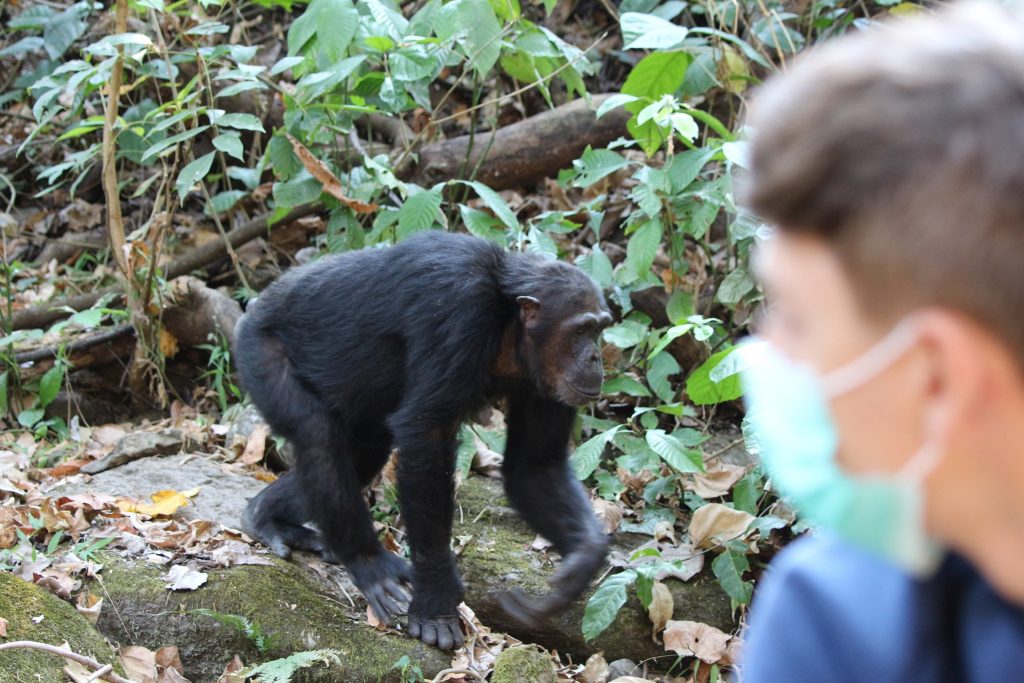
Anyone with a cold, flu, cough or stomach upset is asked to stand down. This is enforced, and it is a miserable thing to be told after a long trip to reach the park. Surgical face masks are required in the presence of the animals, groups are capped at six visitors, and the stated viewing distance runs between seven and ten metres.
An age minimum applies. Camps in Mahale cite twelve years as the figure set by Tanzania National Parks, while several national sources give fifteen as the standard for chimpanzee trekking in Tanzania, so confirm which is being applied when you book.
How to Make the Trek Easier on Yourself
Small choices make a large difference here, and most of them are about preparation rather than fitness.
Boots with genuine grip, broken in before you travel, are the single biggest factor. Worn soles on wet rock turn a manageable descent into a nervous one. Long trousers and long sleeves protect against vegetation. Carry more water than you think you need, since the camps pack it but capacity is yours to check.
Gaiters help in the wetter months. A walking pole is worth having for descents. Keep camera weight down, because every extra kilo is carried uphill in humid air for hours. And book two or three trekking mornings rather than one, both for the sighting odds and because you will pace the second morning better than the first.
Tell your guide the truth about your fitness at the briefing. They plan around it, and nobody benefits from a group that has to turn back.
Getting to Mahale and How Long to Stay
Access is by air or water only. Scheduled charters run from Arusha and the northern circuit on set days in season, typically Mondays and Thursdays, often via Katavi, landing at an airstrip near the boundary followed by a boat transfer of roughly ninety minutes. The cheaper route flies Dar es Salaam to Kigoma in about three hours, then continues south by light aircraft in forty five minutes or by speedboat in four to six hours. If you want to see how the days fit together, our 3 day Mahale chimpanzee safari shows the shortest workable shape of the trip.
Three nights is the practical minimum, giving two or three trekking mornings. Four or five allows a rest day between hard walks, which matters more than it sounds after two demanding mornings on wet slopes.
Trekking Difficulty at Mahale: Frequently Asked Questions
How much does chimpanzee trekking at Mahale cost?
The permit runs to around US$150 per person for non-residents. Park conservation fees add roughly US$80 to US$95 per adult per day depending on whether VAT is shown, and a concession levy of about US$35 per adult per night applies if you stay inside the park. Lakeshore camps usually include one trek per day within inclusive rates starting from around US$1,500 per person per night. East African citizens pay considerably lower park fees.
Is Mahale harder than gorilla trekking?
Usually, yes, though it varies by day in both cases. The terrain is comparably steep, the treks tend to be longer, and chimpanzees keep moving through the canopy during your hour rather than staying put on the ground as gorillas largely do. Expect more scrambling to reposition and a lot of looking upward.
What happens if I cannot keep up during a trek?
Tell your guide early rather than late. Groups move at one pace and a ranger accompanies every party, so turning a group back is possible but disruptive. The better course is an honest conversation at the briefing, which lets the guide plan a realistic route or suggest a shorter forest walk instead on that morning.
Can older travellers trek chimpanzees in Mahale?
Many do. Regular walking fitness matters far more than age, particularly steadiness on steep descents. Aim for August to October when the chimps range low and treks are shortest, build in rest days, and be candid with the camp about pace. The lake activities and shorter forest walks fill the days that trekking does not.
Do I need hiking boots for Mahale?
Yes, and broken in before you travel. Grip is the priority given wet rock, roots and steep descents. Trail shoes with worn soles are the most common regret people report. Gaiters are worth packing for the wetter months, and a walking pole helps on the way down.
How many hours a day will I be walking?
Two to eight, depending entirely on where the chimpanzees are that morning, plus the one hour of viewing time once contact is made. Dry season treks tend towards the shorter end, green season treks towards the longer. Camps usually offer one trek per day, with afternoons free for the lake.
What if I am unwell on the day of my trek?
You will not be allowed to go. Colds, flu, coughs and stomach upsets all disqualify a visitor, because chimpanzees can catch human illnesses and the consequences for them can be fatal. It is worth building an extra night into your stay so that one lost morning does not cost you the whole reason for the trip.
Booking Your Mahale Trip
The safari companies and tour operators listed on this website put trips like this together for a living and know which camps, guides and routes actually deliver. We are an independent guide to Mahale; we do not book or sell tours ourselves.
When you are ready, arrange your safari, tour or holiday with one of the recognised operators listed here. Tell them your dates and what matters most, and a real person, not a form, will handle the itinerary, park bookings and logistics for you.