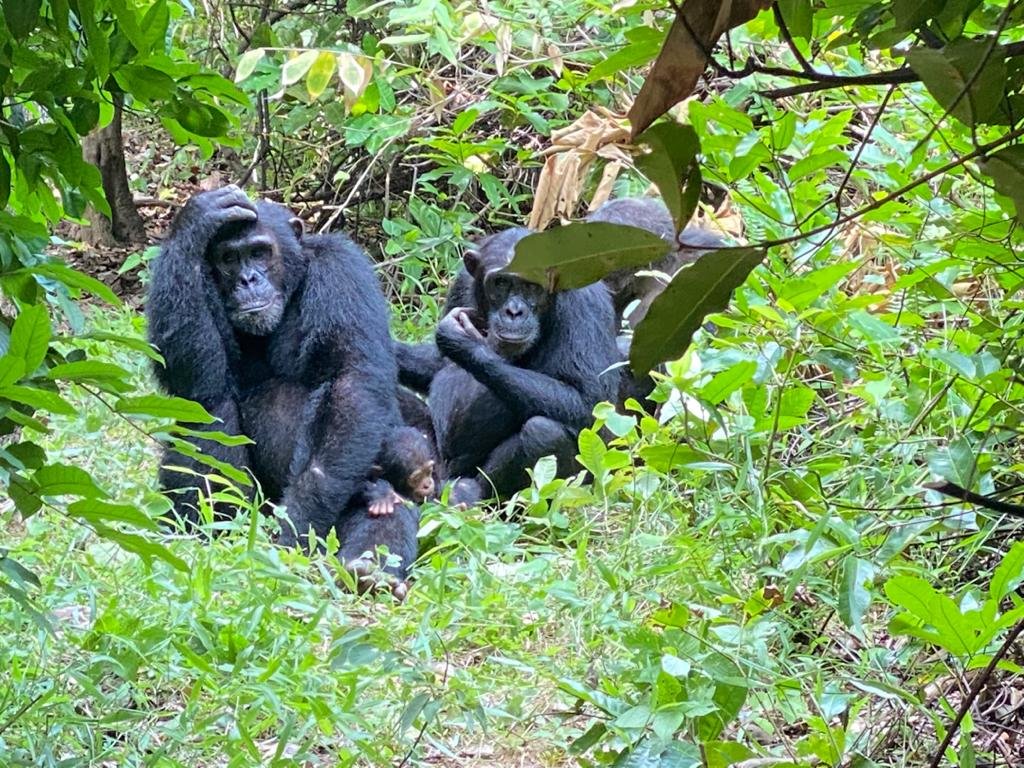
Kansyana Research Area (M-group chimps)
The Kansyana research area is the base of the long-running chimpanzee study in Mahale Mountains National Park and the home range of the M group, the habituated community that visitors track on a Mahale chimpanzee trekking safari. Trekking parties leave from the lakeshore camps and work the forested slopes behind Kansyana with park guides. Mahale sits on the eastern shore of Lake Tanganyika in western Tanzania, and its research site has run continuously since 1965.
That date is the point. Almost everything you see on a trek here rests on six decades of daily observation, carried out mostly by Japanese researchers who arrived when nobody knew whether chimpanzees lived in families, troops or something else entirely.
Chimpanzee Trekking Safaris From the Kansyana Research Area
A chimpanzee trekking safari in Mahale begins early. Trackers go out ahead of the guests to pick up where the M group nested the previous night, then radio back, and your group walks in from camp or is dropped by boat at a beach closer to where the chimps are feeding.
What follows depends entirely on the apes. Some mornings the walk is forty minutes on a reasonable trail; other days it is four hours of steep, humid climbing on ground that gives way underfoot. Guides carry machetes because the route often has to be cut. Once the group is found, you get one hour, and the hour goes fast.
Kansyana itself is a working research camp rather than a tourist facility, and the trails radiating from it are the ones the study has used for decades. You are walking a monitored forest, which is a large part of why the tracking works as reliably as it does.
Set your expectations honestly: the M group is habituated, not tame, and it is not confined. Chimps range widely across steep country, and even at Mahale a single trekking morning can come up empty. Two or three days in the park makes a sighting far more likely, which is why nearly every operator recommends at least three nights.
Who the M Group Are: The Mimikire Clan
The M group, also called the Mimikire clan, is the community that tourism in Mahale is built around. Numbers move as individuals are born, die or transfer, and recent figures put the group at somewhere in the region of sixty to seventy five animals, led in the present era by an adult male the researchers call Teddy.
They are eastern chimpanzees, Pan troglodytes schweinfurthii, the same subspecies found in western Uganda and eastern DRC. Mahale as a whole holds an estimated 700 to 1,000 of them, described by park authorities as the largest protected population of the subspecies anywhere. Only one community is habituated for visitors.
Chimpanzee society here is fission and fusion, which matters practically. The M group does not travel as a block. It splits into feeding parties that come together and separate through the day, so what you actually meet is a subset: a few mothers with infants, a knot of males grooming, a lone adolescent in a fig tree. On a good morning several parties are in the same patch of forest and the noise carries a long way.
Sixty Years of Chimpanzee Research at Kansyana
The story starts in 1961, when Junichiro Itani of Kyoto University began primate work in western Tanzania under what became the Kyoto University Africa Primatological Expedition. Attempts to draw wild chimpanzees close enough for sustained observation kept failing.
Then in 1965 a graduate student named Toshisada Nishida succeeded at Kansyana, provisioning first with sugar cane and later bananas, and the K group came into view in 1966, followed by the M group in 1968. Nishida went on to direct the project until his death in 2011, making Mahale one of the longest continuous field studies of any wild mammal.
The researchers pushed for protection from early on, and their action plan fed directly into the gazetting of Mahale Mountains National Park in 1985. Provisioning was scaled back from 1975 and stopped altogether in 1987, once the chimps were sufficiently used to human observers that food was no longer needed to hold them.
1965 and 1966
Research begins at Kansyana. The K group is provisioned and habituated, and observers work out that chimpanzees live in stable social units rather than nuclear families.
1968
The M group is habituated. Female transfer between communities is documented, overturning assumptions about how chimpanzee groups hold together.
1982
The K group dies out, leaving the M group as the sole habituated community and a natural experiment in what happens to a neighbouring territory.
1987
Provisioning ends. In the same year researchers document chimps using the bitter plant Vernonia amygdalina in what looks like self-medication.
What the Kansyana Study Found: Culture, Tools and Medicine
Mahale’s contribution to primatology is not a single headline discovery so much as a long accumulation of behaviour nobody had recorded before.
Ant fishing is the signature. M group chimps strip a stem, push it into an arboreal ant nest and draw out the insects, a technique that differs in detail from tool use at Gombe and other sites, which is part of the evidence for chimpanzee cultural variation between communities. Hunting and meat sharing were documented here in detail, including the hunting of red colobus monkeys living in the same forest.
The self-medication work is the finding that reaches beyond the field. Sick animals were seen chewing the pith of a bitter plant, Vernonia amygdalina, that they otherwise avoid, and subsequent analysis found compounds active against the parasites those chimps were carrying. Grooming hand-clasp postures, social play, vocal repertoire and bed-making at night have all been catalogued from this one site.
The darker material was documented too. Cannibalism and hostility between neighbouring groups in 1974, infanticide in 1977, and in 1989 the recognition that lions were killing chimpanzees in the park, which is not a predator anyone expected in a rainforest.
Politics of the M Group: Alpha Males and Coalitions
Because individuals are named and followed across their whole lives, Mahale has produced one of the best records anywhere of chimpanzee political life.
The best documented figure is Ntologi, who took the alpha position in 1979 and held it, with one interruption, for well over a decade. Kalunde displaced him briefly in 1991; Ntologi took the top position back in 1992 and lost it for good in 1995. Male coalition strategies were worked out at Mahale through the late seventies, showing that rank here depends on alliances rather than raw size.
Guides on a trek will often tell you who you are looking at by name, and which male is currently pressing for position. That level of detail is only possible because someone has been writing it down since before most visitors were born.
These are not anonymous animals. Every adult in the M group has a name, a mother, a rank history and a file going back decades.
Rules for Visitors on a Kansyana Chimpanzee Tracking Tour
Rules at Mahale are strict, and they exist because chimpanzees share enough of our biology to catch our illnesses, sometimes fatally.
Groups are capped at six visitors. Time with the chimps is limited to one hour from the moment contact is made. Surgical face masks are required in the presence of the apes, and this is enforced rather than suggested. Anyone with a cold, flu or stomach upset is asked to stand down, which is a miserable thing to be told after flying halfway around the world and still the right call.
You keep your distance, usually quoted at seven to ten metres, though chimps move and sometimes walk straight past a seated group. If that happens you stay still and let them. No flash photography, no eating near the animals, no direct prolonged eye contact with adult males, and no wandering from your party. There is an age floor for trekking, cited by Mahale camps as twelve years and by several national sources as fifteen, so check what is being applied at the time you book.
Where the M Group Range Through the Year
The community’s home range covers steep forested country behind the western shoreline, and the animals move up and down it with the seasons.
In the dry months, roughly June through October, they tend to spend more time on the lower slopes near the lakeshore, which is why trekking is easier and sightings more frequent then. From August to October in particular, chimps are often found close enough to the camps that the walk in is short. As the rains build, feeding trees higher up come into fruit and the group climbs, which turns a short trek into a long one.
Nesting behaviour drives the daily rhythm. Chimps build fresh sleeping platforms in trees every evening, so trackers start each morning at the previous night’s nests and work outward from there.
Best Time for Chimp Tracking at Kansyana
Tracking runs year round, but the odds shift. August to October is the strongest window, with drier trails and the group ranging low. June and July are solid, if a little steeper as the chimps have not yet dropped fully towards the lake.
November and December bring the short rains, fewer visitors and harder walking. From March into May the long rains close most camps in the park and scheduled flights stop, so the practical season runs roughly June to February.
Getting to Mahale and the Kansyana Area
Mahale has no internal roads and is reached by air or water. Most visitors fly Dar es Salaam to Kigoma in about three hours, then continue south by light aircraft, roughly forty five minutes, or by speedboat, four to six hours. Fly-in guests to the lakeshore camps use scheduled charters that operate on set days in season, landing at an airstrip near the park boundary followed by a boat transfer of an hour or more. Travellers who want both chimpanzee parks usually look at our 6 day Mahale and Gombe chimp safari.
From the camps, the Kansyana area and the M group’s range are reached on foot or by short boat hop along the shore. There is no vehicle involved at any point once you are inside the park.
Kansyana and the M Group: Frequently Asked Questions
How much does chimpanzee trekking in Mahale cost?
The chimpanzee trekking permit for Mahale is widely quoted at around US$150 per person for non-residents, alongside a park conservation fee of roughly US$80 to US$95 per adult per day depending on whether VAT is shown, and an overnight concession levy of about US$35 per adult per night if you stay inside the park. Lakeshore camps fold all of these into inclusive nightly rates that start from around US$1,500 per person. East African citizens pay substantially lower park fees.
How long do you get with the M group chimpanzees?
One hour from the moment your guide makes contact, capped by park rules and applied strictly. The walk to reach them can take anywhere from under an hour to most of a day. Groups are limited to six visitors, and face masks are required while you are with the animals.
Can you visit the Kansyana research camp itself?
Kansyana is a working research station rather than a visitor attraction, so it is not somewhere you tour freely. What you can do is trek the forest around it with park guides, which is where the M group ranges, and ask your guide about the study. Many of the trackers have worked alongside the researchers for years and know the individual chimps by name.
How many chimpanzees are there in Mahale?
Park authorities put the total at roughly 700 to 1,000 eastern chimpanzees across the park, described as the largest protected population of the subspecies. Only the M group, numbering somewhere around sixty to seventy five animals, is habituated for visitors. Other communities live in the park but are not tracked by tourists.
How likely am I to see chimpanzees on a Mahale trek?
Good, though not guaranteed. Sightings are most reliable from August to October when the group ranges on the lower slopes. With two or three trekking mornings your chances are strong at any time of year; with a single morning you are taking a real gamble, particularly during the rains when the chimps move higher up the mountain. Much of what you take away from the hour comes down to how the chimpanzees behave rather than to the sighting itself.
What is the minimum age for chimpanzee trekking at Mahale?
Camps in Mahale cite twelve years as the minimum set by Tanzania National Parks, while several sources give fifteen as the standard for chimpanzee trekking in Tanzania. The safest course is to confirm directly with your camp or operator at the time of booking. Younger children can usually stay at the camps and use the lake while older family members trek.
Who started the research at Mahale?
Junichiro Itani of Kyoto University began primate work in western Tanzania in 1961, and his student Toshisada Nishida established the Kansyana site in 1965, going on to direct the project until 2011. The study is one of the longest continuous field projects on any wild mammal, and the researchers’ work fed directly into the park’s creation in 1985.
Booking Your Mahale Trip
The safari companies and tour operators listed on this website put trips like this together for a living and know which camps, guides and routes actually deliver. We are an independent guide to Mahale; we do not book or sell tours ourselves.
When you are ready, arrange your safari, tour or holiday with one of the recognised operators listed here. Tell them your dates and what matters most, and a real person, not a form, will handle the itinerary, park bookings and logistics for you.