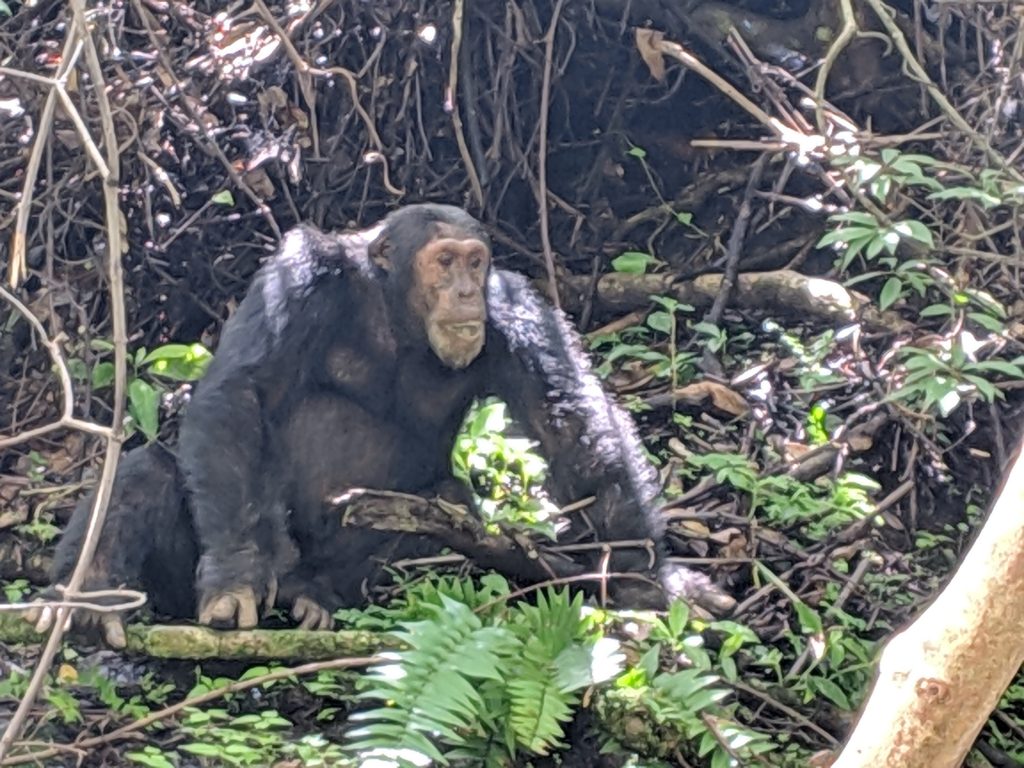
Where Can You Find Chimpanzees in Mahale?
Chimpanzees in Mahale are found on the forested western slopes of the mountain range, within the home range of the habituated M group around the Kansyana research area, at altitudes between the lakeshore and roughly 1,800 metres depending on the season. Visitors reach them on a guided chimpanzee trekking safari from the lakeside camps. Mahale Mountains National Park in western Tanzania holds roughly 700 to 1,000 eastern chimpanzees across some 1,600 square kilometres.
Only a small part of that area is where you actually go. One community is habituated, its range covers a fraction of the park, and within that range the animals shift up and down the slope through the year.
The M Group Home Range on the Western Slopes
The community visitors track is the M group, also called the Mimikire clan, habituated since 1968 and numbering somewhere around sixty to seventy five individuals.
Their range sits on the western face of the Mahale mountains, behind the stretch of shoreline where the camps and park headquarters are. This is the wettest part of the park, where rain arriving off the lake lands on the slope and feeds dense forest cut by steep stream gullies. Fruiting trees concentrate in those gullies, and so do the chimps.
Other communities live across the park, but they are not habituated and are not visited. That is deliberate, and it is a large part of why the population here is in the condition it is.
What “finding them” actually involves: trackers leave before dawn and walk to the trees where the group nested the previous night. Chimpanzees build fresh sleeping platforms every evening, which gives a fixed starting point each morning. From there the trackers follow until they have contact, then radio the camps. You set off once they know.
How Altitude Decides Where the Chimps Are
This is the single most useful thing to grasp about locating chimpanzees at Mahale, and it explains almost every difference between one visitor’s experience and another’s.
The animals follow fruit, fruit follows rainfall, and rainfall on this mountain shifts the fruiting zone up and down the slope through the year. During the dry months from June to October the productive trees sit lower, near the lakeshore, and the group comes down to them. Once the rains arrive and higher trees fruit, the group climbs.
The practical range runs from just above the beaches to well over a thousand metres up. A trek that ends forty minutes from camp in September can involve four or five hours of climbing in January to reach the same animals.
Trekking Around the Kansyana Research Area
Kansyana is where all of this started. Toshisada Nishida established the research site here in 1965 under the Kyoto University expedition, provisioning and habituating the K group from 1966 and the M group from 1968, and directing the project until 2011.
Six decades of daily following cut a network of research trails through the community’s range, and those are the paths guides use. They exist where the chimps go rather than where a route planner would have put them, which is why they climb so directly.
Kansyana remains a working research station rather than a visitor facility, so you trek the forest around it rather than touring the camp itself. The benefit shows in the guiding, since trackers here have worked alongside researchers for years and can name individuals on sight.
Lakeshore Forest and the Beach-Level Sightings
The lowest part of the range is riverine and lowland forest running from the beaches inland, and in the right season this is where the group spends its time.
Fig trees along the shoreline are the draw. When they fruit in the dry months, chimps come right down, and visitors have watched feeding parties from boats sitting a few metres offshore. Guests occasionally see them from camp. This is not something to plan around, but from August to October it happens often enough to be worth knowing.
Those same lower trails are where the shorter guided forest walks go, and where red colobus, red-tailed monkeys, blue monkeys and baboons are most reliably found even when the chimps are elsewhere.
Valley Gullies and Ridge Crossings on the Mid Slopes
Most trekking happens in the middle ground, and its character is dictated by the shape of the mountain.
Dozens of short steep watercourses cut the western face into a series of wooded gullies. Valleys hold deeper soil, more moisture and taller trees than the ridges between them, so the food is in the valleys and the walking between them goes over ridges. That alternation of climb and drop is what makes the trekking here demanding.
Guides read the forest rather than a map. Ask what is fruiting and you will get a better answer about where the group is likely to be than any chart would give you.
Lakeshore and lowland forest
From the beaches to a few hundred metres up. Dry season ground for the M group, particularly August to October. Shortest treks, best odds, occasional sightings from a boat.
Mid slope valleys
The main working area of the research trail network. Where most treks end in shoulder months. Steep, humid and cut by stream crossings.
Upper montane forest
Wet season ground, reached on long climbs. Cooler and mossier, home to the black and white colobus. Treks of three to six hours are normal at this level.
Bamboo and grassland
Above roughly 1,800 metres, running to montane grassland near the summit. Not chimpanzee habitat in any regular sense, and crossed on the Nkungwe climb rather than on treks.
Where the Chimpanzees Are Not
Worth stating, because it sets expectations and explains the shape of the park.
The drier eastern flank beyond the ridge turns to miombo woodland and grassland, which supports roan and sable antelope, buffalo and the lions Mahale is unusual for having. It is not chimpanzee country and visitors do not go there.
The high grassland above the treeline on Mount Nkungwe, at around 2,462 metres, is likewise outside their range. Trekkers climbing the mountain pass through chimpanzee habitat on the lower sections and leave it well before the summit.
And the vast majority of the park’s forest holds unhabituated communities that are not tracked. Only the M group is visited, which keeps disturbance concentrated in one area rather than spread across the whole population.
Sixteen hundred square kilometres of park, one habituated community, and a range you can walk into from the beach on a good morning.
Reading the Signs: How Guides Locate the Group
Trackers work from evidence rather than luck, and knowing what they are looking at makes the walk more interesting.
Nests are the starting point, visible as platforms of folded branches in the canopy. Then feeding remains: dropped fruit, chewed wadges, stripped stems. Dung on the trail tells them what the group has been eating and roughly how recently. Tool marks on arboreal ant nests point to ant fishing, one of the behaviours Mahale is known for in the research literature.
Sound carries furthest. Pant-hoots travel a long way through forest, and a guide will often stop the group, listen, and change direction on the strength of a call nobody else heard. Drumming on buttress roots does the same job.
Best Season for Finding Chimpanzees in Mahale
August to October is the strongest window, with the group low, the trails dry and sightings both more frequent and longer. June and July are solid, though the animals often remain higher up.
November to February brings the short rains and the drier gap after them, with chimps ranging high and treks running long. From March to May the long rains close most camps and the scheduled flights stop, which takes those months off the calendar for practical purposes.
Getting to Mahale to Find the Chimpanzees
Access is by air or water only, since the park has no roads. Scheduled charters run from Arusha and the northern circuit on set days in season, typically Mondays and Thursdays, often calling at Katavi, landing at an airstrip near the boundary followed by a boat transfer of around ninety minutes.
The cheaper route flies Dar es Salaam to Kigoma in roughly three hours, then continues south by light aircraft in forty five minutes or by speedboat in four to six hours. From the camps, the M group’s range starts immediately behind the beach. Our 10 day Mahale, Gombe and lake safari spends the whole trip on Lake Tanganyika, in both chimpanzee parks.
Finding Chimpanzees in Mahale: Frequently Asked Questions
What does it cost to trek chimpanzees at Mahale?
The trekking permit is around US$150 per person for non-residents. Park conservation fees run roughly US$80 to US$95 per adult per day depending on whether VAT is included, and a concession levy of about US$35 per adult per night applies to nights inside the park. Camps usually fold these into inclusive rates starting from around US$1,500 per person per night at the premium end. East African citizens pay considerably less.
How many chimpanzee groups can you visit in Mahale?
One. Only the M group, or Mimikire clan, is habituated for visitors, and it numbers somewhere around sixty to seventy five animals. The park’s total population of roughly 700 to 1,000 eastern chimpanzees includes other communities that are not tracked by tourists. You cannot request a different group as you might request a gorilla family in Uganda or Rwanda.
How far from camp are the chimpanzees usually found?
It depends entirely on the season. From August to October the group often ranges within forty minutes to two hours of the camps on the lower slopes. In the wetter months they climb, and treks of three to six hours become normal. Guides sometimes shorten the walk by running guests along the shoreline by boat to a closer starting point.
Can you see chimpanzees from the beach or from a boat?
Occasionally, in the dry season, when the group feeds in shoreline fig trees. Guests have watched them from boats a few metres offshore. It is a bonus rather than something to plan for, and the reliable way to see them remains a guided trek with trackers.
How do guides know where the chimpanzees are each morning?
Trackers start at the nests the group built the previous evening, since chimpanzees make fresh sleeping platforms every night. From there they follow feeding remains, dung, tool marks and calls until they have contact, then radio the camps. Guests set off once the location is known, which is why departure times shift day to day.
Are chimpanzees found anywhere else in Tanzania?
Yes, at Gombe Stream National Park north of Kigoma, which covers around 35 square kilometres and holds roughly 95 chimpanzees. Mahale and Gombe are the country’s only two protected areas for the species. Mahale is far larger and holds the bigger population by a wide margin.
How long do you get to watch them once found?
One hour, capped by park rules from the moment of contact. Group size is limited to six visitors and surgical face masks are required in the animals’ presence. The walk in and out is additional and can take most of the day in the wetter months.
Booking Your Mahale Trip
The safari companies and tour operators listed on this website put trips like this together for a living and know which camps, guides and routes actually deliver. We are an independent guide to Mahale; we do not book or sell tours ourselves.
When you are ready, arrange your safari, tour or holiday with one of the recognised operators listed here. Tell them your dates and what matters most, and a real person, not a form, will handle the itinerary, park bookings and logistics for you.