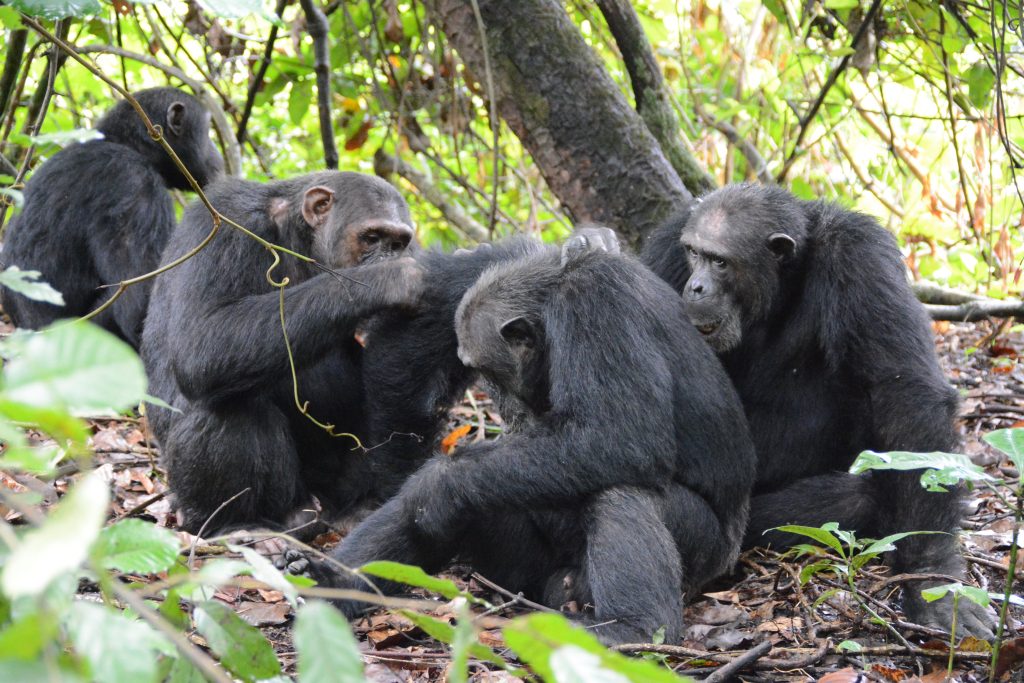
Chimp Behaviour Observation in Mahale National Park
Chimp behaviour observation in Mahale National Park means watching ant fishing, grooming, hunting, dominance displays, nest building and mother and infant interaction during your permitted hour with the habituated M group. Six decades of research make this the best documented chimpanzee community in Africa. Mahale Mountains National Park on Lake Tanganyika in western Tanzania has been studied continuously since 1965 and holds the largest protected population of eastern chimpanzees.
What separates observation from simply seeing them is knowing what you are looking at. Almost everything below was first described here, by researchers who followed these same families for decades.
Ant Fishing: Mahale’s Signature Behaviour
If you watch one thing here, watch this.
M group chimpanzees strip a stem, work it into an arboreal ant nest and draw the insects out to eat. It is deliberate tool use, and the technique differs in detail from tool use recorded at Gombe and other study sites, which forms part of the evidence that chimpanzee communities have genuine cultural traditions rather than a single species-wide behaviour.
You need a bit of luck to catch it during a single hour, though guides point out the physical traces on almost every walk: worked stems left below nests, chewed ends, damage to the nest entrance. Ask and they will show you.
The wider tool repertoire recorded here covers use of objects beyond feeding, and it has been catalogued in detail as part of the long-running study.
Get more from the hour by asking questions. Trackers at Mahale have often worked alongside the research project for years and know individuals by name, mother and rank history. Ask who you are watching and what they are doing, rather than spending the whole sixty minutes behind a camera. The context is the thing you cannot get anywhere else.
Grooming, Greetings and Social Bonds
The behaviour you are most likely to actually see, and the easiest to misread as simply pleasant.
Grooming here is social currency rather than hygiene. Who grooms whom, for how long and in what direction maps onto alliances and rank. Mahale researchers documented the grooming hand-clasp, a posture where two animals raise opposite arms and clasp hands overhead while grooming with the other, which occurs in some chimpanzee communities and not others and is one of the clearest cultural markers in the species.
Greetings and dominance interactions are catalogued in the research literature from this site. Pant-grunts to a higher-ranking animal, presenting, embraces after tension. Once you know these are status signals rather than affection, a grooming cluster becomes considerably more interesting to watch.
Dominance, Displays and M Group Politics
Because individuals are followed across their whole lives, Mahale has produced one of the best records anywhere of chimpanzee political life.
The clearest case is Ntologi, who took the alpha position in 1979 and held it for well over a decade. Kalunde displaced him briefly in 1991; Ntologi regained the top position in 1992 and lost it for good in 1995. Male coalition strategies were worked out here through the late seventies, showing that rank depends on alliances rather than raw size. The current era is led by a male the researchers call Teddy.
What you may witness is a display: an adult male charging through vegetation with hair erect, dragging branches, drumming on buttress roots. It is loud and startling and it is politics rather than aggression towards you. Stay still, follow your guide, and do not run.
Hunting and Meat Sharing
Documented in detail at Mahale, and among the more confronting things to see.
Chimpanzees here hunt red colobus monkeys that live in the same forest, and the meat is then shared in patterns that reflect social relationships rather than who made the kill. Hunting and meat eating in relation to human evolution has been a major research focus at this site.
Witnessing an actual hunt during a one hour visit is rare. What visitors sometimes see is the aftermath: an animal holding a carcass while others beg, or the excitement in a party after a successful hunt. It is not comfortable viewing and it is one of the reasons the behaviour of these animals is studied so intensely.
Feeding, Fission and Fusion
How the group moves explains most of what you see, and why.
Chimpanzee society at Mahale works by fission and fusion, meaning the M group never travels as a single block. It splits into feeding parties that come together and separate through the day. What you meet on a trek is only a subset: a few mothers with infants, males grooming, an adolescent overhead.
Female transfer between communities was documented here in 1968, overturning the assumption that chimpanzee groups were closed family units. So was the existence of the stable social unit itself, worked out in 1966 during the K group work, which challenged the belief that chimpanzees lived in nuclear family groups.
Diet drives the daily pattern. Ask your guide what is fruiting that week and you will understand where the party has come from and where it is heading.
Commonly seen in an hour
Grooming clusters, feeding in fruiting trees, mothers with infants, travel through the canopy, vocal exchanges between parties.
Seen with some luck
Ant fishing with worked stems, dominance displays with branch dragging and drumming, play between juveniles, grooming hand-clasp postures.
Rare
Hunting of red colobus and meat sharing afterwards, self-medication with bitter plants, inter-party aggression.
Seen as traces rather than events
Night nests in the canopy, chewed wadges, worked stems below ant nests, dung on the trail. Guides read these constantly.
Self-Medication and the Bitter Plant
The Mahale finding that travelled furthest beyond primatology.
In 1987 researchers documented sick chimpanzees chewing the pith of Vernonia amygdalina, a bitter plant they otherwise avoid, and subsequent analysis found compounds active against the parasites those animals were carrying. It is among the strongest field evidence anywhere that a wild animal treats its own illness with plants.
You are unlikely to see it. What guides will do is point out the plant on a forest walk, which is a better souvenir than most.
Every adult in this community has a name, a mother, a rank history and a file going back decades. You are not watching anonymous animals.
Nest Building and Nocturnal Behaviour
The behaviour that shapes every trekking morning, even though nobody sees it happen.
Chimpanzees build fresh sleeping platforms in the canopy every evening, folding branches into a bed. Bed making and nocturnal behaviour have been studied at Mahale as subjects in their own right, and camera trap work by conservation partners recently recorded chimps moving at midnight, which was a first for the park.
For visitors, nests are the practical link. Trackers start each morning at the previous night’s nests and work forward from there, which is why departure times shift day to day. Guides will point out old nests overhead on almost any forest walk.
Vocalisations and Reading the Forest by Sound
Much of what happens in a Mahale forest is heard rather than seen.
Pant-hoots carry a long way through dense vegetation and are used to locate and coordinate between parties. Drumming on tree buttresses does a similar job. Vocal communication is one of the behavioural subjects catalogued from this site, alongside laterality of hand function and the diversity of play.
Your guide will often stop the group, listen, and change direction on the strength of a call nobody else registered. Standing still and listening for a minute is one of the better things you can do on a trek.
Best Time for Chimp Behaviour Observation
August through October gives the best viewing conditions. The M group ranges on the lower slopes near the camps, treks shorten so you arrive with energy, undergrowth has thinned and visibility inside the forest improves. Sightings are reported as more frequent and more prolonged through this window.
June and July are dry and comfortable with the group often ranging higher. November to February brings the short rains and the drier gap after them, with chimps climbing and treks running several hours each way. Most camps close from March to May during the long rains.
Whatever the month, book two or three trekking mornings. A single hour rarely shows you much beyond feeding and grooming; three hours across three days shows you a community.
Getting to Mahale for Chimpanzee Observation
Access is by air or water only, since the park has no roads. Scheduled charters run from Arusha on set days in season, typically Mondays and Thursdays, often via Katavi, landing near the boundary followed by a boat transfer of around ninety minutes. Travellers who want both chimpanzee parks usually look at our 6 day Mahale and Gombe chimp safari.
The alternative flies Dar es Salaam to Kigoma in roughly three hours, then continues south by light aircraft in forty five minutes or by speedboat in four to six hours. Three nights is the practical minimum in the park itself.
Chimp Behaviour at Mahale: Frequently Asked Questions
What does it cost to observe the chimpanzees at Mahale?
The chimpanzee trekking permit runs to around US$150 per person for non-residents, alongside a park conservation fee of roughly US$80 to US$95 per adult per day depending on VAT treatment and a concession levy of about US$35 per adult per night inside the park. Camps fold these into inclusive rates starting from around US$1,500 per person per night, which typically include one trek per day. East African citizens pay considerably less.
How long do you get to watch the chimpanzees?
One hour from the moment contact is made, capped by park rules and applied strictly, with groups limited to six visitors and face masks required. The walk in can take anywhere from forty minutes to most of a day. Camps normally include one trek per day, so multiple stays give you multiple hours.
Will I see ant fishing?
Possibly, though it needs luck within a single hour. What you will reliably see are the traces: worked stems below arboreal ant nests, chewed ends and damaged nest entrances, which guides point out on most walks. Ant fishing is the behaviour Mahale is best known for in the research literature.
Is it upsetting to watch chimpanzees hunt?
It can be. Chimpanzees here hunt red colobus monkeys living in the same forest, and the meat is shared afterwards in patterns reflecting social relationships. Seeing an actual hunt during a one hour visit is rare, though the aftermath is sometimes witnessed. Researchers have documented cannibalism and infanticide at this site as well, though visitors do not see these.
What should I do if a chimpanzee displays or comes close?
Stay still and follow your guide precisely. Displays involve charging, branch dragging and drumming, and they are directed at other chimpanzees rather than at you. If an animal walks past closer than the stated seven to ten metres, remain where you are rather than backing away suddenly. Never run, and avoid prolonged eye contact with adult males.
How do guides know which chimpanzee is which?
The research project has followed named individuals since 1965, identifying and tracking them across their whole lives, and many trackers have worked alongside it for years. Rank histories, maternal lines and individual quirks are all documented. Asking who you are watching is the single best way to get more from your hour.
Can I join the researchers or visit Kansyana?
Kansyana is a working research station rather than a visitor facility, so it is not somewhere you tour, and the study is not a volunteer operation. What you can do is trek the forest around it with guides who know the project and ask about the work. Fifty years of findings from this site have been collected into a published volume for anyone wanting to read further.
Booking Your Mahale Trip
The safari companies and tour operators listed on this website put trips like this together for a living and know which camps, guides and routes actually deliver. We are an independent guide to Mahale; we do not book or sell tours ourselves.
When you are ready, arrange your safari, tour or holiday with one of the recognised operators listed here. Tell them your dates and what matters most, and a real person, not a form, will handle the itinerary, park bookings and logistics for you.