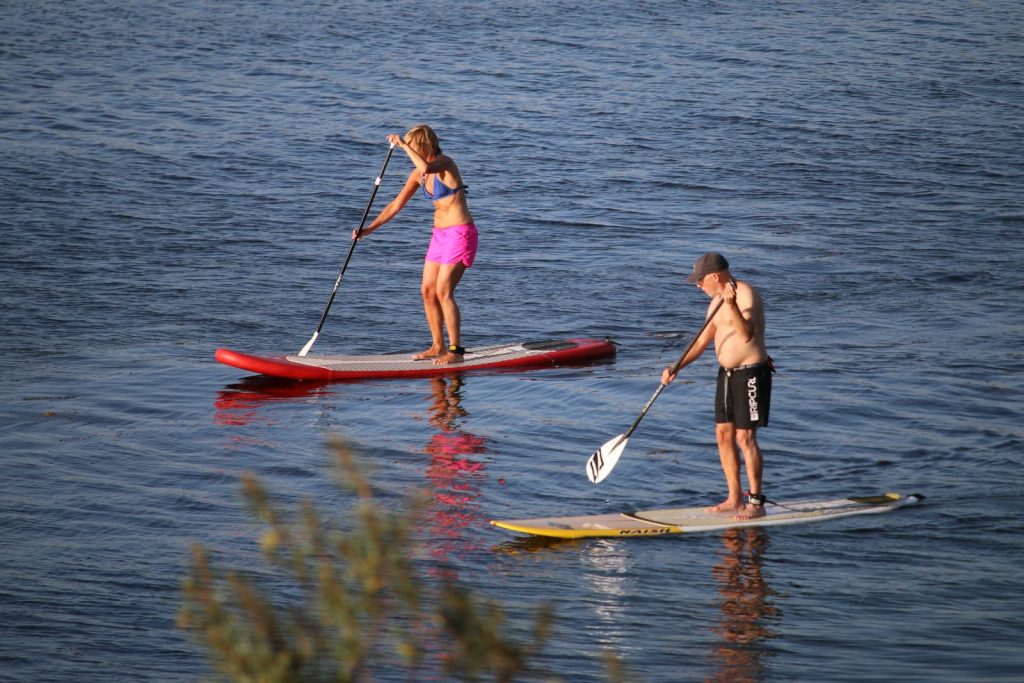
Paddleboarding in Mahale National Park
Paddleboarding in Mahale National Park is a flat-water morning activity on Lake Tanganyika, offered at some of the lakeside camps alongside kayaking, and best done at dawn before the wind gets up. Availability varies by camp, so confirm before you count on it. Mahale Mountains National Park in western Tanzania sits on the eastern shore of the world’s longest freshwater lake, with mountains rising to roughly 2,462 metres behind the beaches.
Set expectations honestly. This is a pleasant hour on beautiful water, not a headline reason to fly to western Tanzania, and it works only when the lake cooperates.
Whether Paddleboarding Is Available at Mahale
The first thing to establish, because it is not universal.
Kayaks are a standard inclusion at both lakeside camps and appear in every rate description. Paddleboards have appeared at some camps as an additional option, but they are not the guaranteed part of the offering that kayaks and snorkelling gear are.
If paddleboarding matters to you, ask the camp directly before booking rather than assuming. With only two properties in the park and fewer than forty beds between them, this is a quick question to get answered, and it saves the disappointment of arriving with expectations the beach cannot meet.
Where boards are available they come with the room rather than as a paid extra, in line with how the other water activities work.
The honest framing: paddleboarding here is a lovely way to spend an hour on a dead-flat morning lake below a rainforest mountain. It is not why anyone books Mahale, and if the wind is up it is not happening. Treat it as a bonus and you will enjoy it; treat it as a plan and you may not get it.
Why Conditions Decide Everything
A paddleboard is less forgiving of chop than a kayak, and Lake Tanganyika has a daily wind cycle.
At first light the surface is usually glass, flat enough to reflect the mountains, and that is when a board works properly. By mid morning a breeze often starts. By afternoon the surface can carry a genuine chop, at which point standing up becomes a balance exercise rather than a paddle and the return leg turns into work.
Water temperature holds near 25 degrees Celsius year round, so falling in is no hardship. Falling in repeatedly a few hundred metres from the beach in a rising wind is a different matter, which is why camps steer people towards the flat early hours.
Dry season from June to October gives the most settled conditions. Wet season mornings are frequently still calm, but the weather turns faster.
What the Paddle Is Actually Like
Being upright changes what you see, which is the argument for a board over a kayak on a still morning.
From standing you look down through clear water onto the rock and sand of the shallows, and on a flat dry season morning with visibility reaching around twenty metres you can watch fish under the board as you move. Looking up, the Mahale range fills the view: forest running almost to the waterline, stream gullies cutting the slope, and the whole 1,700 metre wall of it from a lake surface at about 770 metres.
Sound carries across still water. Fish eagles call from the shoreline trees, and the forest behind is at its noisiest early. Yellow baboons work the rocks at the ends of the beaches.
You stay along the shoreline rather than heading out. The camps will tell you how far to go and where to turn.
Paddleboarding Compared With Kayaking
Both are on the same water, and they suit different mornings and different people.
Paddleboard
Better view down into the water and a more open perspective on the mountains. Needs genuinely flat conditions and a bit of balance. Availability varies by camp. Best at dawn, unusable in a chop.
Standard inclusion at both camps, stable, forgiving of light wind, and easier for anyone unsure on water. Better for covering distance along the shore and for carrying a mask out to a rocky headland.
Boat safari
Included during your stay. Covers far more shoreline than either, with a guide, and is the option that puts you level with wildlife along the base of the slope.
Dhow sailing
Traditional sailing boats working this coast, used for evening trips at some camps. Slow, quiet and the version many guests rate highest.
The sensible plan is to take whichever is available on the morning the water is flat, rather than committing to one in advance.
What You Might See
The shoreline delivers the same cast whether you are standing or sitting.
African fish eagles are common along the whole lakeshore and call constantly. Palm-nut vultures are also common here, and giant kingfishers work branches over the water. Where streams meet the lake, herons, waders and smaller kingfishers concentrate, and otters use some of the rocky outlets.
Yellow baboons come down onto the rocks, particularly late in the day. Red colobus, red-tailed monkeys and blue monkeys move through the canopy immediately behind the beaches, part of a primate community of around nine or ten species.
Below the board, the lake’s fish. Tanganyika holds more than 250 described cichlid species with roughly 98 percent found nowhere else, concentrated in the shallow rocky habitat you will be paddling over.
A flat lake at dawn, a two thousand metre mountain in front of you, and nobody else on the water. The board is incidental.
Safety on the Board
Straightforward, with the same rules that govern every water activity here.
Stay close to the shore and within the stretch your camp uses. Tell someone where you are going. Turn back before the wind gets up, since a chop that is manageable outbound is considerably harder returning, and a board is slower than a kayak into wind.
Hippos hold at a few river mouths, which is why camps direct guests along specific stretches rather than letting people paddle wherever they like. Crocodiles are recorded in the park but described as rare on this shoreline. Bilharzia occurs in shallower, weedier parts of the wider lake, so if you fall in, do so where the camp swims.
Wear a leash if one is provided, use the buoyancy aid, and take sun protection seriously. Reflection off open water is stronger than it feels, and you are standing in it.
Who It Suits
Anyone reasonably steady on their feet and comfortable falling into deep water, since you will.
No fitness threshold applies on a flat morning, and unlike chimpanzee trekking there is no age minimum of the kind camps enforce at twelve years, with several national sources citing fifteen. Younger family members who cannot trek can often use the water with an adult, subject to the camp’s own rules.
Anyone nervous about balance is better served by a kayak, which does the same job with none of the wobble. Anyone who paddleboards at home will find these conditions easy on the right morning and impossible on the wrong one.
It is also a good rest-day activity between hard trekking mornings, when another climb has no appeal.
Fitting Water Time Into a Mahale Trip
The constraint is the schedule rather than the equipment.
Chimpanzee trekking goes out early, which is exactly when the lake is flat, so on trekking days the boards stay on the beach. Most guests are back by early afternoon, by which point the wind is often up.
That makes a non-trekking morning the thing that actually buys you a paddle, and it is the practical argument for four or five nights rather than three. Because the charter flights dominate the cost of reaching Mahale, extra nights are proportionally the cheapest part of the trip.
Late afternoon sometimes calms again before sunset, which is the second window worth watching for.
Best Time for Paddleboarding at Mahale
June to October gives the most settled weather and the flattest mornings, alongside the clearest water for looking down through. September is about as good as the conditions get.
November to February brings the short rains and the drier gap after them, with calm mornings still common but weather that turns faster. Most camps close from March to May during the long rains, when lake levels rise and the shoreline shifts.
Whatever the month, dawn.
Getting to Mahale
Access is by air or water only, since the park has no roads. Scheduled charters run from Arusha and the northern circuit on set days in season, typically Mondays and Thursdays, often calling at Katavi, landing at an airstrip near the boundary followed by a boat transfer of around ninety minutes to the camp beaches. Our 5 day Mahale and Lake Tanganyika safari gives the lake side of the park proper time rather than an afternoon.
The alternative flies Dar es Salaam to Kigoma in roughly three hours, then continues south by light aircraft in forty five minutes or by speedboat in four to six hours.
Paddleboarding at Mahale: Frequently Asked Questions
Do the Mahale camps have paddleboards?
Some do, and they have appeared alongside the kayaks that are a standard inclusion at both lakeside properties. Availability is not universal, so ask the camp directly before booking rather than assuming. Where boards are provided they come within the inclusive rate, which starts from around US$1,500 per person per night at the premium end and also covers meals, transfers, snorkelling gear and a daily chimpanzee trek.
Do I need to pay extra for paddleboarding?
Where boards are available they are normally part of the inclusive rate, like kayaks and snorkelling equipment. Park charges apply separately at roughly US$80 to US$95 per non-resident adult per day depending on VAT treatment and about US$35 per adult per night concession levy, though camps usually fold these into the quoted figure.
When can you paddleboard at Mahale?
Early morning, when the lake surface is usually flat. Wind commonly picks up through the day and afternoons can carry a chop that makes standing difficult. Late afternoon sometimes calms again before sunset. Seasonally, June to October gives the most settled conditions.
Do I need experience to paddleboard here?
Not on flat water, though a little balance helps and you should expect to fall in, which is no hardship at around 25 degrees Celsius. Anyone unsure on their feet is better served by a kayak, which covers the same shoreline with none of the wobble and is available at both camps.
Is paddleboarding safe on Lake Tanganyika?
Along the sheltered shoreline with camp guidance, yes. Stay close to shore, tell the camp where you are going and turn back before the wind rises, since a board is slow into wind. Hippos hold at some river mouths and crocodiles are recorded but rare here, which is why camps direct guests along particular stretches.
Can children paddleboard?
Usually with an adult and subject to the camp’s own rules, which makes it a reasonable option for family members below the chimpanzee trekking age minimum, cited as twelve years by Mahale camps and fifteen by several national sources. Confirm directly when booking.
Is paddleboarding worth planning a trip around?
No, and it would be misleading to say otherwise. It is a pleasant hour on a flat morning and depends entirely on conditions and camp availability. Come to Mahale for the chimpanzee trekking, the forest and the lake, and treat a paddle as a bonus on the right morning.
Booking Your Mahale Trip
The safari companies and tour operators listed on this website put trips like this together for a living and know which camps, guides and routes actually deliver. We are an independent guide to Mahale; we do not book or sell tours ourselves.
When you are ready, arrange your safari, tour or holiday with one of the recognised operators listed here. Tell them your dates and what matters most, and a real person, not a form, will handle the itinerary, park bookings and logistics for you.