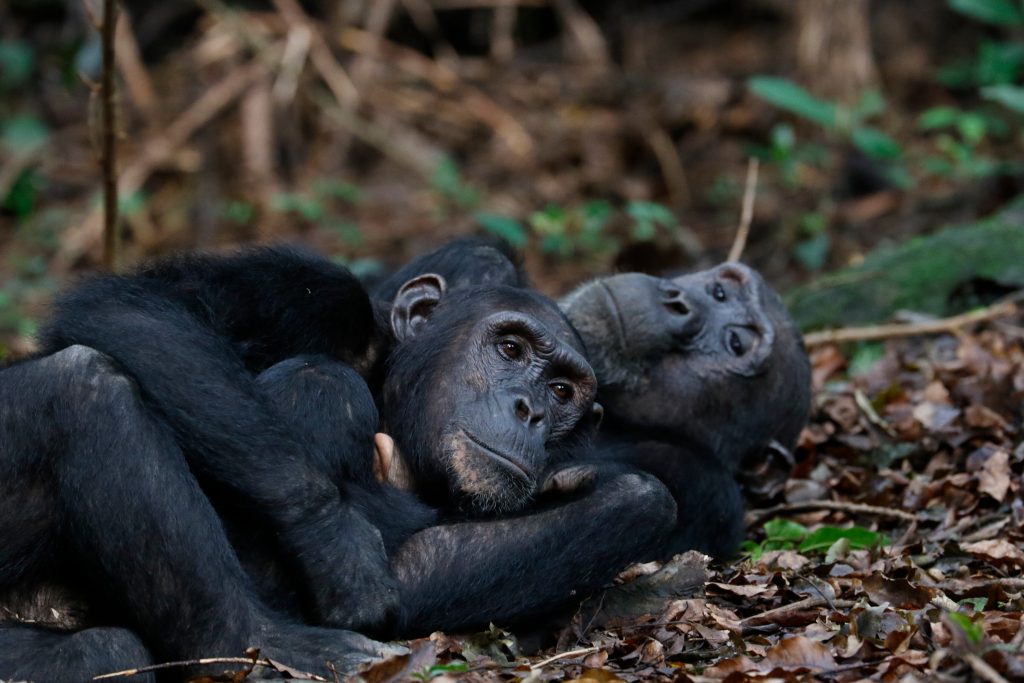
What Conservation Projects Operate in Mahale?
Conservation in Mahale runs through the Kyoto University chimpanzee research project, Frankfurt Zoological Society’s park support work, The Nature Conservancy’s Tuungane project with Pathfinder International, and the Greater Mahale Ecosystem Research and Conservation Project, all working alongside Tanzania National Parks. Visitors fund this directly through park fees paid on a Mahale chimpanzee trekking safari. Mahale Mountains National Park in western Tanzania protects the largest population of eastern chimpanzees anywhere.
What is unusual here is how much of it sits outside the park boundary. The chimpanzees inside are relatively secure; the pressure is on the forest, fisheries and farmland around them.
The Kyoto University Chimpanzee Research Project
The oldest project in Mahale is also the reason the park exists at all.
Junichiro Itani began primate work in western Tanzania in 1961 under the Kyoto University Africa Primatological Expedition. His student Toshisada Nishida established the site at Kansyana in 1965, habituating the K group from 1966 and the M group from 1968, and directed the study until 2011. It is now one of the longest continuous field projects on any wild mammal, and the Japanese researchers pushed for protection from early on, with their action plan feeding directly into the park’s gazetting in 1985.
Provisioning with food was scaled back from 1975 and stopped altogether in 1987 once the animals tolerated observers without it. The published output covers everything from ant fishing and hunting behaviour to male coalition strategies, self-medication with the bitter plant Vernonia amygdalina, and the discovery in 1989 that lions prey on chimpanzees here.
Fifty years of that work were collected into a single volume published to mark the project’s anniversary, covering the site’s history, chimpanzee ecology and social organisation, and the effects of tourism.
How your visit funds this: park entry fees and the chimpanzee trekking permit go to Tanzania National Parks and support protection of the population and the forest. Park material makes the connection explicitly, describing visitor fees as what gives the park the means to safeguard the chimpanzees and their habitat.
Frankfurt Zoological Society and Park Management
Frankfurt Zoological Society works directly with Tanzania National Parks on the running of the park, and its support concentrates on infrastructure, equipment and planning rather than headline species work.
The organisation has led development and implementation of a General Management Plan for Mahale Mountains National Park, and of the wider Mahale Ecosystem Management Plan. It also carries out ecological research and assessment across the broader ecosystem, and supports ranger operations and monitoring.
Camera trap work has produced findings the older observation methods missed, including chimpanzees recorded moving at midnight, which was a first for the park.
Beyond the boundary, the society works with local communities on long-term livelihoods, land use planning and forest protection. Its activities include community conservation banks with a membership of more than 2,200 people, of whom around 70 percent are women, running group loan and saving schemes tied to conservation commitments.
The Tuungane Project on Lake Tanganyika
Tuungane, which means let us unite in Kiswahili, is the largest community-facing programme in the region and is deliberately joined up.
It is run by The Nature Conservancy with Pathfinder International, a reproductive health organisation, and involves Frankfurt Zoological Society, Carbon Tanzania, the Jane Goodall Institute, Tanzania National Parks, the Tongwe Trust and the Government of Tanzania. The work covers the Greater Mahale Ecosystem and Lake Tanganyika together.
The logic behind combining health services, microfinance and habitat protection is that they are the same problem. Sediment washing off cleared hillsides damages the rocky lake habitats the endemic fish depend on, fishing pressure rises with the shoreline population, and forest is cleared for farmland when other livelihoods fail. More than twenty beach management units have been established along this stretch of shoreline to improve fishing yields and take pressure off the forests behind.
Kyoto University research project
Continuous chimpanzee study at Kansyana since 1965. Produced the science that justified the park and continues to monitor the M group and other communities.
Frankfurt Zoological Society
Park management planning, infrastructure, equipment, ranger support and ecological assessment, plus community livelihoods and land use work beyond the boundary.
Tuungane project
The Nature Conservancy and Pathfinder International with partners, linking family health services, microfinance, fisheries management and forest protection across the ecosystem.
Greater Mahale Ecosystem Research and Conservation Project
Chimpanzee surveys across the wider ecosystem since the mid two thousands, tracking density, abundance and habitat connectivity outside the park.
Surveying Chimpanzees Beyond the Park Boundary
Chimpanzees do not stop at the park edge, and a substantial part of the conservation effort is aimed at the animals living outside it.
The Greater Mahale Ecosystem Research and Conservation Project has coordinated chimpanzee surveys across the region since the mid two thousands, working with the Jane Goodall Institute, The Nature Conservancy, Frankfurt Zoological Society and the Tanzania Wildlife Research Institute. Published work from these surveys has covered monkey distribution, chimpanzee habitat connectivity and gene flow, and changes in chimpanzee abundance over time.
The threats identified are unglamorous and familiar: deforestation from expanding settlement and agriculture, annual burning, and logging. Chimpanzees have been listed as endangered on the IUCN Red List since 1996 and populations continue to decline across their range.
In response, district and village land use plans covering nearly 6,500 square kilometres have expanded protection outside the park, with around 80 percent as local authority forest reserves managed at district level and the remainder as village-managed reserves of various kinds.
The Mahale to Katavi Wildlife Corridor
One project deserves separate mention because it is about connection rather than protection of a single site.
An animal-made route known as the Mahale to Katavi corridor links the two parks, and work is underway to restore it. Tanzania National Parks is leading this with Frankfurt Zoological Society, the Tanganyika and Uvinza districts, and funding from the KfW German development bank, as part of a national plan to restore wildlife corridors between protected areas.
Survey work supported by the Arcus Foundation and Frankfurt Zoological Society has returned to assessing key habitat corridors for chimpanzees, particularly between Mahale and Katavi. Isolated populations lose genetic diversity and become more vulnerable over time, which is why connectivity matters as much as the parks themselves.
The park protects the chimpanzees. Everything happening outside its boundary decides whether that protection still means anything in fifty years.
The Greater Mahale Ecosystem
The park sits at the core of something considerably larger. The Greater Mahale Ecosystem covers close to 20,000 square kilometres and forms part of the globally recognised Eastern Afromontane biodiversity hotspot.
Lake Tanganyika is the other half of the picture. Conservation organisations describe it as the last of Africa’s great lakes still close to its natural state, holding more than 250 cichlid species with roughly 98 percent found nowhere else, and around a sixth of the planet’s available surface fresh water. For tens of thousands of people along its shore it is water supply, transport and food source at once.
That combination, an intact forest ecosystem and a nearly intact ancient lake with a growing human population between them, is why the region attracts the range of organisations it does.
How Tourism Fits Into Conservation Here
Visitor numbers at Mahale run in the low thousands a year, which is tiny by Tanzanian standards and deliberate.
The rules exist to keep the impact low. Trekking groups are capped at six visitors, contact time at one hour, and surgical face masks are required because chimpanzees catch human illnesses, sometimes fatally. Anyone with a cold, cough or stomach upset is turned back. Only one community, the M group, is habituated at all, which concentrates disturbance in one part of a large park rather than spreading it.
Fees fund the protection directly, and the research project has published on the current status of tourism as one of its own subjects of study. Camps in the park operate on a small scale with fewer than forty beds between them.
The honest version is that tourism here is a modest funding stream and a modest pressure at the same time. It is not what will save or lose these chimpanzees; land use outside the park will do that.
What Visitors Can Do
Realistic rather than performative, since a three night stay is not going to change an ecosystem.
Follow the health rules without argument, including standing down from a trek if you are unwell, which is the single most concrete thing any visitor does for the chimpanzees. Keep the stated distance and follow your guide. Use the camps and local staff rather than bringing everything with you. And if you want to contribute beyond the park fees, the organisations named above take donations directly and can tell you what the money does.
Asking your guide about the research is also worth doing. Many trackers have worked alongside the Kyoto University project for years and know the individual chimpanzees by name, and that history is not in any brochure.
Best Time to Visit and Getting to Mahale
June to October is the dry season and the main window, with August through October strongest for chimpanzee sightings. Most camps close from March to May during the long rains and the scheduled flights stop with them.
Access is by air or water only. Scheduled charters run from Arusha on set days in season, typically Mondays and Thursdays, often via Katavi, landing near the boundary with a boat transfer of around ninety minutes. The alternative flies Dar es Salaam to Kigoma in roughly three hours, then continues south by light aircraft in forty five minutes or by speedboat in four to six hours. Travellers who want both chimpanzee parks usually look at our 6 day Mahale and Gombe chimp safari.
Conservation in Mahale: Frequently Asked Questions
Where does my park fee actually go?
Park entry fees and the chimpanzee trekking permit go to Tanzania National Parks and fund protection of the chimpanzee population and the forest, with park material stating the connection directly. Non-resident adults pay roughly US$80 to US$95 per day depending on VAT treatment, about US$35 per adult per night concession levy, and around US$150 per person for the trekking permit. The research and community projects described here are funded separately by their own organisations and donors.
How long has chimpanzee research been running at Mahale?
Since 1965, when Toshisada Nishida established the site at Kansyana under the Kyoto University expedition, following work begun in western Tanzania by Junichiro Itani in 1961. Nishida directed it until 2011 and it continues today, making it one of the longest continuous field studies of any wild mammal.
What are the main threats to Mahale’s chimpanzees?
Outside the park rather than inside it: deforestation from expanding settlement and agriculture, annual burning, and logging across the Greater Mahale Ecosystem. Chimpanzees have been listed as endangered by the IUCN since 1996 and populations continue to decline across their range. Habitat fragmentation and loss of connectivity between populations are the longer-term concerns.
What is the Tuungane project?
A community-focused partnership run by The Nature Conservancy with Pathfinder International across the Greater Mahale Ecosystem and Lake Tanganyika, joined by Frankfurt Zoological Society, Carbon Tanzania, the Jane Goodall Institute, Tanzania National Parks, the Tongwe Trust and the Tanzanian government. It links family health services, microfinance, fisheries management and forest protection, on the basis that these are one problem rather than several.
Can visitors take part in conservation work?
Not in any hands-on sense. Kansyana is a working research station rather than a visitor facility, and the community programmes are not volunteer operations. What visitors do contribute is the fee income, compliance with the health and distance rules, and support for the camps and local staff. Direct donations to the named organisations are the practical route for anyone wanting to do more.
Why are trekking groups limited to six people?
To limit stress on the animals and reduce disease transmission risk. Chimpanzees share enough human biology to catch our illnesses, sometimes fatally, which is also why face masks are required, why viewing is capped at one hour, and why anyone with a cold or stomach upset is asked to stand down. Only one community in the park is habituated at all.
What is the Mahale to Katavi corridor?
An animal-made route linking the two national parks, now the subject of a restoration effort involving Tanzania National Parks, Frankfurt Zoological Society, the Tanganyika and Uvinza districts and KfW German development bank funding. Restoring connectivity between protected areas helps prevent isolated populations losing genetic diversity over time.
Booking Your Mahale Trip
The safari companies and tour operators listed on this website put trips like this together for a living and know which camps, guides and routes actually deliver. We are an independent guide to Mahale; we do not book or sell tours ourselves.
When you are ready, arrange your safari, tour or holiday with one of the recognised operators listed here. Tell them your dates and what matters most, and a real person, not a form, will handle the itinerary, park bookings and logistics for you.