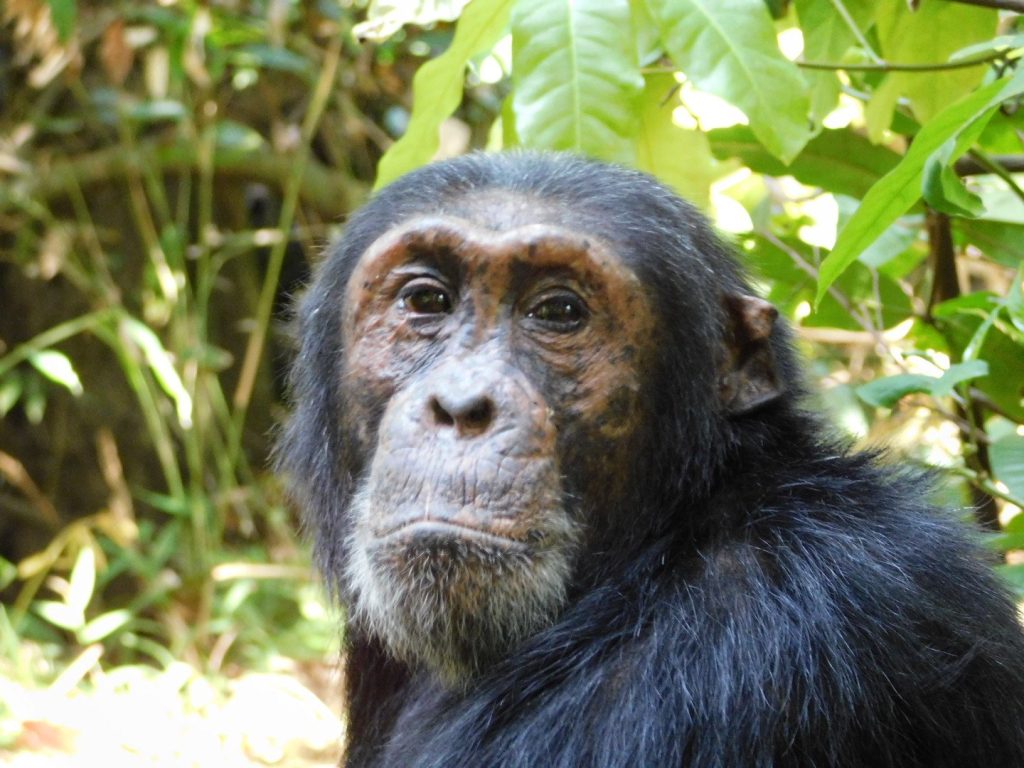
What Photography Opportunities Exist in Mahale?
Mahale offers chimpanzee portraits in low forest light, mountains rising from a lake shoreline, white sand beaches, sunsets west across open water, night fishing lamps, and underwater cichlids, all shot on foot or from a boat since the park has no roads. Photographers work these on a Mahale chimpanzee trekking safari from lakeside camps. Mahale Mountains National Park in western Tanzania is described in park material as a destination worth visiting for its sunsets alone.
It is also a technically demanding place to shoot. Dark canopy, fast-moving animals overhead, no flash permitted, weight limits on the aircraft and humidity that fogs glass. Knowing that before you pack changes what you bring.
Photographing Chimpanzees on a Trekking Safari
This is the hardest subject in the park and the one everyone comes for.
Chimpanzees spend a lot of their day in the canopy, under closed leaf cover, in poor light. Flash is prohibited. Groups are capped at six visitors, viewing at one hour from the moment contact is made, and the stated distance runs between seven and ten metres, though the animals move and sometimes walk straight past a seated group.
Practically, this means high ISO performance matters more than reach. A fast lens is worth more than an extremely long one, since the apes are often closer than the light is good, and something around 70 to 300 millimetres covers most situations. Shoot wide open, push your shutter speed higher than feels necessary because chimps rarely hold still, and expect to work at ISO settings you would avoid elsewhere.
Face masks are required, which fogs viewfinders and glasses. Bring a lens cloth and accept some frustration.
The single biggest gain: book two or three trekking mornings rather than one. Chimpanzee photography is largely a numbers game, and a second morning gives you better light, a calmer start and the chance to work a situation you fluffed the first time. It improves your pictures more than any lens will.
Forest Light and the Practical Problems
Mahale’s forest is beautiful and photographs badly unless you plan for it.
Contrast is the issue. Shafts of light through a dark canopy blow out while the shadows go black, and the dynamic range in a typical forest frame is wider than a sensor handles comfortably. Overcast mornings, common in the wetter months, are technically easier than bright ones. Shooting up into the canopy against a white sky is the losing scenario, so reposition where you can.
Humidity fogs lenses when you move between an air-conditioned space and the forest, though camps here are open-sided, which helps. Rain arrives quickly in the wet season and the canopy stops very little of it, so a rain cover for the body and a dry bag for everything else earn their space.
Weight is the other constraint, and a real one. Light aircraft serving Mahale enforce baggage limits well below commercial flights and require soft bags. Everything you bring also gets carried uphill in humid air for hours on a trek.
Scenic Photography: Mountains From the Water
The classic Mahale frame is the range seen from the lake, and it is easiest to get on the boat transfer in.
The mountains rise from a lake surface at about 770 metres to Mount Nkungwe at roughly 2,462 metres, with six further peaks above 2,000 metres, and the forest runs almost to the waterline. From a boat you get the whole vertical extent in one frame, which is impossible from the beach.
Late afternoon works best, when the western face catches warm light and the peaks hold it after the shoreline has gone into shade. Morning gives flatter, cooler light with the sun behind the mountains. Dry season haze from inland burning softens distance, which can help or hurt depending on what you want.
Ask the camp for a boat trip laid on for photography rather than treating the included boat safari as your only chance. Cutting the engine and drifting gives a stable platform; a moving tender does not.
Sunset Photography Over Lake Tanganyika
Mahale faces west across the widest part of the lake, straight into the sunset, with the Congolese highlands forty to fifty kilometres out and visible on clear days.
The park sits close to the equator, so sunset falls around six thirty in the evening year round and dusk is short. Be in position twenty minutes early rather than five. Foreground is the problem on a featureless beach, so use the camp dhows, a passing fishing boat, the rocky headlands or the fire.
Dry season gives reliable clear evenings with hazier distance. Green season from November onwards brings cloud structure, towering build-ups over the Congo side, and electrical storms out over the water at night. Both are worth shooting and they produce completely different pictures.
Chimpanzee portraits
Low light, closed canopy, no flash, one hour. Fast glass and high ISO. The most demanding subject and the reason most people come.
Mountains from the lake
Shot from a boat, ideally with the engine cut. Late afternoon light on the western face. The frame that shows what Mahale actually is.
Sunsets and the fishing lamps
West-facing beaches, short equatorial dusk, then kerosene lamps spreading across the dark water. Tripod and long exposures for the second half.
Underwater cichlids
Rocky shallows off the beach, twenty metre visibility in the dry season, water near 25 degrees. Needs housing or an action camera.
Forest detail and butterflies
Mud-puddling congregations at stream crossings, light gaps, tool marks on ant nests. Macro or a close-focusing lens rewards a slow walk.
Summit panoramas
From the Nkungwe ridge above 2,300 metres, west across the full width of the lake. Needs a two to three day climb and a clear dry season morning.
Night Photography and the Fishing Lamps
The subject nobody expects and plenty of people rate highest.
After dusk, fishing crews put out from villages along the shore in small wooden boats hung with kerosene lamps, drawing sardines up towards the light. Within an hour the dark water carries scattered points of light out towards the horizon, and it continues all night. Locally the effect is known as the fishing fire.
This wants a tripod and long exposures. Camps will not mind you setting up on the beach. Skies here are genuinely dark with no settlement light for many kilometres, so the stars come into the same frame, and from a high camp on the Nkungwe route you are looking down on the whole fleet from above.
Green season storms over the lake at night are the other option, lighting the entire water surface in bursts.
The hardest pictures here are the chimpanzees. The best ones are often taken after dark from a beach chair.
Underwater and Beach Photography
Lake Tanganyika is a legitimate underwater subject and an unusual one, since almost nobody shoots freshwater cichlids in the wild.
More than 250 described cichlid species live here with roughly 98 percent found nowhere else. The rocky shallows off the camp beaches hold the small bright ones: shell dwellers in beds of empty snail shells, rock-grazing Tropheus, gobies in crevices. Water sits near 25 degrees Celsius year round and dry season visibility reaches around twenty metres. You need housing or an action camera, since camps supply masks and fins but not photographic gear.
Above water, the beaches themselves are small coves of fine pale sand between rocky headlands, backed by forest with mountains behind, and empty of other people. Morning light is flat; late afternoon is when they come alive.
Wildlife Beyond the Chimpanzees
Easier subjects than the apes, and worth planning for rather than treating as filler.
Yellow baboons on the beaches and rocks in the late afternoon are the most cooperative large mammals in the park, fully terrestrial and used to people. African fish eagles and palm-nut vultures are common along the shoreline, and giant kingfishers work branches over the water. Red-tailed monkeys, blue monkeys and red colobus move through the canopy behind camp, all difficult for the same reasons the chimps are.
Butterflies congregate on damp sand at stream crossings and lift in clouds when a walking party steps through. Forest birds are hard, with the park’s list running between 337 and 398 species and most of them high in a closed canopy.
Best Season for Photography in Mahale
June to October gives clear skies, thinner undergrowth, better forest visibility, the calmest and clearest lake, and chimpanzees ranging low so treks are short and you arrive with energy to shoot. It is the straightforward choice.
November to February suits photographers who want green forest, dramatic cloud, storms over the lake, migrant birds and near-total solitude, at the cost of longer wetter treks with the apes high on the mountain. Most camps close from March to May during the long rains.
Getting to Mahale With Camera Gear
Access is by air or water only. Scheduled charters run from Arusha on set days in season, typically Mondays and Thursdays, often via Katavi, landing near the boundary followed by a boat transfer of around ninety minutes. The alternative flies Dar es Salaam to Kigoma in roughly three hours, then continues south by light aircraft or speedboat. At the top end, our 14 day Tanzania chimps safari and Zanzibar covers Tanzania end to end and finishes on the coast.
Confirm the baggage allowance before packing, since light aircraft limits are lower than commercial ones and soft bags are required rather than hard cases. Boat transfers get spray in any season, so gear travels in a dry bag rather than trusted to a rucksack. Charging is possible at camps but capacity can be limited, so bring spare batteries and a power bank.
Photography in Mahale: Frequently Asked Questions
What does a photography-focused trip to Mahale cost?
Lakeside camps are fully inclusive from around US$1,500 per person per night at the premium end, covering meals, transfers, kayaking, snorkelling, a boat safari and a daily chimpanzee trek. Park charges add roughly US$80 to US$95 per non-resident adult per day depending on VAT treatment, about US$35 per adult per night concession levy, and around US$150 per person for the chimpanzee trekking permit. Private boat charters for dedicated photography sessions are usually an extra.
Can you use flash when photographing chimpanzees?
No. Flash photography is prohibited around the chimpanzees, as it disturbs them and can provoke a defensive reaction. This is why high ISO performance and fast glass matter far more here than at a savanna destination. Face masks are also required, which fogs viewfinders, so bring a lens cloth.
What lens should I bring for Mahale?
Something fast in the 70 to 300 range covers most chimpanzee situations, since the animals are often closer than the light is good. Add a wider lens for forest scenes, the lake and the mountains. Very long telephotos are less useful than at a savanna park and are heavy to carry uphill for hours in humid air, which matters given the aircraft weight limits.
Are drones allowed in Mahale?
No. Drones require permits in Tanzania that are difficult to obtain and are not welcome in the park. The same applies across Tanzanian national parks, so plan on ground and boat-based photography only.
What is the best time of day to shoot in Mahale?
Mornings for trekking and forest work, since that is when the chimpanzees are active and the light through the canopy is best. Late afternoon for the shoreline, boat trips and the mountains catching warm light. After dusk for the fishing lamps and stars, with a tripod. Sunset falls around six thirty year round and dusk is short.
Can I photograph underwater at Mahale?
Yes, with your own housing or an action camera. The rocky shallows off the beaches hold the lake’s endemic cichlids, dry season visibility reaches around twenty metres and the water sits near 25 degrees Celsius. Camps supply masks and fins but not photographic equipment.
How many days should a photographer allow?
At least four or five nights. Three gives you two trekking mornings, which is the minimum for reasonable chimpanzee results, while extra nights add a spare morning, better light options and time for boat work, night shooting and snorkelling. Since the flights dominate the cost, additional nights are proportionally cheap.
Booking Your Mahale Trip
The safari companies and tour operators listed on this website put trips like this together for a living and know which camps, guides and routes actually deliver. We are an independent guide to Mahale; we do not book or sell tours ourselves.
When you are ready, arrange your safari, tour or holiday with one of the recognised operators listed here. Tell them your dates and what matters most, and a real person, not a form, will handle the itinerary, park bookings and logistics for you.