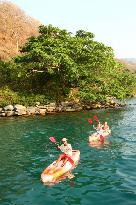
Kayaking in Mahale National Park
Kayaking in Mahale National Park means paddling the Lake Tanganyika shoreline below forested mountains rising to roughly 2,462 metres, using kayaks included in the lakeside camp rates, with early morning the best time because the lake goes flat at dawn. It needs no booking and no experience. Mahale Mountains National Park in western Tanzania has no roads, so the water is the only way to travel along the park.
This is the quietest way to see Mahale. No engine, no guide talking, no tracker on a radio, just you moving along the base of a mountain that rises 1,700 metres out of the water beside you.
What Kayaking Here Involves
Kayaks sit on the beach at the camps and are included in the inclusive rate, along with snorkelling gear. There is no separate charge and no need to arrange anything in advance.
You paddle along the shoreline rather than out into the lake, staying within the sheltered water below the forested slope. Beaches, boulder fields and stream mouths alternate every few hundred metres, and the whole coast is empty apart from the two camps and the occasional fishing boat.
Camps will tell you how far along to go and where to turn around. Follow that, since conditions vary and the lake is not somewhere to improvise. Some guests paddle for twenty minutes, others for two hours.
No experience is needed. These are stable sit-on or touring kayaks used on flat water, not whitewater boats, and the skill required is closer to walking than to sailing.
Go at dawn. The lake is glass in the early morning and picks up a chop most afternoons as the wind gets up, which turns an easy paddle into work and can make the return leg harder than the outward one. First light also puts the sun behind the mountains rather than in your eyes.
Why Morning Is the Only Real Answer
Wind is the daily rhythm of Lake Tanganyika, and it decides everything about a paddle.
At first light the surface is usually flat enough to reflect the mountains, and sound carries a long way across it. Fish eagles call from the shoreline trees, baboons work the rocks, and the forest behind is at its noisiest. By mid morning a breeze often starts, and by afternoon the surface can be genuinely choppy.
The complication is that mornings are also when chimpanzee trekking goes out. On trekking days the kayaks stay on the beach. This is a real argument for four or five nights rather than three, since a non-trekking morning is what buys you the flat water.
Late afternoon sometimes calms again before sunset, which is the second window if the mornings are spoken for.
What You See From a Kayak
Being low, quiet and slow changes what the shoreline gives you.
African fish eagles are common along the whole lakeshore and call constantly from waterside trees. Palm-nut vultures are also common here. Giant kingfishers work branches over the water and drop into the shallows. Where streams come down and meet the lake, herons, waders and smaller kingfishers concentrate.
Yellow baboons come down onto the rocks at the ends of the beaches, particularly in the late afternoon, and a kayak gets you closer than a walking party would. Otters use some of the rocky stream outlets. Red colobus, red-tailed monkeys and blue monkeys move through the canopy immediately behind the shoreline.
In the dry season, chimpanzees sometimes come down to feed in shoreline fig trees, and guests have watched the M group from a few metres offshore. That is a bonus rather than a plan, and it happens often enough between August and October to be worth keeping an eye out for.
The View Back at the Mountains
The thing a kayak gives you that nothing else does is perspective on the range itself.
The lake surface sits at about 770 metres and Mount Nkungwe tops the range at roughly 2,462 metres, with six further peaks above 2,000 metres. From the beach you see the bottom of that; from a hundred metres out on flat water you see the whole wall of it, forest running almost to the waterline with stream gullies cutting the slope.
Early light on the western face is soft and low. Late afternoon light is warmer and catches the upper slopes after the shoreline has gone into shade, which is the frame photographers want.
It is also the clearest way to grasp why the park has no roads. Look at the gradient and the question answers itself.
Dawn paddle
Flat water, best light, most birdlife, coolest air. The version everyone should do at least once. Thirty minutes to two hours along the shore.
Kayak and snorkel
Paddle out early, hold onto a rock and get in with a mask. The quietest way to reach the rocky shallows where the lake’s endemic cichlids live.
Late afternoon paddle
Second window if the morning went to trekking. Warmer light on the mountains, baboons on the rocks, and often calmer than midday.
Combined with a boat safari
Camps include a boat safari during your stay, which covers more shoreline than a kayak can. Do both rather than treating them as alternatives.
Kayaking and Snorkelling Together
The best use of a kayak here is as transport to a better swim.
Rocky headlands a short way along from the camp beaches hold higher fish density than the water directly in front of camp, simply because nothing has been disturbed by swimmers. Paddling out early, holding onto a rock and getting in with a mask puts you over that habitat without an engine and without company.
Lake Tanganyika holds more than 250 described cichlid species with roughly 98 percent found nowhere else, and most of the colourful ones sit in the first few metres of water over rock. Visibility in the dry season can reach around twenty metres. Water sits near 25 degrees Celsius year round.
Take the same safety advice as for swimming: go where your camp goes, do not go alone, and stay out of open water.
No engine, no guide, no schedule. On a park with no roads, a kayak at dawn is as close to being alone here as a visitor gets.
Safety on the Water
The lake is enormous and deserves respect even a few hundred metres from the beach.
Tanganyika reaches 1,470 metres at its deepest and stretches roughly fifty kilometres to the Congolese shore. Wind can get up quickly, and a chop that is manageable outbound becomes hard work coming back. Stay close to shore, tell the camp where you are going, and turn around earlier than you think you need to.
Hippos hold at a few river mouths, which is why camps direct guests along specific stretches rather than letting people paddle wherever they like. Crocodiles are recorded in the park but described as rare on this shoreline. Follow the camp’s guidance and neither becomes a concern.
Wear the buoyancy aid if one is provided. Sun on open water is stronger than it feels, so a hat, sun cream and a long-sleeved layer are worth having on a longer paddle.
Who Kayaking Suits
Almost everyone, which is unusual in a park where the headline activity is a demanding forest trek.
It needs no particular fitness on flat morning water, no experience, and no age minimum of the kind that governs chimpanzee trekking, where camps cite twelve years and several national sources give fifteen. Younger family members who cannot trek can usually kayak with an adult, subject to the camp’s own rules.
It is also the obvious activity for a rest day between hard trekking mornings, when another climb holds no appeal but sitting on the beach all day is not quite enough.
Anyone nervous on water can stay within a few metres of the shore and still get everything worth having from it.
Best Time for Kayaking at Mahale
June to October gives the calmest and clearest conditions overall, with settled weather and flat mornings, overlapping with the strongest chimpanzee trekking months. This is the window most visitors travel in anyway.
November to February brings the short rains and the drier gap after them, with more variable conditions and occasional storms, though mornings are frequently still calm. Most camps close from March to May during the long rains, when lake levels rise and the shoreline shifts.
Within any season, dawn is the answer.
Getting to Mahale
Access is by air or water only. Scheduled charters run from Arusha and the northern circuit on set days in season, typically Mondays and Thursdays, often calling at Katavi, landing at an airstrip near the boundary followed by a boat transfer of around ninety minutes to the camp beaches. Our 5 day Mahale and Lake Tanganyika safari gives the lake side of the park proper time rather than an afternoon.
The alternative flies Dar es Salaam to Kigoma in roughly three hours, then continues south by light aircraft in forty five minutes or by speedboat in four to six hours. That final boat leg gives you a preview of the shoreline you will be paddling.
Kayaking in Mahale: Frequently Asked Questions
Is kayaking included at the Mahale camps?
Yes. Kayaks are standard inclusions at the lakeside camps, whose fully inclusive rates start from around US$1,500 per person per night at the premium end and also cover meals, most drinks, transfers, snorkelling equipment, a boat safari and a daily chimpanzee trek. Park charges of roughly US$80 to US$95 per non-resident adult per day depending on VAT treatment, plus about US$35 per adult per night concession levy, are usually folded in. There is no separate kayaking fee.
Do I need kayaking experience?
No. These are stable boats used on sheltered flat water along the shoreline, not whitewater kayaks, and camps will point out where to paddle and where to turn around. Anyone comfortable in water can manage a morning paddle without instruction.
When is the best time to kayak?
Early morning, when the lake is usually flat and the light is best. Wind commonly picks up through the day and afternoons can be choppy. Late afternoon sometimes calms again before sunset. Seasonally, June to October gives the most settled conditions.
Is it safe to kayak on Lake Tanganyika?
Along the sheltered shoreline with camp guidance, yes. Stay close to shore, tell the camp where you are going, and turn back before the wind gets up, since a chop that is manageable outbound is harder work returning. Hippos hold at some river mouths and crocodiles are recorded but rare here, which is why camps direct guests along specific stretches.
Can you combine kayaking with snorkelling?
Yes, and it is the best use of a kayak here. Paddle out early to a rocky headland, hold onto a rock and get in with a mask. Fish density is higher away from the camp beaches, and Lake Tanganyika holds over 250 cichlid species with roughly 98 percent found nowhere else.
Can children kayak at Mahale?
Usually, with an adult and subject to the camp’s own rules, which makes it a useful option for family members below the chimpanzee trekking age minimum, cited as twelve years by Mahale camps and fifteen by several national sources. Ask the camp directly when booking.
Might I see chimpanzees from a kayak?
Occasionally in the dry season from August to October, when the M group ranges lower and sometimes feeds in shoreline fig trees. Guests have watched them from a few metres offshore. It is a bonus rather than something to plan around. Fish eagles, baboons and kingfishers are far more reliable company.
Booking Your Mahale Trip
The safari companies and tour operators listed on this website put trips like this together for a living and know which camps, guides and routes actually deliver. We are an independent guide to Mahale; we do not book or sell tours ourselves.
When you are ready, arrange your safari, tour or holiday with one of the recognised operators listed here. Tell them your dates and what matters most, and a real person, not a form, will handle the itinerary, park bookings and logistics for you.