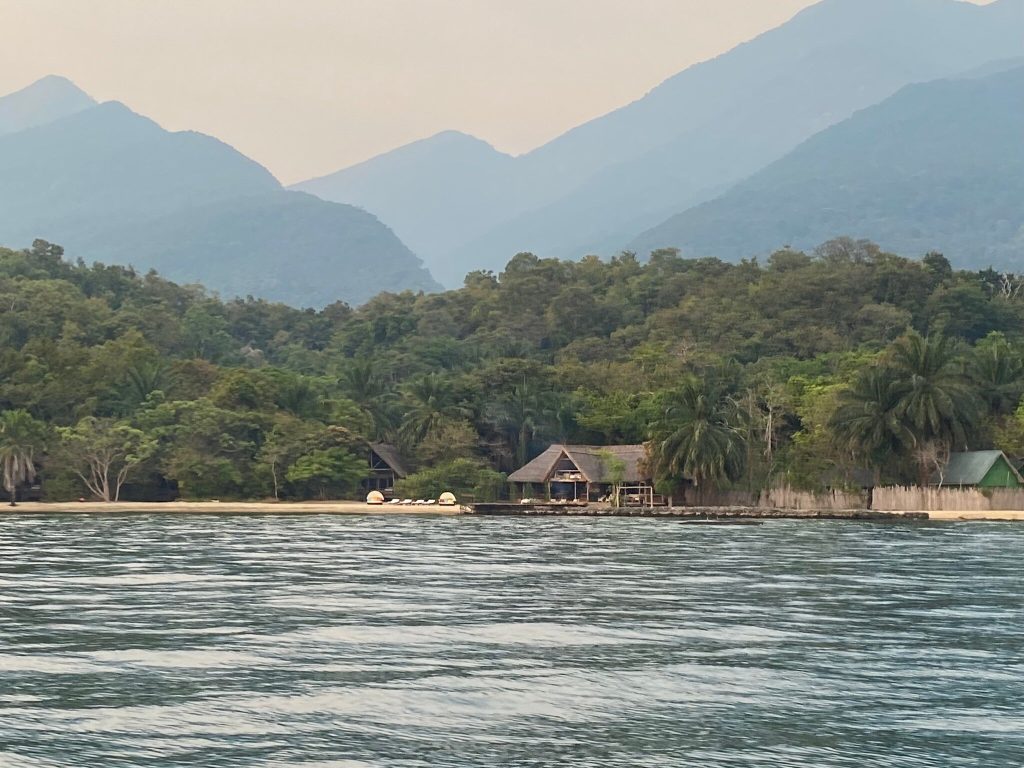
Mountain-Trail Hiking in Mahale National Park
Mountain-trail hiking in Mahale National Park means walking steep, humid, often unmarked forest trails on the western face of a range rising from a lake at about 770 metres to roughly 2,462 metres, always with a guide and an armed ranger. Trails are research and patrol paths rather than a signposted network. Mahale Mountains National Park in western Tanzania has no roads, so every trail begins at a beach.
This page is about what the trails are actually like underfoot and how a hiking day unfolds, rather than a list of routes. If you want to know whether you will enjoy walking here, that is the more useful question.
What the Trails Are Made Of
Almost nothing here is engineered. There are no steps, no boardwalks, no drainage and no waymarking.
What you walk on is forest floor: tree roots crossing the line at knee height, wet rock at stream crossings, loose leaf litter lying on gradient, and soil that holds water long after the last rain. On the steeper pitches the trail is a scar rather than a path, worn by decades of trackers and rangers following the same lines.
Higher up, alpine bamboo narrows the trail to a tunnel and the ground beneath stays saturated. Above about 2,300 metres the forest gives out and you are pushing through high grass on open slopes with no defined path at all.
Guides carry machetes for a reason. On chimpanzee treks in particular, the line often has to be cut fresh.
The surface is the difficulty, not the height. There is no altitude problem at 2,462 metres and no technical climbing anywhere in Mahale. What tires people is unrelenting gradient on ground that gives way, in air that will not take any more moisture.
How a Hiking Day Runs
Early, is the first thing. Everything on foot here happens in the morning.
You start from a camp beach or from a boat drop further along the shore, and you are in closed-canopy forest within a hundred metres. The first hour is the warmest, since you are at lake level with the sun already up and the canopy holding the air still.
Climbing is sustained rather than punctuated. The western face is cut by dozens of short steep stream gullies, so the pattern is climb into a valley, cross the stream, climb out over a ridge, repeat. Valleys hold the deepest soil and the tallest trees; ridges are drier and more open.
Groups move at one pace with a ranger in position, and stops are dictated by what the guide notices rather than by a schedule. On a chimpanzee trek the pace is set by the trackers ahead and can be brisk. On a guided forest walk it is yours.
By early afternoon you are back at the beach, and the lake is twenty metres away at around 25 degrees Celsius. That is not a small part of why the walking here is bearable.
Gradient, Distance and the Numbers That Matter
Some figures to calibrate against.
The lake sits at about 770 metres. Mount Nkungwe tops the range at roughly 2,462 metres, with six further peaks above 2,000 metres. The full climb involves close to 1,700 metres of ascent, done over two or three days with camping.
Chimpanzee treks cover far less height but are unpredictable in length, running from forty minutes to most of a day depending on where the M group moved overnight. Dry season treks from August to October tend towards the short end as the animals range low near the lakeshore. Wet season treks of three to six hours each way are normal.
Guided forest walks run two to three hours by agreement, which makes them the only walking here with a known length before you set off.
Navigation and Why Nobody Walks Alone
Independent hiking is not permitted anywhere in Mahale, and the reasons are practical as much as regulatory.
An armed park ranger accompanies every walking party. Buffalo range the park’s grassland and are among the more dangerous animals to meet on foot in Africa. Lions occupy those same grassland sectors, unusually for a forest park, and were documented preying on chimpanzees here in 1989. Elephant occur in the wider ecosystem.
Beyond safety, the trails would defeat most visitors on their own. Outside the main lines the paths are faint or absent, the canopy removes any long view, and a wrong valley puts you a long way from where you meant to be in country with no signal.
Guides also read the forest constantly: nests overhead, chewed wadges, tool marks on ant nests, a call that changes the direction of the walk. That is most of the value of the day.
Lower forest, beach to a few hundred metres
Hottest section, closed canopy, streams every few hundred metres. Dry season chimpanzee ground and the start of every route.
Montane forest, the long middle
Cooler and mossier with better views back to the lake. Where wet season treks usually finish, and the bulk of the Nkungwe climb.
Alpine bamboo, upper slopes
Trail narrows to a tunnel, ground holds water, progress slows. Reached only on the mountain route.
Montane grassland, above 2,300 metres
Open, windy, no defined path, high grass to push through. Cold at night and the source of the summit views west across the lake.
What Makes the Walking Worthwhile
The trade for all that effort is a forest almost nobody else is walking in.
Mahale carries around nine or ten primate species, one of the densest communities in Tanzania. Red colobus in the lower valleys, Angolan black and white colobus in the montane band as a race found only in these mountains, red-tailed and blue monkeys through the canopy, baboons near the shore. Bird records run between 337 and 398 species.
Butterflies gather on damp sand at stream crossings and lift in clouds as a party steps through. Waterfalls sit in several gullies where the rock steps down, some with pools used for swimming.
And the park holds fewer than forty beds across 1,600 square kilometres, with visitor numbers in the low thousands a year. You will not pass another group.
No steps, no waymarkers, no drainage, no other walkers. The trail is wherever the trackers have been going for sixty years.
Fitness and Pacing Yourself
The useful self-test is simple: can you walk uphill for four hours in humid heat on rough ground, then do it again the next morning?
If yes, everything in this park is open to you. If not, say so at the briefing rather than finding out at 900 metres. Guides can pace a walk, choose a shorter route or suggest a forest walk instead, and none of that is a problem if raised early. A party that has to turn back mid-trek is a problem for everyone in it.
Descents deserve particular thought. The way down is on the same wet roots and loose litter you climbed, usually done in one push, and knees complain more than lungs do. A walking pole helps more than most people expect.
Drink more than feels necessary. Heat exhaustion is a likelier problem here than any animal.
Footwear and Kit for the Trails
Footwear first, because it causes more regret at Mahale than anything else.
Bring boots with aggressive tread, broken in before you travel. Grip on wet rock and steep descents is the whole game, and worn trail shoes are the most common mistake visitors report. Add gaiters for the wetter months, when undergrowth is heavy and trails hold water.
Long trousers and long sleeves in light quick-drying fabric protect against stinging plants, thorny scramblers and biting insects while handling humidity better than cotton. A packable rain shell earns its place in any month, since the canopy stops very little.
Carry at least two litres of water, insect repellent and a walking pole if descents trouble you. Keep camera weight down, because everything goes uphill with you and light aircraft baggage limits are lower than commercial flights.
Best Season for Mountain-Trail Hiking
June to October is the window. Trails firm up, streams drop, undergrowth thins and the camps that arrange guides, rangers and porters are open. June brings the coldest nights of the year at around 14 degrees Celsius at lake level, which helps considerably for walking.
October runs hottest before the rains break, which makes the lower forest sections heavy going even on dry ground. The drier gap from December to February also works for walking, with far fewer visitors, though ground stays slippery.
From March into May the long rains close most camps and stop the scheduled flights, which takes the whole trail network out of use for practical purposes.
Getting to Mahale
Access is by air or water only. Scheduled charters run from Arusha and the northern circuit on set days in season, typically Mondays and Thursdays, often calling at Katavi, landing at an airstrip near the boundary followed by a boat transfer of around ninety minutes to the camp beaches. Our 12 day chimps, plains and crater safari is the long version, forest, plains and crater in one run.
The alternative flies Dar es Salaam to Kigoma in roughly three hours, then continues south by light aircraft in forty five minutes or by speedboat in four to six hours. Allow three nights minimum for trekking, or five to six if the Nkungwe climb is in your plans.
Mountain-Trail Hiking at Mahale: Frequently Asked Questions
What does hiking in Mahale cost?
Guided forest walks and one chimpanzee trek per day are normally included in camp rates, which start from around US$1,500 per person per night at the premium end. Park charges add roughly US$80 to US$95 per non-resident adult per day depending on VAT treatment and about US$35 per adult per night concession levy, with the chimpanzee trekking permit at around US$150 per person. The Mount Nkungwe climb is quoted separately since rangers, porters and equipment need arranging.
Are the trails marked?
No. There is no waymarking, no steps and no engineered path. What exists is a network of research and patrol trails on the western slopes, largely centred on the Kansyana area, plus the recognised Nkungwe route. On chimpanzee treks guides frequently cut a fresh line through undergrowth.
How steep is the hiking?
Sustained rather than punctuated. The range climbs from a lake surface at about 770 metres to roughly 2,462 metres, and the western face is cut by dozens of stream gullies, so routes climb into valleys and out over ridges repeatedly. There is no technical ground and no altitude risk; gradient, heat and footing are what make it hard.
Can I hike alone in Mahale?
No. An armed park ranger is required on every walking party because buffalo, lions and elephant occur in the park, and trails outside the main lines are faint or absent. Independent walking is not permitted and camps will not arrange it.
What boots should I wear?
Hiking boots with aggressive tread, broken in before you travel. Grip matters more than anything else given wet rock, roots and steep descents. Gaiters help in the wetter months, and a walking pole is worth having for the way down. Worn trail shoes are the most common footwear regret here.
How long are the hikes?
Guided forest walks run two to three hours by agreement. Chimpanzee treks run from forty minutes to most of a day, decided by where the animals moved overnight, with dry season treks shortest. The Mount Nkungwe climb takes two to three days with camping and close to 1,700 metres of ascent.
What if I struggle partway through a trek?
Tell your guide early rather than late, ideally at the briefing before you set off. Groups move at one pace with a ranger, so turning back is disruptive but possible. The better plan is an honest conversation up front, after which the guide can choose a shorter route or suggest a forest walk on that morning instead.
Booking Your Mahale Trip
The safari companies and tour operators listed on this website put trips like this together for a living and know which camps, guides and routes actually deliver. We are an independent guide to Mahale; we do not book or sell tours ourselves.
When you are ready, arrange your safari, tour or holiday with one of the recognised operators listed here. Tell them your dates and what matters most, and a real person, not a form, will handle the itinerary, park bookings and logistics for you.