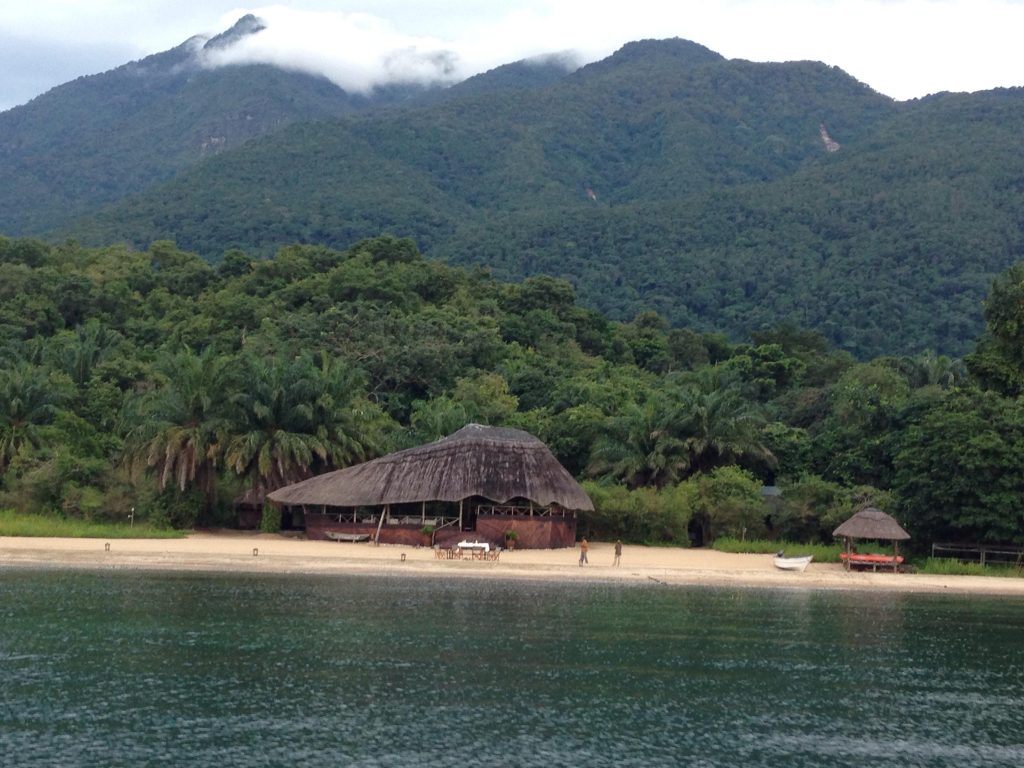
Mount Nkungwe (~2,462m, highest peak)
Mount Nkungwe is the highest point in Mahale Mountains National Park, rising to roughly 2,462 metres and climbed as a two or three day trekking expedition with an armed park ranger and overnight camping. Trekkers start near Kansyana or park headquarters and gain close to 1,700 metres from the lakeshore. The peak anchors the Mahale mountain range in western Tanzania, on the eastern shore of Lake Tanganyika, and is held sacred by the Tongwe people.
Sources put the summit anywhere between about 2,460 and 2,520 metres, and the old imperial figure of 8,069 feet still turns up on park signage. Nobody in the forest is going to argue about forty metres. What matters on the ground is that you climb from a beach at around 780 metres to grassland above the treeline, in humid heat, on a mountain with no cable car, no huts and no other walkers.
Mount Nkungwe Trekking Safari: What the Climb Involves
A Mount Nkungwe trek is not a day walk. Most parties take two or three days, sleeping at a tented camp partway up and summiting on the second morning before dropping back to the lake.
The standard start is from Kansyana or from park headquarters, both on the western flank near the shoreline. Day one climbs through lowland and then montane forest to a base camp; day two is the push to the ridge and the summit; day three walks out. Rangers accompany every group, armed, because this is a park where lions live in the same forest as chimpanzees and buffalo use the higher grassland.
Everything you sleep in and eat comes up with you. There is no lodge at altitude, no water point beyond the streams, and no signal. Camps at the lakeshore will organise porters, tents and rangers on request, and the climb is booked as an extra rather than being part of a standard Mahale safari package.
Practical note: the Nkungwe climb needs arranging in advance rather than on the day. Rangers have to be assigned, camping kit assembled and food packed, which is straightforward if your camp knows a week out and awkward if you mention it over dinner the night before.
Where Mount Nkungwe Sits in the Mahale Mountain Range
The Mahale range runs roughly northwest to southeast through the park, dropping steeply into Lake Tanganyika along its western edge. Nkungwe is the high point of that chain, and because the lake surface sits at around 770 metres, the mountain presents nearly its full vertical extent to anyone standing on the beach.
That geometry explains the park’s shape. Rain lands on the western slopes, feeds a dense band of forest, and drains down short steep streams into the lake. Move east and over the ridge and the country dries out into miombo woodland. One mountain, two worlds, and a park of about 1,600 square kilometres wrapped around the divide.
It also explains why the chimpanzees behave as they do through the year. In the wetter months they range higher up the slopes below Nkungwe; in the dry season they drift down towards the lakeshore. Anyone walking the mountain trail is moving through the same altitudinal bands the apes use.
Forest Zones on the Nkungwe Hiking Trail
The climb reads like a cross-section through the park’s habitats, which is a large part of why it appeals to walkers who have already done their chimp trekking.
Lowland and riverine forest, from the beach upward
Tall, humid, closed canopy, cut by streams running off the slope. This is where trekking parties most often cross paths with chimpanzee feeding parties in the dry season, and where the going is hot rather than steep.
Montane forest, the long middle section
Cooler, mossier, with a thinner canopy and better views back down to the water. Black and white colobus live through this band and are heard long before they are seen.
Bamboo, the awkward stretch
Alpine bamboo forms dense stands on the upper slopes. It is atmospheric and it is hard work, since the trail narrows and the ground underneath holds water.
Montane grassland, above roughly 2,300 metres
The forest stops fairly abruptly and gives way to open grass and scattered scrub. Guides describe cutting a line through high grass on the last pull up to the ridge. Wind, sun, and the first proper views.
Few mountains in Tanzania stack that many vegetation types into under 1,700 metres of ascent. Kilimanjaro does it over a much greater distance and with a queue.
Wildlife on a Nkungwe Trekking Adventure
A Nkungwe hiking trip is not a wildlife guarantee, and it would be dishonest to sell it as one. The forest is thick and animals hear you coming.
What walkers do report with reasonable regularity: Angolan black and white colobus in the montane band, red colobus lower down, red-tailed and blue monkeys crossing the canopy, and yellow baboons on the forest edges. Mahale holds one of the densest primate communities in Tanzania, with around nine or ten species inside the park, so something is usually moving overhead.
Larger animals are more elusive. Bushpig, blue duiker and bushbuck use the forest floor; roan and sable antelope live in the drier eastern woodland; buffalo and, unusually for a rainforest park, lions range in the park’s grassland sectors. The lion presence is the reason for the ranger escort, and sightings on the mountain trail are rare rather than routine.
Birdlife is the quieter reward. Mahale records well over 300 species, with Albertine Rift specials and forest birds that most Tanzanian itineraries never reach. A trekking party moving slowly through montane forest at dawn will hear far more than it sees.
The Sacred Peak: Tongwe Heritage on the Nkungwe Climb
Nkungwe carries meaning that predates the national park by a long way. The Tongwe people, who lived in and around these mountains before the park was gazetted in 1985, hold the peak as a sacred site, and the mountain features in their oral history and ritual practice.
Guides on the climb will explain the significance if you ask, and it is worth asking. Parts of the route pass near old settlement areas and forest paths that were in use long before any trekking party came through. Treating the summit as a cultural place rather than just a high point changes the walk.
Nkungwe was a sacred mountain for generations before it was a peak on a park map. The trail you climb is somebody’s older path.
How Hard Is the Mount Nkungwe Climb
Harder than most people expect, and harder than the modest altitude suggests.
There is no acclimatisation problem at 2,462 metres. The difficulty is heat, humidity, gradient and surface. Trails are steep, frequently slick, and cut by stream crossings, and the vegetation on the upper slopes has to be pushed through rather than strolled along. You are carrying water in a place where the day starts warm at lake level and stays warm for the first several hundred metres of ascent.
Fitness matters more than technique. No ropes, no scrambling of consequence, no exposure worth worrying about. If you can walk uphill for five or six hours in humid heat on rough ground, on consecutive days, you will manage. If your knees complain on steep descents, note that the way down is on the same ground and usually done in one push.
Chimpanzee trekking in Mahale already ranks among the more strenuous primate treks in Africa. Nkungwe sits a clear step above that.
Camping Overnight on a Nkungwe Trekking Expedition
The overnight is the part people remember. Camps are simple tented affairs pitched at whatever clearing the route allows, with rangers, porters and a cook depending on how the trip is put together.
Nights on the mountain are cool, which comes as a relief after the climb, and quiet in a way the lakeshore is not. From higher camps on clear evenings you can look down onto the lake and pick out the lamps of the fishing boats, spread across the black water where crews work through the night. Locally the sight is well known, and it is one of the odder pleasures of a Mahale camping safari: a mountain camp looking down on a working fishing fleet.
Bring warm layers. People pack for equatorial forest, arrive at 2,000 metres at dusk, and regret it.
Summit Views Over Lake Tanganyika From the Nkungwe Trail
From the ridge and the summit grassland, the view runs west across the whole width of Lake Tanganyika, with the forested spurs of the park falling away below and, when the haze lifts, the Congolese highlands visible on the far shore.
Clarity depends entirely on season and time of day. Mornings after dry-season nights give the sharpest conditions; late afternoon in the green months often means cloud sitting on the summit and nothing at all to see. Trekking parties usually aim to be on top early for exactly this reason.
Looking east from the same ridge, the country changes completely: miombo woodland rolling away into the interior, dry where the western slope is wet. Standing on the divide and turning around is the clearest illustration of Mahale’s geography you will get.
Best Season for a Mount Nkungwe Hiking Trip
The dry months, June through October, are the practical window, and most operators quote the climb as available from around May to October. Trails firm up, streams drop, visibility improves and the camps that arrange the trek are open.
Some walkers also go in the drier spell around December to February, between the short and long rains, and conditions can be reasonable. From March into May the long rains close most camps in the park entirely, flights stop, and the mountain is out of reach for visitors.
Heat is the other seasonal factor. October runs hot before the rains break, which makes the lower forest sections heavy going even when the trail is dry underfoot.
Getting to Mahale for a Nkungwe Trek
Mahale has no roads inside it and is reached by air or water only. Most trekkers fly to Kigoma from Dar es Salaam, a flight of around three hours, then continue south by boat, taking four to six hours by speedboat or a full day using slower lake transport. Fly-in guests use scheduled light aircraft to an airstrip near the park boundary, typically on Mondays and Thursdays in season, followed by a boat transfer of an hour or more to camp. For forest and open plains in one trip, see our 7 day Mahale and Serengeti safari.
From the lakeshore camps or park headquarters, the Nkungwe trailhead is close at hand. That last run in on the water, with the mountain filling the view ahead, is a decent preview of what you have signed up for.
Mount Nkungwe Trekking: Frequently Asked Questions
How much does it cost to climb Mount Nkungwe?
The climb is charged on top of your normal park costs rather than being included in a standard package. You pay the Mahale conservation fee, quoted for non-resident adults at roughly US$80 to US$95 per person per day depending on whether VAT is shown, plus a camping or concession levy of around US$35 per adult per night while inside the park. Ranger escort, porters, camping equipment and food are arranged through your camp or through park headquarters and quoted case by case, so ask for a written figure when you book. East African residents pay considerably less on the park fees.
How long does the Mount Nkungwe trek take?
Two to three days is standard, with one or two nights camping on the mountain. Most itineraries climb to a base camp on day one, summit early on day two, and descend either that afternoon or the following morning. Trying to compress it into a single day is not realistic from the lakeshore given the vertical gain of close to 1,700 metres.
Do I need a guide and a ranger to climb Nkungwe?
Yes. Park rules require an armed ranger escort, and in practice you also want a guide who knows the route, since the upper sections cross ground where the trail is faint. This is not a mountain you set off up alone, and no camp will let you try.
How fit do I need to be for the Nkungwe hiking trail?
Reasonably fit. There is no technical climbing and no altitude risk, but you are walking steep, humid, often slippery forest trails for several hours a day, back to back, and pushing through bamboo and high grass near the top. If long uphill days in the heat are within your normal range, you will cope. If they are not, the standard chimpanzee trekking on the lower slopes is a better fit and still demanding.
Can I combine chimpanzee trekking with the Nkungwe climb?
Most people do, and it is the sensible order: chimp trekking first over two or three mornings, then the mountain. Both use the same forest, and guides often pick up chimpanzee signs on the lower part of the Nkungwe route. Allow at least five or six nights in the park to fit both without rushing.
What should I pack for a Mount Nkungwe trekking expedition?
Broken-in boots with grip, long trousers and long sleeves for the bamboo and grass, a rain shell whatever the forecast says, and warm layers for camp at altitude. Add gaiters if you have them, at least two litres of water capacity, insect repellent, a head torch and gloves for pushing through vegetation. Camps supply tents and cooking, but confirm what is provided rather than assuming.
What is the best time of year to climb Mount Nkungwe?
June to October is the reliable window, with drier trails and open camps. The short drier spell from December to February also works for some parties. Avoid March to May, when the long rains close most of the park’s accommodation and scheduled flights stop.
Booking Your Mahale Trip
The safari companies and tour operators listed on this website put trips like this together for a living and know which camps, guides and routes actually deliver. We are an independent guide to Mahale; we do not book or sell tours ourselves.
When you are ready, arrange your safari, tour or holiday with one of the recognised operators listed here. Tell them your dates and what matters most, and a real person, not a form, will handle the itinerary, park bookings and logistics for you.