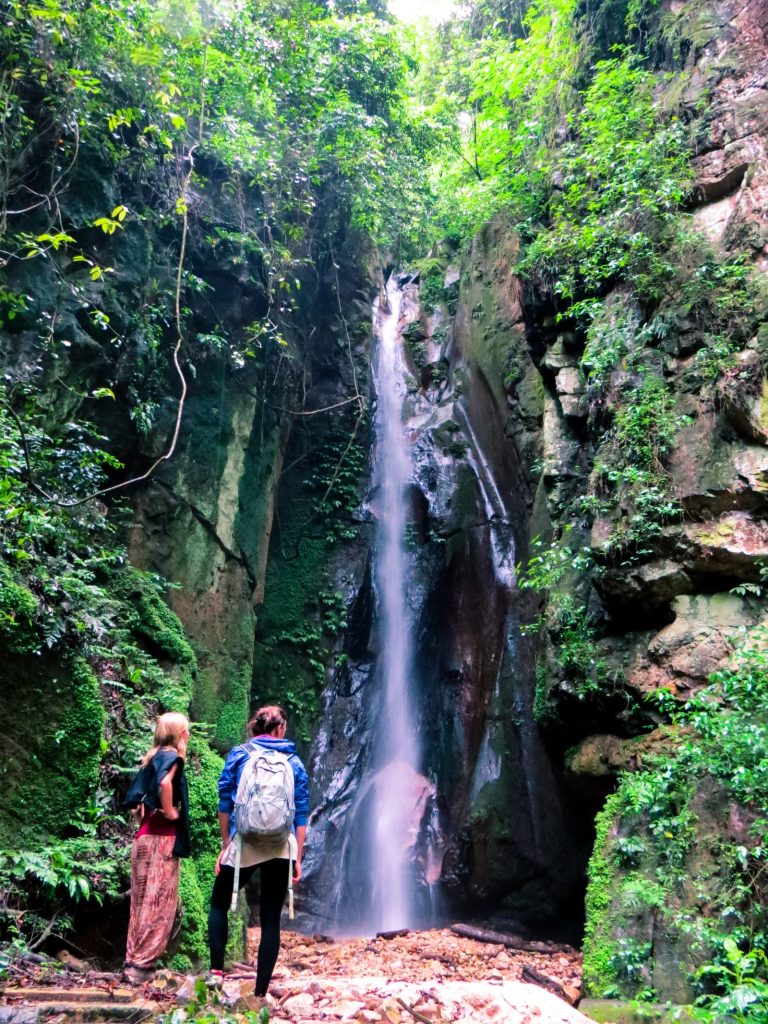
Waterfall Visits in Mahale National Park
Waterfall visits in Mahale National Park are guided walks into the stream gullies behind the camp beaches, reaching modest falls where the rock steps down, with some pools used for swimming. Walks run two to three hours and are normally included in the lakeside camp rates. Mahale Mountains National Park in western Tanzania is drained by dozens of short steep watercourses running off a range rising to roughly 2,462 metres.
These are not thundering cataracts and it would be misleading to present them as one. What they are is cold clear water in closed forest with nobody else within twenty kilometres, reached on a walk that is worth doing for its own sake.
Where the Waterfalls Are
The geography explains them. Rain arrives from the west off the lake, lands on the mountain slope and runs straight back down, producing dozens of short steep watercourses rather than a few long rivers.
Each has cut a gully into the western face. Where the underlying rock steps down, a fall forms. Where the gradient eases near the shore, the stream spreads into a small delta of sand and boulders before reaching Lake Tanganyika.
The shorter falls sit low enough in the gullies to be reached on a morning walk from camp. Higher ones are picked up on the Mount Nkungwe route, which crosses several watercourses on its way up through the vegetation belts.
None of them have names on visitor maps, which is fitting for a park with no signposted trails at all.
Ask which pools are used. Some are swum in regularly and guides will point them out. Conditions vary by valley and by season, and water levels after rain change what is sensible. Follow the camp’s guidance rather than choosing your own spot, exactly as you would for the lake.
The Walk In
Getting to a waterfall here is most of the experience, and it is the same walking as every other trail in the park.
You leave from a camp beach and are in closed-canopy forest within a hundred metres, then follow a stream gully inland, climbing gradually as the valley narrows. Two or three hours covers the round trip on the shorter routes.
Underfoot: roots, wet rock, loose leaf litter on gradient, and stream crossings that come thick and fast the further in you go. Boots with real grip matter more than anything else you bring. An armed park ranger accompanies every walking party, since buffalo range the park’s grassland and lions occupy those areas too.
The pace is yours rather than a tracker’s, which is the main difference from a chimpanzee trek and the reason these walks suit people who would rather look at things than chase them.
What You See on the Way
The valley bottoms hold the wettest, tallest forest in the park, and most of what lives here concentrates there.
Overhead you get the primates that are not chimpanzees: red colobus in noisy troops through the canopy, red-tailed monkeys with their white nose spots working the mid-storey, blue monkeys in the wetter forest. Mahale carries around nine or ten primate species in total.
At stream crossings, butterflies gather on damp sand in mud-puddling congregations that lift in clouds when a party steps through. Park material lists butterflies among Mahale’s attractions, and the gullies are where you find them.
Birds are harder work in a closed canopy, on a park list running between 337 and 398 recorded species, though stream crossings and light gaps concentrate activity where water and flowering trees line up. Guides will also point out chimpanzee sign along the way: nests overhead, chewed wadges, worked stems below arboreal ant nests.
Swimming in the Pools
The reward at the turnaround, on the routes where it is offered.
Water coming off the mountain is cold and clear, a genuine contrast with Lake Tanganyika sitting at around 25 degrees Celsius down at the beach. After two hours of humid climbing, cold water is exactly what you want.
Pools are small, ringed by forest with the canopy closed overhead. Guides will tell you which are used and which are better left alone, and that advice reflects local knowledge about depth, current and what sits upstream. Water levels change with the season, running full in the wet months and dropping considerably by late dry season.
Bring swimwear on the walk if a waterfall is on the plan, since nobody wants to walk back down in wet clothing.
Short gully walk
Two to three hours round trip from camp to a lower waterfall and back. Included in camp rates. Suits rest days and anyone not up to a chimpanzee trek.
Combined with a forest walk
A waterfall makes a natural turnaround point on a general guided walk pitched at birds, butterflies or primates.
Higher falls on the Nkungwe route
Picked up in passing on the two to three day mountain climb, which crosses several watercourses on the way up through the vegetation belts.
Wet season versus dry
Falls run full from November to February and drop through the dry months. Wetter ground makes the walk harder, and most camps close March to May.
Setting Expectations Honestly
Worth being direct, because waterfall content is prone to overselling.
These are modest falls in a park whose headline attractions are the largest protected population of eastern chimpanzees, a mountain range topping 2,400 metres and one of the oldest lakes on earth. Nobody flies to Mahale for the waterfalls, and any page suggesting otherwise is padding.
What they genuinely offer is a destination for a walk that would otherwise be an out-and-back through forest, a cold swim on a hot morning, and a stretch of gully where the primates and butterflies concentrate. That is a good morning by any standard, and it costs nothing extra.
The setting does the work. Cold water under closed canopy with a mountain above and no other visitors anywhere is not something you get in many places.
Small falls, cold water, closed forest, nobody else. The scale is modest and the solitude is not.
Who Waterfall Walks Suit
Three groups in particular.
Anyone for whom steep open-ended walking is a real problem. Chimpanzee trekking here is rated among the more strenuous primate walks in Africa and can run three to six hours each way in the wet season, whereas a waterfall walk has an agreed length and a turnaround point.
Travellers on rest days between hard trekking mornings, when another climb has no appeal but a full day on the beach is not quite enough.
And families with children below the chimpanzee trekking age minimum, cited as twelve years by Mahale camps and fifteen by several national sources. Confirm with your camp, since the ranger escort and terrain still need considering for younger walkers.
What to Wear and Carry
Lighter than for a trek, but not casual.
Boots with grip remain the priority, since wet rock at stream crossings is the same whatever the length of the walk. Long trousers and long sleeves in light quick-drying fabric protect against vegetation, stinging plants and insects. A rain shell is worth carrying in any month.
Bring swimwear if a pool is on the route, a small towel, water, insect repellent and binoculars if birds interest you. Because the distance is known in advance, you can be more generous with camera weight than on a chimpanzee trek where everything goes uphill for hours.
Best Time for Waterfall Visits
The falls and the walking pull in opposite directions, which is worth knowing.
November to February gives the fullest water, the greenest forest, the most butterflies and the best birding, with migrants present. It also gives slippery ground and harder walking, and it coincides with chimpanzees ranging higher up the mountain.
June to October gives the driest, firmest trails and the easiest going, with the falls running lower as the dry season progresses. This is also the peak window for chimpanzee sightings, so most visitors are here then anyway.
Most camps close from March to May during the long rains, when the falls run hardest and nobody is there to see them.
Getting to Mahale
Access is by air or water only, since the park has no roads. Scheduled charters run from Arusha and the northern circuit on set days in season, typically Mondays and Thursdays, often calling at Katavi, landing at an airstrip near the boundary followed by a boat transfer of around ninety minutes to the camp beaches. Our 5 day Mahale and Lake Tanganyika safari gives the lake side of the park proper time rather than an afternoon.
The alternative flies Dar es Salaam to Kigoma in roughly three hours, then continues south by light aircraft in forty five minutes or by speedboat in four to six hours. From the beach, the gullies start immediately behind you.
Waterfall Visits at Mahale: Frequently Asked Questions
Do waterfall walks cost extra?
Normally no. Guided forest walks, including routes to the lower waterfalls, are usually part of the inclusive rate at the lakeside camps, which start from around US$1,500 per person per night at the premium end. Park charges apply separately at roughly US$80 to US$95 per non-resident adult per day depending on VAT treatment and about US$35 per adult per night concession levy, though camps usually fold these in. No permit is needed beyond the standard park entry.
How big are the waterfalls at Mahale?
Modest. These are falls where the rock steps down in short steep stream gullies rather than major cataracts, and none carry names on visitor maps. The appeal is the setting, the cold water and the walk in, not the scale. Volume varies considerably with season, running full in the wet months and dropping through the dry.
Can you swim in the waterfall pools?
Some pools are used for swimming and guides will point out which. Follow that advice rather than choosing your own spot, since depth, current and conditions vary by valley and season. Bring swimwear on the walk if a pool is on the route, and a small towel.
How long is a waterfall walk?
Two to three hours round trip for the shorter routes from camp, with the length agreed before you set off. This is the main difference from a chimpanzee trek, which follows the animals and can run from forty minutes to most of a day.
Do I need a guide for a waterfall walk?
Yes, and an armed ranger. Independent walking is not permitted anywhere in Mahale, since buffalo, lions and elephant occur in the park and trails outside the main lines are faint. Camps arrange both as part of any walk.
Are waterfall walks suitable for children?
Often, and they are a useful alternative for children below the chimpanzee trekking age minimum, cited as twelve years by Mahale camps and fifteen by several national sources. Confirm with your camp, since the terrain and the ranger escort still need considering for younger walkers.
When are the waterfalls at their best?
November to February, when the streams run fullest, though ground is slippery and walking is harder. June to October gives easier trails with lower water. Most camps close from March to May during the long rains, which is when the falls are at their strongest and the park is closed to most visitors.
Booking Your Mahale Trip
The safari companies and tour operators listed on this website put trips like this together for a living and know which camps, guides and routes actually deliver. We are an independent guide to Mahale; we do not book or sell tours ourselves.
When you are ready, arrange your safari, tour or holiday with one of the recognised operators listed here. Tell them your dates and what matters most, and a real person, not a form, will handle the itinerary, park bookings and logistics for you.