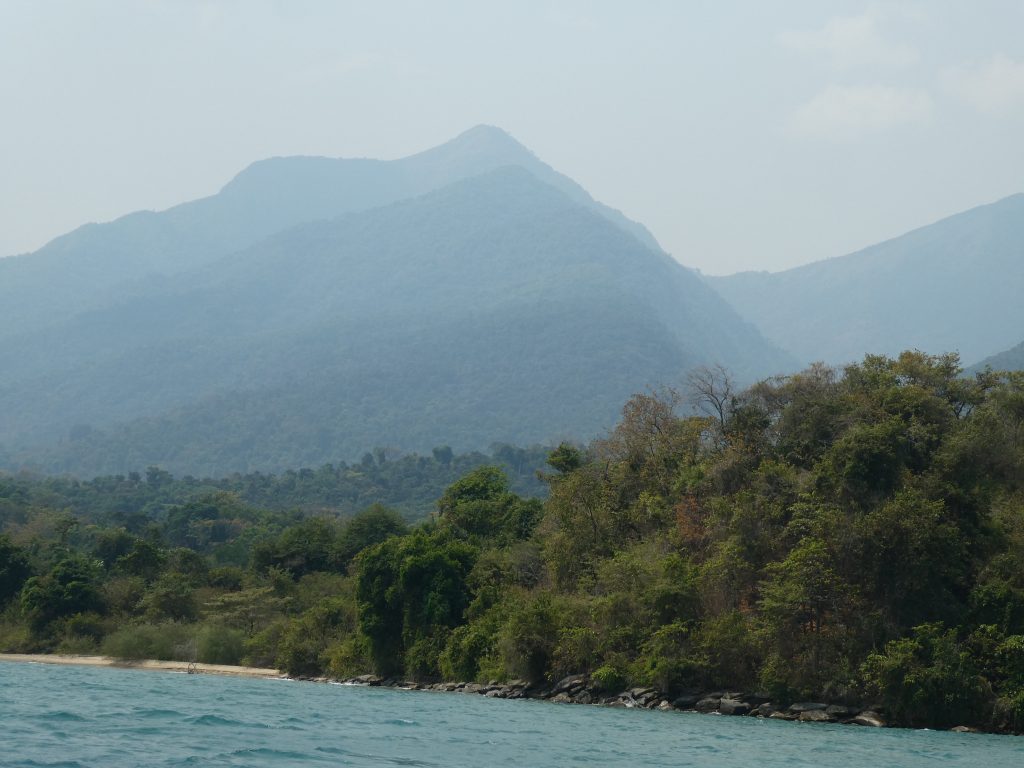
Where Are the Best Hiking Routes in Mahale?
The best hiking routes in Mahale are the Mount Nkungwe climb to roughly 2,462 metres, the chimpanzee trekking trails on the western slopes around Kansyana, the shorter stream valley walks from the camp beaches, and waterfall routes in the gullies. Every route on a Mahale hiking safari is walked with a guide and an armed ranger. Mahale Mountains National Park in western Tanzania has no roads at all, so hiking is the only way to move inland.
What the park does not have is a marked trail network with signposts and numbered routes. It has research paths, patrol lines and one recognised mountain climb, and guides choose between them according to the day.
The Mount Nkungwe Trek: The Park’s Main Hiking Route
This is the one route in Mahale with a genuine identity, and the only multi-day hike available.
The climb starts near Kansyana or park headquarters and takes two to three days, with one or two nights camping on the mountain and an armed park ranger required throughout. Elevation gain from the lakeshore runs close to 1,700 metres, since the lake sits at about 770 metres and the summit at roughly 2,462.
The route passes through the full sequence of the park’s vegetation belts: lowland forest at the bottom, montane forest through the long middle section, alpine bamboo on the upper slopes where the trail narrows and the ground holds water, then open montane grassland above about 2,300 metres. Guides describe cutting a line through high grass on the final pull to the ridge.
From the top the view runs west across the full width of Lake Tanganyika to the Congolese highlands on clear days, and east into the drier miombo country beyond the ridge. Nkungwe is sacred to the Tongwe people who lived in these mountains before the park was gazetted in 1985.
Book the Nkungwe climb in advance. Rangers have to be assigned, porters organised, and tents and food packed. A week of notice makes this straightforward; mentioning it over dinner the night before does not. Camps supply the logistics but they are not a standing offer.
Chimpanzee Trekking Trails on the Western Slopes
Most hiking in Mahale happens on the research trail network radiating from Kansyana, where the chimpanzee study has run since 1965.
Six decades of daily following cut a lot of paths, and they exist where the animals go rather than where a route planner would put them, which is why they climb so directly. There is no fixed route on a given morning. Trackers start at the nests the M group built the previous evening, work forward until they have contact, and radio back, and only then does anyone know where you are walking.
Distance varies enormously with the season. From June to October the group ranges on the lower slopes near the lakeshore and treks can be forty minutes to two hours. In the wetter months they climb after higher fruiting trees and treks run three to six hours each way. Guides carry machetes because the line often has to be cut.
Stream Valley Walks From the Camp Beaches
The gentlest option, and the one that suits anyone not up to open-ended pursuit.
Trails run inland from the camp beaches along the stream gullies that cut the western face, climbing gradually as the valleys narrow. Two or three hours covers a lot of habitat, and these walks are included in the rate at the lakeside camps.
They go slower than chimpanzee treks and see different things: butterflies mud-puddling on damp sand at stream crossings, forest birds, tool marks on arboreal ant nests, the bitter plant chimps chew when carrying parasites. Red colobus, red-tailed monkeys, blue monkeys and baboons are all regular here.
These are the routes to ask for if steep ground or heat is a genuine problem for you. Tell your camp honestly and they will pitch the walk accordingly.
Waterfall Routes in the Gullies
Waterfalls sit in several of the stream gullies where the underlying rock steps down, and the shorter ones are reachable on a morning walk from camp.
None are large. What makes them worth walking to is the setting: cold clear water off the mountain into a pool ringed by closed forest, with nobody else within twenty kilometres. Some pools are used for swimming and guides will tell you which; follow that advice rather than choosing your own.
Higher falls on longer routes tend to be picked up on the Nkungwe climb, which crosses several watercourses on the way up through the vegetation belts.
Stream valley walk, two to three hours
From camp inland and back. Included in camp rates. Gentle by Mahale standards, good for birds, butterflies and other primates, with a waterfall pool at the turnaround on some routes.
Chimpanzee trek, one hour to a full day
Follows the M group wherever they are. Steep, humid, often on cut lines rather than paths. Rated among the more strenuous primate walks in Africa. One trek per day is standard.
Nkungwe climb, two to three days
Close to 1,700 metres of ascent through every vegetation belt to grassland above 2,300 metres. Camping, rangers and porters. The park’s only multi-day route.
Boat-assisted trailheads
Not a route so much as a technique. Guides run guests along the shoreline to a landing point closer to the action, then walk inland, which widens the trail network considerably.
Boat Access as Part of the Trail Network
Because the park’s western edge is water, the shoreline works as a road nobody had to build.
When the chimpanzees range away from the camps, guides run guests along the coast by boat and start the walk from a different beach entirely. This saves an hour of hot going before the forest even begins, and it means the practical hiking network is far wider than what you could reach on foot from a single point.
Boats also handle the return on long days, which matters after four hours of climbing. Ask how the day is planned before setting off, since knowing whether you walk back or ride back changes how you pace yourself.
There is no trail map to study before you arrive. There is a forest, a network of research paths through it, and guides who decide each morning where you are going.
How Hard the Routes Are
Fitness decides everything here, since no route involves technical climbing, exposure or altitude risk.
What there is: sustained gradient, heat, humidity and poor footing. Trails carry roots, wet rock, loose leaf litter on slope and frequent stream crossings. Descents cause more trouble than climbs, and the way down from a long trek is on the same ground you struggled up.
A short dry season chimpanzee trek compares to a hard hill walk. A long green season one is several hours of continuous climbing in humid air and is genuinely tough. The Nkungwe climb sits a clear step above both.
Boots with real grip, broken in beforehand, prevent most problems. A walking pole helps on descents. Carry more water than you expect to need, since camps pack it but capacity is yours to check.
Rules and Guides on Every Route
Nobody walks alone in Mahale, and this is not negotiable.
An armed park ranger accompanies every walking party, because buffalo range in the park’s grassland, lions occupy those areas too and were documented preying on chimpanzees here in 1989, and elephant occur in the wider ecosystem. Groups move at one pace with the ranger in position.
On chimpanzee treks in particular, groups are capped at six visitors, viewing at one hour, and surgical face masks are required near the animals. Anyone with a cold, cough or stomach upset is asked to stand down. Keep seven to ten metres, stay still if an animal passes close, no flash, no eating nearby, no prolonged eye contact with adult males. An age minimum applies, cited by Mahale camps as twelve years and by several national sources as fifteen.
Best Season for Hiking in Mahale
June to October is the window for every route. Trails firm up, streams drop, undergrowth thins and the camps that organise rangers and porters are open. Operators quote roughly May to October for the Nkungwe climb, with June to September best for summit visibility, since cloud sits on the top outside the driest months.
The shorter drier spell from December to February also works for walking, with fewer visitors around. October runs hot before the rains break, which makes the lower forest sections heavy going even on dry ground.
From March into May the long rains close most camps in the park and the scheduled flights stop with them, which puts the whole trail network out of reach for practical purposes.
Getting to Mahale for a Hiking Trip
Access is by air or water only. Scheduled charters run from Arusha and the northern circuit on set days in season, typically Mondays and Thursdays, often calling at Katavi, landing at an airstrip near the boundary followed by a boat transfer of around ninety minutes to the camp beaches. For forest and open plains in one trip, see our 7 day Mahale and Serengeti safari.
The alternative flies Dar es Salaam to Kigoma in roughly three hours, then continues south by light aircraft in forty five minutes or by speedboat in four to six hours. Allow five or six nights if you want the Nkungwe climb alongside chimpanzee trekking, and three nights minimum for the trekking alone.
Hiking in Mahale: Frequently Asked Questions
What does hiking in Mahale cost?
Guided forest walks and one chimpanzee trek per day are normally included in camp rates, which start from around US$1,500 per person per night at the premium end. Park charges add roughly US$80 to US$95 per non-resident adult per day depending on VAT treatment and about US$35 per adult per night concession levy, with the chimpanzee trekking permit at around US$150 per person. The Mount Nkungwe climb is an extra, quoted case by case since rangers, porters, tents and food all need arranging, so ask for a written figure.
Are there marked hiking trails in Mahale?
Not in the way a hiking park has them. There is a network of research and patrol paths, largely centred on the Kansyana area and the western slopes, plus the recognised Mount Nkungwe route. Chimpanzee treks follow the animals rather than a fixed line, and guides often cut through undergrowth to reach them.
Can you hike in Mahale without a guide?
No. An armed park ranger is required on every walking party, because buffalo, lions and elephant all occur in the park, and trails outside the main routes are faint. Independent walking is not permitted and no camp will arrange it.
How long does the Mount Nkungwe hike take?
Two to three days, with one or two nights camping on the mountain. Most itineraries climb to a base camp on day one, summit early on day two and descend that afternoon or the following morning. Compressing it into a single day is not realistic given close to 1,700 metres of ascent from the lakeshore.
Which route suits someone who cannot manage a hard trek?
The stream valley walks from the camp beaches, which run two to three hours at a gentler pace over less ground and can be matched to what you are comfortable with. They still produce red colobus, guenons, baboons, forest birds and butterflies. Chimpanzee treks are open-ended and can turn into hours of steep climbing without warning.
How fit do I need to be for Mahale’s hiking?
Fitter than for most primate destinations. There is no technical climbing or altitude risk, but slopes are steep and humid, footing is poor and treks are open-ended. If several hours of uphill walking in heat is within your normal range you will manage. Steadiness on steep descents matters as much as uphill fitness.
When is the best time for hiking in Mahale?
June to October, with June to September best for clear summit views on the Nkungwe route. December to February also works between the rains. Avoid March to May, when the long rains close most camps and the scheduled flights stop, which removes the logistics for any organised hike.
Booking Your Mahale Trip
The safari companies and tour operators listed on this website put trips like this together for a living and know which camps, guides and routes actually deliver. We are an independent guide to Mahale; we do not book or sell tours ourselves.
When you are ready, arrange your safari, tour or holiday with one of the recognised operators listed here. Tell them your dates and what matters most, and a real person, not a form, will handle the itinerary, park bookings and logistics for you.