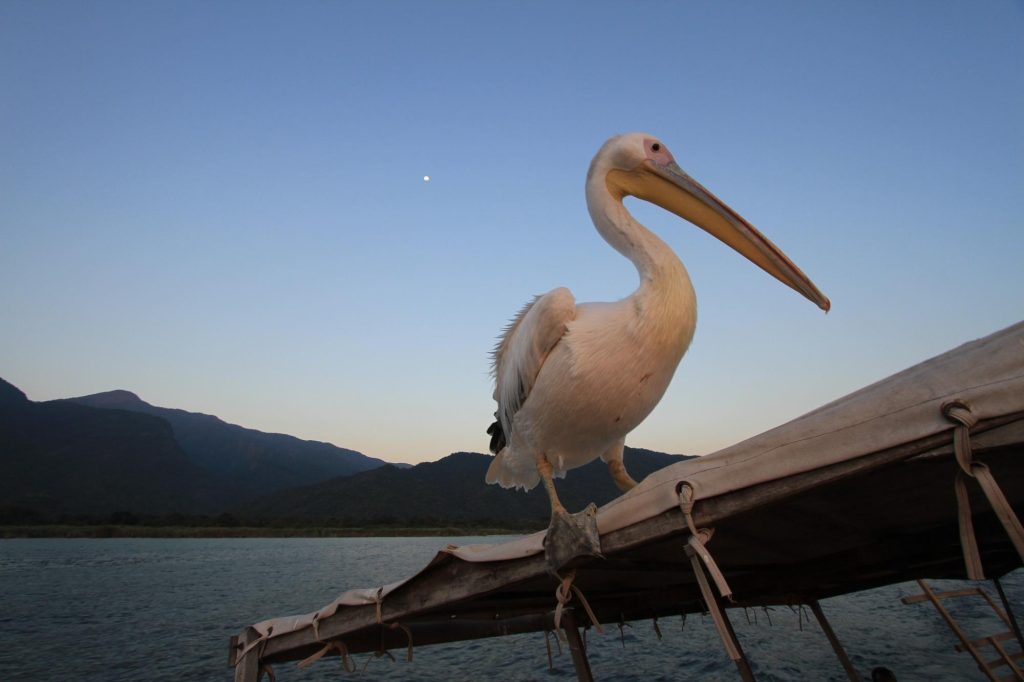
What Birds Can Be Seen in Mahale?
Mahale’s bird list runs to somewhere between 337 and 398 recorded species, headed by African fish eagle, palm-nut vulture, giant kingfisher, crested guineafowl and Ross’s turaco, with forest species making up the bulk and being far harder to spot. Birdwatching safaris run alongside chimpanzee trekking from the lakeside camps. Mahale Mountains National Park in western Tanzania spans lakeshore, rainforest, montane forest, bamboo and grassland, which is why the list is as long as it is.
Most visitors come for the chimpanzees and leave surprised by the birds. The forest species are difficult, the shoreline species are easy, and the mix between them is what makes a slow morning here worthwhile.
How Many Bird Species Live in Mahale
Figures vary, and the range tells you something useful about how little surveying this park has had.
Tanzania National Parks cites at least 337 species. Most operators quote over 350. One specialist source puts the recorded total at 398 and expects the complete checklist to top 400 once the work is done, noting that current records may represent only around 80 percent of what is actually present.
That gap exists because the park is remote, roadless and thickly forested. Birders reach it in small numbers, and much of the interior has never been properly worked. For anyone who enjoys the idea of a list that is still being written, this is unusual in East Africa.
Bring binoculars, and good ones. Mahale’s forest birds sit high in a closed canopy in poor light, and the difference between a silhouette and a Ross’s turaco is entirely optical. Camps do not supply them, and the shoreline species are the only ones you will identify comfortably without.
Lakeshore Birds Along Tanganyika
The easiest birding in the park happens without a walk. The shoreline in front of the camps produces a steady cast of large, obvious species.
African fish eagle is the constant, common along the whole lakeshore and heard far more often than most birds are seen. Palm-nut vulture is also common here, feeding on oil palm fruit and scavenging along the water’s edge, which makes it one of the more approachable raptors anywhere. Giant kingfisher works branches over the water and dives into the clear shallows, and other kingfisher species are present too.
Where the streams come down and meet the lake, herons, waders and smaller kingfishers concentrate. Blue-cheeked bee-eaters are recorded, and boat safaris along the shore in the late afternoon are the most productive way to work this habitat.
Forest Birds of the Valley and Montane Zones
Inland is where the numbers are and where the effort is.
Forest species dominate the Mahale list and are, by every account, hard to spot. The canopy is closed, the light is poor and birds are heard long before they are seen. Ross’s turaco is the flagship, flashing green, blue and red as it moves between trees with a loud carrying call. Livingstone’s turaco and Hartlaub’s turaco are also on the list, and turacos reward patience more than pursuit.
Trumpeter hornbill works the canopy with its distinctive wailing call. Crested malimbe and Vieillot’s black weaver occupy the mid-storey, the latter common. Scaly francolin and western crested guineafowl move through the forest floor in parties, the guineafowl dark and speckled with white, and it is one of the more conspicuous forest birds even though it lives on the ground.
Crowned eagle is the forest raptor to look for, a serious predator of monkeys, and bamboo warbler occupies exactly the habitat its name suggests on the upper slopes.
African fish eagle
Common along the lakeshore, calling constantly from waterside trees. The soundtrack to every afternoon on the beach.
Palm-nut vulture
Common near the lake, feeding on oil palm fruit as well as scavenging. Unusual among vultures for how much of its diet is vegetable.
Ross’s turaco
The forest flagship, glossy violet with crimson wing flashes, calling loudly from the canopy. Recorded as occasional rather than guaranteed.
Western crested guineafowl
Ground-dwelling parties moving through the forest floor, dark plumage flecked with white. Among the more conspicuous forest species.
Giant kingfisher
Perched over the lake and the stream mouths, dropping into clear water. Occasional rather than constant, but hard to miss when present.
Pel’s fishing owl
The name that draws birders west. Large, ginger and nocturnal, hunting fish along wooded watercourses. A genuine prize and never a certainty.
The Kabezi Area and Where to Bird
If you want to be deliberate about it, the northern sector of the park around Kabezi is repeatedly cited as the best birding ground in Mahale.
For most visitors, though, birding happens around the trekking rather than instead of it. The trails inland from the camp beaches pass through the productive lower forest, and a slow guided walk along a stream valley produces far more than a fast one on a ridge. Stream crossings and light gaps concentrate activity, since water, edge habitat and flowering trees line up in the same narrow band.
Higher up, the montane forest and bamboo hold different species again, which is one more argument for the Mount Nkungwe trek if you have the days for it. The park’s high ground also includes six further peaks above 2,000 metres alongside Nkungwe itself.
Albertine Rift Species and What Makes the List Special
Mahale’s location on the eastern side of Lake Tanganyika puts it at a meeting point between faunal regions, and the bird list reflects that as much as the mammal list does.
Park material notes that many of the recorded species are rare, with Albertine Rift affinities, and Pel’s fishing owl appears repeatedly as the headline. The mixture of forest species with Congo basin connections alongside more widespread East African birds is what gives the list its character.
The honest caveat is that Mahale is not a specialist birding destination in the way Nyungwe or Bwindi are marketed. It is a chimpanzee park with a long and under-recorded bird list, visited mostly by people who came for something else. That is either a drawback or the appeal, depending on your temperament.
Nearly four hundred species recorded and a checklist still incomplete. Very few East African parks can still say that.
Best Time for Birdwatching Safaris in Mahale
Birding runs opposite to the chimpanzee calendar, which is worth knowing before you pick dates.
November to April is the best period, when migratory birds are present alongside residents in breeding plumage. Birdlife is plentiful year round, but this window adds the migrants and the calling activity that makes forest species findable at all.
The complication is that the chimpanzees range high in those same months, treks lengthen and the ground turns slippery, while most camps close entirely from March to May during the long rains. That leaves November, December, January and February as the practical birding window inside the open season.
Dry season birding from June to October is still productive, with easier walking, thinner foliage and better light, concentrated around the shoreline and remaining water sources. You lose the migrants and gain comfort.
Birding Alongside Chimpanzee Trekking
In practice most people do both, and the two activities fit together imperfectly.
Chimpanzee treks move at the pace of the trackers, not the birder, and stopping to work a canopy flock is not usually an option when the group is on the move. What works better is booking shorter guided forest walks on non-trekking mornings, where the pace is yours and the guide can be told what you are after.
Afternoons on a boat safari cover the shoreline species comfortably. And a great deal turns up from a chair on the beach, since fish eagles, palm-nut vultures and kingfishers all work the water directly in front of the camps.
Tell your camp in advance if birding matters to you. Guides here know the forest well and will pitch a walk differently if they know that is the point.
Butterflies and Other Small Life
Worth mentioning alongside the birds, since they occupy the same slow walk.
Mahale carries butterflies in real numbers, and park material lists them among the park’s attractions. Damp sand at stream crossings draws mud-puddling congregations that lift in clouds when a walking party steps through, and the light gaps along watercourses hold constant traffic through the day.
For anyone who enjoys the smaller end of natural history, an unhurried morning along a Mahale stream delivers more than the headline species suggest.
Getting to Mahale for a Birding Trip
Access is by air or water only, since the park has no roads. Scheduled charters run from Arusha and the northern circuit on set days in season, typically Mondays and Thursdays, often calling at Katavi, landing at an airstrip near the boundary followed by a boat transfer of around ninety minutes.
The alternative flies Dar es Salaam to Kigoma in roughly three hours, then continues south by light aircraft in forty five minutes or by speedboat in four to six hours. Birders travelling in the November to February window should note that charter frequency drops to roughly twice weekly from October onwards. Our 9 day Mahale, Serengeti and Crater safari pairs the chimpanzees with the classic northern circuit.
Birds of Mahale: Frequently Asked Questions
What does a birding trip to Mahale cost?
Guided forest walks and boat safaris are normally included in the fully inclusive camp rates, which start from around US$1,500 per person per night at the premium end. Park charges add roughly US$80 to US$95 per non-resident adult per day depending on VAT treatment and about US$35 per adult per night concession levy. The chimpanzee trekking permit of around US$150 per person applies only to chimp treks, not to birdwatching. East African citizens pay considerably lower park fees.
How many bird species have been recorded in Mahale?
Sources give between 337 and 398, with most operators quoting over 350. One specialist source expects the complete checklist to top 400, noting that current records may cover only around 80 percent of the species actually present. The park is remote and under-surveyed, which is why the figures differ so widely.
When is the best time for birdwatching in Mahale?
November to April, when migratory species are present and residents are in breeding plumage. Since most camps close from March to May during the long rains, the practical window is November through February. Dry season birding from June to October is still productive with easier walking and better light, but without the migrants.
Where in the park is the best birding?
The northern sector around the Kabezi area is repeatedly cited as the strongest ground. For most visitors, the productive spots are the stream valleys inland from the camp beaches, where water, edge habitat and flowering trees concentrate activity, and the shoreline itself for fish eagles, palm-nut vultures and kingfishers.
Can you see Pel’s fishing owl at Mahale?
It is on the park list and appears in official material as one of the rarer species present, but it is nocturnal, thinly distributed and hunts along wooded watercourses, so a sighting is a genuine piece of luck rather than something to plan around. Tell your guide it is a target and they will know where to try.
Is Mahale a good destination for serious birders?
It is an under-recorded park with a long list and very few observers, which appeals to some birders enormously. It is not set up as a specialist birding destination the way Nyungwe or Bwindi are, guiding is oriented towards chimpanzees, and forest species here are genuinely hard to see. Book extra non-trekking mornings and tell the camp what you want.
Do I need a specialist bird guide?
The camps’ guides know the forest and the common species well and can pitch a walk towards birds if told in advance. There is no dedicated bird guiding operation inside the park, so bring your own field guide and binoculars, and expect to do some of the identification yourself.
Booking Your Mahale Trip
The safari companies and tour operators listed on this website put trips like this together for a living and know which camps, guides and routes actually deliver. We are an independent guide to Mahale; we do not book or sell tours ourselves.
When you are ready, arrange your safari, tour or holiday with one of the recognised operators listed here. Tell them your dates and what matters most, and a real person, not a form, will handle the itinerary, park bookings and logistics for you.