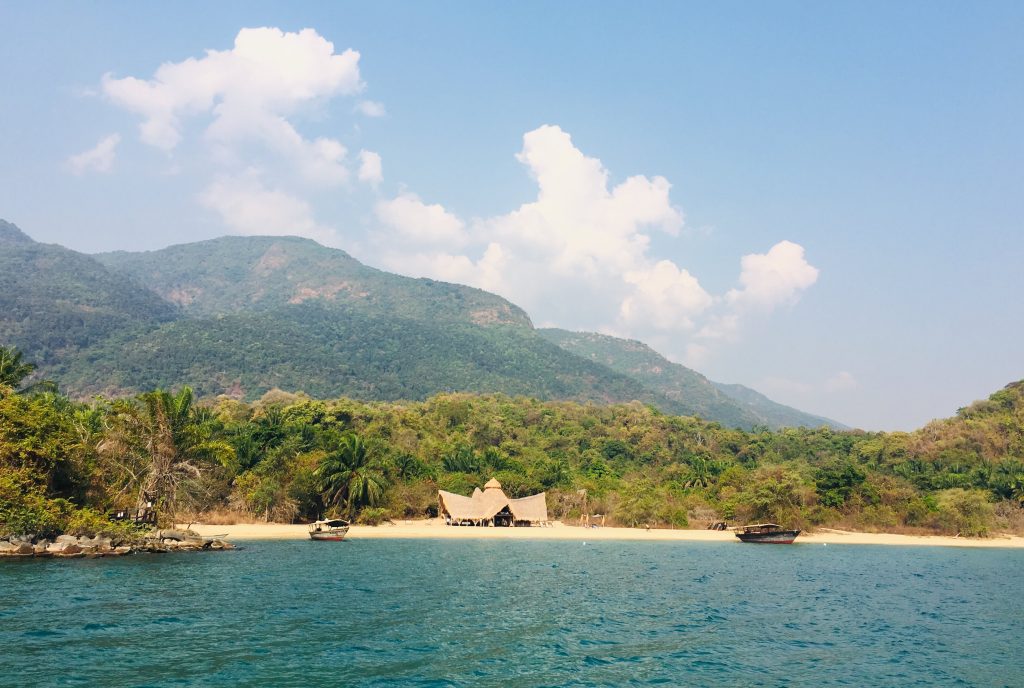
What Are the Main Habitats in Mahale?
Mahale’s main habitats are lowland and riverine rainforest along the lakeshore, montane forest on the middle slopes, alpine bamboo higher up, montane grassland above roughly 2,300 metres, miombo woodland on the drier eastern flank, and the waters of Lake Tanganyika itself. Visitors pass through several of these on a single Mahale trekking safari. Mahale Mountains National Park in western Tanzania stacks all of them across less than 1,700 metres of vertical distance.
Tanzania National Parks describes the park as a mosaic of overlapping habitat types, and that overlap is the reason a place of roughly 1,600 square kilometres carries the species list it does.
Lowland and Riverine Rainforest Along the Lakeshore
From the beaches inland, the first habitat you enter is tall closed-canopy forest running up the valleys where streams come down off the mountain.
This is the wettest and most productive part of the park. Deep soil in the gullies supports figs, mahogany, silk trees and a dense understorey that keeps the light green and the air still. Fruiting cycles here set the calendar for a great deal of the wildlife, and it is where the M group chimpanzees spend the dry months from June to October.
Walking it is hot rather than steep, at least at first. Guides on a guided forest walk stop for the small material along the streams: butterflies mud-puddling on damp sand, tool marks on arboreal ant nests, and the bitter plant chimps chew when they are carrying parasites.
Why the habitats matter to your trek: chimpanzees follow fruit, and fruit moves between these bands with the rains. Which habitat you walk in on a given morning is decided by the season, not by your guide. Dry months mean lowland forest; wet months mean climbing into the montane band.
Montane Forest on the Middle Slopes
Climb a few hundred metres and the character changes. Montane forest is cooler, mossier and thinner in the canopy, with more light reaching the ground and better views back down to the water.
This is where the Angolan black and white colobus live, occurring in Mahale as a race recognised in the literature as found nowhere else. Mist sits in this band frequently, particularly in the wetter months, and the ground stays damp for longer than it does below.
Trekking parties reach this zone regularly during the green season, when the chimpanzees have climbed after higher fruiting trees. It is also the long middle section of the Mount Nkungwe route, and the part of that climb where most people find their rhythm.
Alpine Bamboo on the Upper Slopes
Higher again, bamboo takes over in dense stands, and it is a habitat that photographs beautifully and walks badly.
Trails narrow, the ground underneath holds water, and progress slows considerably. Guides describe cutting through it on the way to the summit. There is a small population of black and white colobus through this band as well, heard more often than seen.
Visitors only meet this habitat on the Mount Nkungwe trek, since chimpanzee trekking rarely goes this high. It sits between the montane forest and the open ground above.
Montane Grassland Above the Treeline
At around 2,300 metres the forest stops fairly abruptly and open grassland with scattered scrub takes over, running to the summit of Mount Nkungwe at roughly 2,462 metres.
Wind and sun replace canopy shade, nights turn genuinely cold, and this is where the views open west across the full width of Lake Tanganyika to the Congolese highlands on clear days. Guides describe the final stretch as pushing a line through high grass rather than following a trail.
It is not chimpanzee habitat in any regular sense. Buffalo use the grassland areas of the park, which is one of the reasons an armed ranger accompanies the climb.
Lowland and riverine forest
Lakeshore to a few hundred metres. Tall closed canopy, streams, figs. Dry season chimpanzee ground and the easiest walking in the park.
Montane forest
The long middle band. Cooler, mossier, misty. Home to the black and white colobus race found only here.
Alpine bamboo
Dense stands on the upper slopes. Slow going and wet underfoot. Crossed on the Nkungwe climb rather than on chimpanzee treks.
Montane grassland
Above roughly 2,300 metres. Open, windy, cold at night, and the source of the summit panorama west across the lake.
Miombo woodland
The drier eastern flank beyond the ridge. Roan and sable antelope, buffalo, and the grassland where lions range. Rarely visited.
Lake Tanganyika
The park’s western boundary and an aquatic habitat in its own right, holding over 250 cichlid species with roughly 98 percent found nowhere else.
Miombo Woodland on the Eastern Flank
Cross the ridge and the park changes completely. Rain arriving off the lake lands on the western face, so the eastern side sits in a rain shadow and turns to miombo woodland and open grassland.
This is savanna country in a park most people think of as rainforest. Roan and sable antelope live here, along with buffalo, and the park’s lions occupy the grassland rather than the forest slopes. It is the habitat that makes Mahale unusual among chimpanzee sites, since researchers documented lion predation on chimpanzees here in 1989.
Visitors rarely see this side. The camps, trails and trekking routes all sit on the western shoreline, so the eastern flank is part of what makes the park biologically interesting rather than part of what you will walk in three nights.
Lake Tanganyika as a Habitat
The park’s western boundary is the lake, and it may be the richest habitat of the lot.
Lake Tanganyika is between nine and thirteen million years old, drops to 1,470 metres and holds more than 250 described cichlid species of which roughly 98 percent live nowhere else, plus around 75 non-cichlid species with a high rate of endemism. Rocky shallows near the beaches hold the small colourful species snorkellers see; sardines and predatory Lates dominate the open water offshore.
Where the streams meet the lake, the two systems interact. Freshwater outflow changes the fish community immediately offshore, otters use some of the rocky outlets, fish eagles hunt the shallows and hippos hold at a few river mouths.
Rainforest, montane forest, bamboo, grassland, miombo and a nine million year old lake, all inside one boundary and one day’s walk of each other.
Why This Mosaic Produces Such an Odd Species List
Mahale sits at a meeting point between two faunal worlds, and the habitat mixture is what allows both to coexist.
The researcher Hiroshi Ihobe described the park’s fauna as including both savanna-adapted species of eastern and southern Africa and forest-adapted species of western and central Africa and the Congo basin. That is why roan antelope and red colobus occur inside the same protected area, and why chimpanzees and savanna elephants are found together here in a way conservation organisations describe as unique.
The numbers follow. Frankfurt Zoological Society counts ten primate species in the park. Tanzania National Parks records at least 337 bird species, including Albertine Rift specials and rare species such as Pel’s fishing owl. The Greater Mahale Ecosystem around the park forms part of the Eastern Afromontane biodiversity hotspot.
How the Habitats Change Through the Year
Rainfall moves the productive zone up and down the mountain, and everything responds.
During the dry months from June to October, fruiting concentrates in the lower forest near the lake and the chimpanzees come down to it. Undergrowth thins, trails firm up and forest visibility improves. From November onwards, higher trees fruit, the group climbs into the montane band and the understorey thickens again, which is why wet season treks run so much longer.
The grassland above the treeline is at its clearest in the dry season, when summit views open up. Cloud sits on it frequently the rest of the year. The lake is calmest and clearest from June to October, with underwater visibility reaching around twenty metres, and lake levels rise during the long rains, shifting the shoreline itself.
Where to Walk to See Each Habitat
Most visitors experience three of the six, and that is a full trip.
Chimpanzee treks cover lowland and montane forest depending on the season. Shorter guided forest walks from camp stay in the lower valleys and produce red colobus, guenons, birds and butterflies without the pursuit. Boat safaris along the shoreline give you the lake and the forest edge in one afternoon, and snorkelling covers the aquatic habitat directly.
Only the Nkungwe climb takes you through the bamboo and out onto the grassland, which is one of the better reasons to add the two or three days it requires. Nobody routinely visits the miombo on the eastern flank.
Best Time and Getting to Mahale
June to October is the dry season and the main window, with August through October strongest for chimpanzee sightings. Most camps close from March to May during the long rains and the scheduled flights stop with them. For forest and open plains in one trip, see our 7 day Mahale and Serengeti safari.
Access is by air or water only, since the park has no roads. Scheduled charters run from Arusha on set days in season, typically Mondays and Thursdays, often via Katavi, landing near the boundary with a boat transfer of around ninety minutes. The alternative flies Dar es Salaam to Kigoma in roughly three hours, then continues south by light aircraft in forty five minutes or by speedboat in four to six hours.
Mahale’s Habitats: Frequently Asked Questions
What does it cost to visit Mahale’s forests?
Non-resident adults pay a park conservation fee of roughly US$80 to US$95 per person per day depending on whether VAT is included, plus an overnight concession levy of about US$35 per adult per night, and around US$150 per person for the chimpanzee trekking permit. Lakeside camps are fully inclusive from around US$1,500 per person per night and usually fold the park charges in, along with guided forest walks, kayaking, snorkelling and a boat safari. East African citizens pay considerably less on park fees.
How many habitat types does Mahale have?
Six main ones: lowland and riverine rainforest, montane forest, alpine bamboo, montane grassland, miombo woodland and the lake itself. Tanzania National Parks describes the park as a mosaic of overlapping types, which is unusual for an area of this size and is the reason its species diversity is so high.
Which habitat do the chimpanzees live in?
Lowland and montane forest on the western slopes, moving between the two with the seasons. They range low near the lakeshore from June to October when fruiting concentrates there, and climb into the montane band during the wetter months. They do not use the bamboo, the grassland above the treeline or the miombo on the eastern flank.
Why is one side of the park forest and the other savanna?
Rainfall. Weather arrives from the west across the lake and drops its moisture on the western slopes, leaving the eastern flank beyond the ridge in a rain shadow. Dense rainforest grows on the wet side; miombo woodland and grassland on the dry side. Standing on the ridge and turning around is the clearest illustration of it.
Can you visit the miombo woodland side of the park?
Not on a normal itinerary. All the camps, trails and trekking routes sit on the western shoreline, and there is no visitor infrastructure on the eastern flank. Travellers who want miombo and savanna species usually add Katavi National Park, which sits on the same flight rotation. All of this is set against the Mahale mountain range that gives the park its name.
What lives in the montane grassland?
Little that visitors see. Buffalo use the park’s grassland areas and lions range there, which is part of why an armed ranger accompanies the Nkungwe climb. The habitat’s main draw for travellers is the view west across Lake Tanganyika from above the treeline at around 2,300 metres and up.
Is Lake Tanganyika part of the park?
The lake forms the park’s western boundary and functions as its access route, since there are no roads. Whether the water surface counts inside the gazetted area is part of why published figures for the park’s size vary between about 1,589 and 1,650 square kilometres. Either way, snorkelling off the beaches is part of a standard Mahale stay.
Booking Your Mahale Trip
The safari companies and tour operators listed on this website put trips like this together for a living and know which camps, guides and routes actually deliver. We are an independent guide to Mahale; we do not book or sell tours ourselves.
When you are ready, arrange your safari, tour or holiday with one of the recognised operators listed here. Tell them your dates and what matters most, and a real person, not a form, will handle the itinerary, park bookings and logistics for you.