What Makes Lake Tanganyika Special?
Lake Tanganyika is special because it is the world’s longest freshwater lake, the second deepest at 1,470 metres, somewhere between nine and thirteen million years old, and home to more than 250 cichlid species of which roughly 98 percent live nowhere else. Visitors reach it on Lake Tanganyika boat safaris and snorkelling trips from Mahale Mountains National Park in western Tanzania. The lake holds around a sixth of the planet’s available surface fresh water and borders four countries.
Superlatives pile up quickly here, and they are not decorative. Each one connects to the others: the age produced the endemism, the depth produced the age, and the rift produced the depth.
The Oldest and Deepest of Africa’s Great Lakes
Tanganyika sits in the western branch of the East African Rift, formed by the tectonic pulling apart that opened the Rift Valley. Estimates of its age run between nine and thirteen million years, making it considerably older than Lake Malawi to the southeast and one of the oldest lakes on earth.
Depth follows from the geology. The floor lies 1,470 metres below the surface at its deepest, second only to Baikal in Siberia, and the lake ranks second in the world by freshwater volume. It stretches roughly 673 kilometres north to south and reaches about 50 kilometres at its widest.
Age plus depth plus stability is the combination that matters biologically. This is a body of water that has never dried out, never frozen and never fully mixed, giving species millions of uninterrupted years to specialise.
A useful frame for the scale: Tanganyika holds something in the region of 16 to 17 percent of the world’s available surface fresh water. Standing on a beach at Mahale, you are looking at a meaningful fraction of the planet’s accessible drinking water, and at a shoreline where people have been fishing it for generations.
The Cichlids and Why Biologists Care
The lake’s headline biological fact is its fish. More than 250 described cichlid species live here, and roughly 98 percent of them exist nowhere else on the planet. Add around 75 non-cichlid species, of which approximately 60 percent are also endemic, and the total count of animal and plant species runs past 2,000 with several hundred found only in this lake.
What draws biologists is not just the number but the variation. Tanganyikan cichlids differ enormously in body shape, feeding strategy and behaviour in a way that exceeds what is normally found within a single fish family. Some graze algae off rocks. Some sift sand. Some live their entire lives inside empty snail shells. At least one specialises in eating the scales and fins of other fish.
The lake functions as a reference case in the study of speciation, in much the same way the Galapagos finches do, and researchers have used it that way for decades.
Snorkelling and the Fish You Actually See
All of that is visible with a mask, straight off the beaches at Mahale, which is the part travellers care about.
Water temperature holds near 25 degrees Celsius year round and dry season visibility over the rocky shallows can reach around twenty metres. Most of the interest sits in the first few metres of water over rock, so you do not need to be a strong swimmer or to go out of your depth. Camps supply masks and fins as part of the rate.
Shell dwellers
Tiny cichlids living in and around beds of empty snail shells, sometimes in colonies of thousands, with young moving freely between shells. The smallest reach barely five centimetres.
Rock grazers
Bright, territorial Tropheus and related species working the algae film on boulders in shallow water. Usually the first fish anyone notices.
Emperor cichlid
The largest cichlid in the world, found across most habitats in the lake, with adults pairing up at breeding time and defending their territory firmly.
Open water species
Sardines and four species of predatory Lates dominate the offshore biomass. These are what the night fishing fleets target, and they are rarely what a snorkeller sees.
An Inland Sea in Four Countries
Tanzania, the Democratic Republic of Congo, Burundi and Zambia all hold shoreline, and the lake works as a boundary and a highway at once.
From the Mahale beaches you look west across forty to fifty kilometres of open water at the Congolese highlands, visible as a low line on clear days. Four protected areas sit on the lake’s shores: Gombe Stream and Mahale Mountains in Tanzania, Rusizi Natural Reserve in Burundi, and Nsumbu in Zambia.
Water flows in from the Malagarasi, Ruzizi and Kalambo rivers among others. The Malagarasi is Tanzania’s second largest river and, being older than the lake itself, once flowed into the Congo before the rift filled.
The Lake as a Working Highway
None of this is a wilderness untouched by people, and that is part of what makes it interesting.
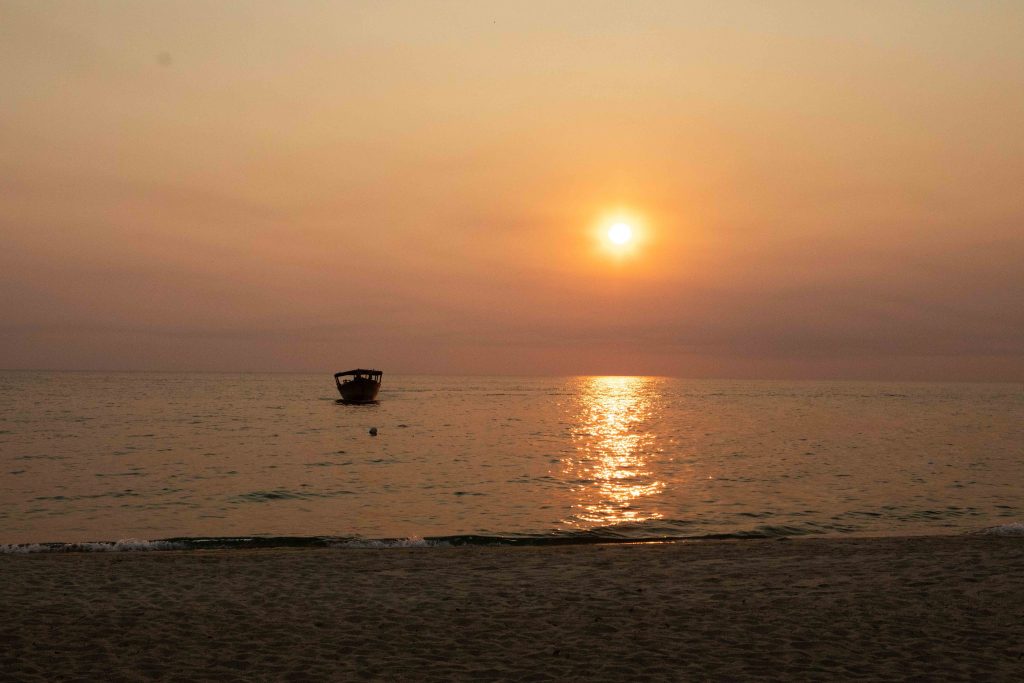
Fishing communities line the shore the whole length of the lake, and for tens of thousands of people the water is transport, water supply and food source combined. Crews go out at night in small wooden boats hung with kerosene lamps, drawing sardines up towards the light, and from a beach at Mahale the effect is of a floating town assembling itself after dusk.
The MV Liemba, a German-built steamer over a century old, still carries passengers and cargo down the Tanzanian shore towards Zambia, calling at the Mahale stop at Lagosa on the way. Speedboats, timber boats and dugout canoes handle everything else. There are stretches of this coastline where the lake is the only road there has ever been.
Nine million years of evolution on one side of the boat, and a fishing fleet that has worked the same water for generations on the other.
Why Conservationists Call It Nearly Untouched
Of Africa’s seven great lakes, Tanganyika is the one described by conservation organisations as still close to its natural state, which is a striking claim given the pressure on the others.
That status is not accidental and it is not secure. Sediment washing off cleared hillsides damages the rocky habitats the endemic fish depend on, and fishing pressure rises with the shoreline population. Protecting the forest and protecting the fish turn out to be the same job.
The Tuungane project, run by The Nature Conservancy with Pathfinder International and partners including Frankfurt Zoological Society, the Jane Goodall Institute, Carbon Tanzania, the Tongwe Trust and Tanzania National Parks, works across the Greater Mahale Ecosystem on fisheries, forest protection, health services and village land use planning. More than twenty beach management units have been established along this shoreline to improve yields and take pressure off the forests behind.
Where the Forest Meets the Water at Mahale
What makes Tanganyika special at Mahale in particular is the junction. Mountains rise from the shoreline to roughly 2,462 metres, and the forest comes down almost to the waterline.
The practical effect is a park where you can trek chimpanzees on a steep humid slope in the morning and swim in the second deepest lake on earth by early afternoon. Conservation groups describe these mountains as the only place in Africa where chimpanzees and savanna elephants occur together, and the lake is what gives the whole setting its shape.
Streams draining the western face carry fresh water into the lake through boulder fields and small sand deltas, and those junctions concentrate activity: fish eagles hunting, baboons on the rocks, otters at some outlets, and a shift in fish species immediately offshore where the stream enters.
Boat Safaris, Kayaking and Sailing on the Lake
Camps at Mahale include a boat safari during your stay along with kayaking and snorkelling equipment, and traditional dhows work this coast for sailing trips and transfers.
Boat safaris run along the shoreline in the late afternoon, tracking the base of the forested slopes where the streams come down. Fish eagles, hippos at river mouths and baboons on the rocks are regular; in the dry season a boat can put you level with chimpanzees feeding in shoreline figs. Kayaks are best early, when the water is glass.
Sport fishing runs as an extra, going after Nile perch and tigerfish. Catches vary considerably with season and luck, and nobody sensible promises a fish.
Best Time on Lake Tanganyika and Getting There
Dry season from June to October gives the clearest water, calmest conditions and best underwater visibility, overlapping neatly with the strongest chimpanzee trekking months. November and December bring short rains and lightning storms over the water at night. From March to May the long rains raise lake levels, shift the shoreline and close most Mahale camps.
Access is by air or water only. Scheduled charters run from Arusha on set days in season, typically Mondays and Thursdays, landing near the park boundary with a boat transfer of about ninety minutes. The alternative flies Dar es Salaam to Kigoma in roughly three hours, then continues south by light aircraft in forty five minutes or by speedboat in four to six hours. Our 10 day Mahale, Gombe and lake safari spends the whole trip on Lake Tanganyika, in both chimpanzee parks.
Lake Tanganyika: Frequently Asked Questions
What does it cost to visit Lake Tanganyika at Mahale?
Lakeside camp rates start from around US$1,500 per person per night at the premium end and are fully inclusive of meals, most drinks, boat transfers, kayaking, snorkelling and a daily chimpanzee trek. Park charges add roughly US$80 to US$95 per non-resident adult per day depending on VAT treatment and about US$35 per adult per night concession levy, with the chimpanzee trekking permit at around US$150 per person. East African citizens pay considerably lower park fees, and park bandas near headquarters cost a fraction of camp rates.
How old is Lake Tanganyika?
Estimates run between nine and thirteen million years, which makes it one of the oldest lakes in the world and substantially older than Lake Malawi. That age, combined with stable conditions and isolation, is what allowed such a high proportion of its species to evolve nowhere else.
Why are the fish in Lake Tanganyika so unusual?
Millions of years of isolation in a deep, stable lake allowed cichlids to specialise into a very wide range of niches. More than 250 described cichlid species live here with roughly 98 percent endemic, alongside around 75 non-cichlid species of which about 60 percent are endemic. The variation in body shape, feeding strategy and behaviour exceeds what is normally seen within a single fish family, which is why the lake is used as a reference case in the study of speciation.
Is Lake Tanganyika safe to swim in?
Camps at Mahale swim daily and treat the deep, rocky, well-flushed water on this shore as low risk. Bilharzia occurs in parts of the wider lake, particularly in shallow, still, weedy areas, so swim where your camp swims and ask their current advice. Crocodiles are recorded in the park but are described as rare on this stretch, and hippos hold at some river mouths.
Which countries share Lake Tanganyika?
Tanzania, the Democratic Republic of Congo, Burundi and Zambia. Four protected areas sit on its shores, including Gombe Stream and Mahale Mountains in Tanzania and Nsumbu in Zambia. From Mahale, the Congolese shore lies roughly forty to fifty kilometres west and is visible on clear days.
Can you scuba as well as snorkel?
Scuba is possible on the lake more broadly, and the clear water and rocky drop-offs make good conditions. What the Mahale camps actually offer is snorkelling, with masks and fins included in the rate, since most of the colourful shallow-water species sit in the first few metres over rock anyway.
When is the water clearest?
The dry season from June to October, when underwater visibility over the rocky shallows can reach around twenty metres. Water temperature holds near 25 degrees Celsius year round, so warmth is never the limiting factor. Mornings are calmest; afternoon wind often puts a chop on the surface.
Booking Your Mahale Trip
The safari companies and tour operators listed on this website put trips like this together for a living and know which camps, guides and routes actually deliver. We are an independent guide to Mahale; we do not book or sell tours ourselves.
When you are ready, arrange your safari, tour or holiday with one of the recognised operators listed here. Tell them your dates and what matters most, and a real person, not a form, will handle the itinerary, park bookings and logistics for you.