Which Animals Are Most Common in Mahale?
The animals you are most likely to see in Mahale are yellow baboons on the beaches, red-tailed and blue monkeys in the canopy, red colobus in the valley forest, African fish eagles along the shoreline, and the habituated M group chimpanzees on a guided trek. A Mahale safari is a walking and boat destination rather than a game drive one. Mahale Mountains National Park in western Tanzania holds around ten primate species and an estimated 700 to 1,000 chimpanzees.
Common here means something different from common in the Serengeti. There are no plains to scan and no vehicles, so the animals you see most are the ones that live close to the camps and are not bothered by people.
Yellow Baboons: The Animal You Cannot Avoid
If you spend three nights at Mahale, you will see baboons. They are the most reliably visible large mammal in the park by a wide margin.
Yellow baboons work the beaches and rocky headlands, coming down in the late afternoon to forage along the shoreline. Being fully terrestrial and used to people, they are the easiest species here to watch at length, and troop social behaviour is on open display in a way canopy monkeys never manage.
They are also opportunists. Camp staff will tell you to keep tent flaps closed and not to leave food out, and this is advice rather than decoration. Watch them from a distance and they are excellent company; leave a bag unattended and they are a problem.
A useful reframe: Mahale’s “common” animals are primates and birds, not herds. If you arrive expecting the density of large mammals you get on a northern circuit game drive, you will be disappointed by a park that is doing exactly what it is supposed to do.
Red-Tailed and Blue Monkeys in the Canopy
These two guenons are the most frequently recorded primates on guided forest walks, and something is usually moving overhead when you are inland.
Red-tailed monkeys are small, fast and constantly in motion, identified by a white spot on a dark face and chestnut underneath the tail. They forage across the mid canopy and drop lower into the understorey than the colobus do, which makes them easier to see properly.
Blue monkeys share much of the same forest and are often confused with red-tails at a glance, being similar in size and speed. The colouring separates them: grizzled grey-blue through the body, dark cap, no white nose spot. They favour the wetter valley forest and the taller closed canopy.
Both are usually heard before they are seen. A sudden crash and shake in the canopy is one of these two more often than not, and guides call the species from the sound.
Red Colobus and the Angolan Black and White Colobus
The colobus monkeys are the next tier down in frequency, regular with a guide rather than automatic.
Red colobus live in the lower valley forest near the camps and move in noisy troops through the middle and upper canopy, large and russet with long tails. They occupy an awkward position in the park’s ecology, since the chimpanzees hunt them, and the hunting and meat sharing behaviour documented at Mahale is among the best studied anywhere.
Angolan black and white colobus live higher up in the montane band, and Mahale supports a race of them recognised in the literature as found only in these mountains. Long white shoulder mantles and a habit of launching between trees make them unmistakable, but they are seldom down at beach level, so seeing them usually means walking into the middle slopes.
Vervet monkeys occupy the edges: forest margins, clearings and the ground between habitats. Widespread across Tanzania and the most familiar species on this list to anyone who has been on a northern circuit safari.
Almost daily
Yellow baboons on the beaches and rocks, African fish eagles calling along the shore, red-tailed monkeys in the canopy near camp, giant squirrels. Visible without going anywhere.
Regular on a guided walk
Blue monkeys, red colobus, palm-nut vultures, crested guineafowl, butterflies at stream crossings. Two or three hours in the valley forest usually produces most of these.
The main event, with a trek
The M group chimpanzees, found by trackers each morning. Strong odds across two or three mornings, particularly from August to October, though never guaranteed.
Occasional to rare
Angolan black and white colobus higher up, otters at stream mouths, hippos at river outlets, bushbuck, duiker, bushpig. Present but unpredictable.
Chimpanzees: Common in the Park, Not on a Given Morning
The park holds an estimated 700 to 1,000 eastern chimpanzees, described by Tanzania National Parks as the largest protected population of the subspecies anywhere. By any population measure they are common here.
Seeing them is a different matter. Only the M group, at somewhere around sixty to seventy five animals, is habituated for visitors, and it ranges across steep forested country on the western slopes. Trackers start each morning at the previous night’s nests and work forward until they have contact, and the walk can be forty minutes or most of a day depending on the season.
Operators note that most guests see the chimpanzees at least once in a three or four day stay, while being clear that sightings are not guaranteed. Chimps could be right behind the camp one day and high in the mountains the next. Odds are strongest from August to October when the group ranges low.
Birds You Will See Every Day
Birds are the most consistently visible wildlife in Mahale, and the shoreline species need no effort at all.
African fish eagle is common along the whole lakeshore and calls constantly from waterside trees. Palm-nut vulture is also common near the lake, feeding on oil palm fruit as well as scavenging. Giant kingfisher works branches over the clear water and dives into the shallows.
Inland the forest species dominate the park’s list, which runs somewhere between 337 and 398 recorded species, but they are far harder to spot in a closed canopy. Western crested guineafowl and Ross’s turaco are among the more conspicuous, and Vieillot’s black weaver is recorded as common.
Baboons, guenons and fish eagles are what you actually see here. Lions and elephant are what appears on the species list.
Small Forest Mammals on the Trails
Below the primates sits a layer of smaller animals that turn up as glimpses on guided walks.
Giant squirrel and red-legged sun squirrel work the canopy and are common enough to count as regular sightings. Bushpig root through the valley floors. Blue duiker and bushbuck use the same ground and vanish at speed. Brush-tailed porcupine and bushy-tailed mongoose are recorded, though the porcupine is nocturnal and mostly known from quills found on the trail.
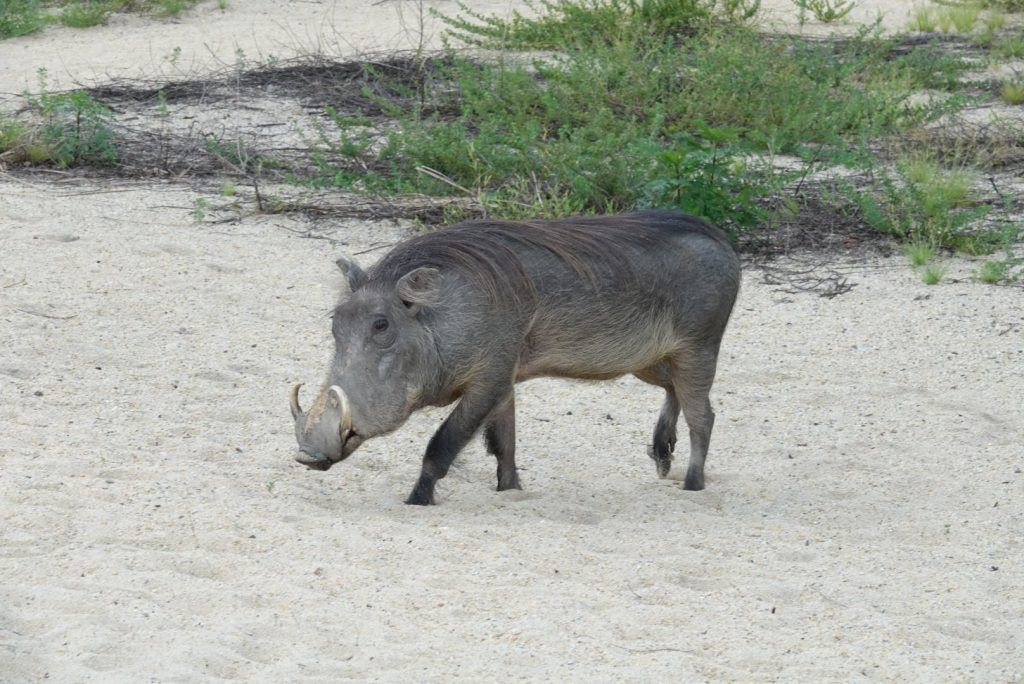
Otters use some of the rocky stream outlets where fresh water meets the lake, which makes those junctions worth pausing at on a boat safari. Warthog are also on the park list.
Most of these are seen rather than watched. A guide who names the species from a rustle and a flash of rump is doing the job well.
The Animals That Are Present but Rarely Seen
Worth being clear about, since some published material about Mahale is unreliable on this point.
Lions live in the park’s limited grassland sectors and were documented as a predator of chimpanzees here in 1989. Leopard occur. Buffalo range in the grassland and are the main reason for the armed ranger escort. Elephant occur in the wider ecosystem, and conservation organisations describe these mountains as the only place chimpanzees and savanna elephants are found together. Roan and sable antelope live in the miombo woodland on the drier eastern flank. Crocodiles are recorded but described as rare on this shoreline.
Visitors rarely see any of them, because the camps, trails and trekking routes all sit on the forested western face rather than in the grassland. Anyone wanting large mammals should add Katavi, which sits on the same flight rotation and delivers exactly that.
Fish: The Most Numerous Animals in Mahale
If common means numerous, the answer is not a mammal at all.
Lake Tanganyika holds more than 250 described cichlid species with roughly 98 percent found nowhere else, plus around 75 non-cichlid species. Park material puts the count in the waters off Mahale at over 90 species. Snorkelling straight off the camp beaches puts you over the rocky shallows where the small colourful ones concentrate: shell dwellers in beds of empty snail shells, rock-grazing Tropheus working the algae film, gobies in crevices.
Water sits near 25 degrees Celsius year round and dry season visibility can reach around twenty metres. This is the most reliable wildlife viewing in the entire park, and it is included in camp rates.
Best Time and Getting to Mahale
June to October gives easier walking, thinner undergrowth and the strongest chimpanzee sightings, with August through October the peak. November to February suits birds and butterflies best. Most camps close from March to May during the long rains and the scheduled flights stop with them. Our 12 day chimps, plains and crater safari is the long version, forest, plains and crater in one run.
Access is by air or water only, since the park has no roads. Scheduled charters run from Arusha on set days in season, typically Mondays and Thursdays, often via Katavi, landing near the boundary with a boat transfer of around ninety minutes. The alternative flies Dar es Salaam to Kigoma in roughly three hours, then continues south by light aircraft or speedboat.
Mahale’s Common Animals: Frequently Asked Questions
What does a wildlife trip to Mahale cost?
Lakeside camps are fully inclusive from around US$1,500 per person per night at the premium end, covering meals, most drinks, transfers, kayaking, snorkelling, a boat safari and a daily chimpanzee trek. Park charges add roughly US$80 to US$95 per non-resident adult per day depending on VAT treatment and about US$35 per adult per night concession levy, with the chimpanzee trekking permit at around US$150 per person. East African citizens pay considerably less.
What is the most commonly seen animal in Mahale?
Yellow baboons, which work the beaches and rocky headlands daily and are used to people. Along with African fish eagles on the shoreline, they are the wildlife most visitors see without making any effort at all. Red-tailed monkeys in the canopy near camp come close behind.
Will I definitely see chimpanzees?
No. Operators report that most guests see them at least once in a three or four day stay, but sightings cannot be guaranteed in an unfenced wild population. The M group can be behind the camp one day and high in the mountains the next. Odds are best from August to October, and two or three trekking mornings improve them far more than any other single factor.
How many primate species live in Mahale?
Between eight and ten depending on the source, with Tanzania National Parks citing eight and possibly nine and Frankfurt Zoological Society giving ten. The species visitors see are chimpanzees, red colobus, Angolan black and white colobus, red-tailed monkeys, blue monkeys, vervets and yellow baboons, with nocturnal galagos also recorded.
Can you see lions or elephants in Mahale?
Both occur, but sightings by visitors are rare. Lions live in the park’s limited grassland areas and elephant range the wider ecosystem, while the camps and trails sit on the forested western slopes. The armed ranger on every walk relates mainly to buffalo. Travellers wanting large mammals reliably should add Katavi National Park.
Is Mahale a good park for general game viewing?
No, and it is not trying to be. There are no roads, no vehicles and no open plains, so this is a walking and boat destination built around primates, birds and the lake. Anyone whose main interest is big mammals should pair it with a savanna park rather than expect Mahale to deliver both.
What can I see without going on a trek?
A great deal. Baboons on the beach, fish eagles and palm-nut vultures on the shoreline, monkeys in the canopy behind camp, and the lake’s endemic cichlids while snorkelling. Shorter guided forest walks add red colobus, blue monkeys, forest birds and butterflies without the pursuit of a chimpanzee trek.
Booking Your Mahale Trip
The safari companies and tour operators listed on this website put trips like this together for a living and know which camps, guides and routes actually deliver. We are an independent guide to Mahale; we do not book or sell tours ourselves.
When you are ready, arrange your safari, tour or holiday with one of the recognised operators listed here. Tell them your dates and what matters most, and a real person, not a form, will handle the itinerary, park bookings and logistics for you.