How Large Is Mahale National Park?
Mahale Mountains National Park covers roughly 1,600 square kilometres, with published figures ranging between about 1,589 and 1,650 square kilometres and 1,613 most commonly quoted. Visitors explore a small fraction of it on foot during a Mahale chimpanzee trekking safari, since the park has no roads. Mahale Mountains National Park lies on the eastern shore of Lake Tanganyika in western Tanzania and was gazetted in 1985.
Size here is less interesting as a number than as a ratio. Sixteen hundred square kilometres, fewer than forty beds, one habituated chimpanzee community, and annual visitor numbers in the low thousands.
Why Sources Disagree on Mahale’s Area
You will find three different figures depending on where you look, and the variation is worth explaining rather than papering over.
The most commonly cited number across Tanzanian sources is 1,613 square kilometres. Wikipedia gives 1,650. The official GANP entry puts it at 1,589, which converts to about 613 square miles. Expert Africa rounds to roughly 1,600.
Discrepancies of this kind usually come from boundary revisions, different mapping methods and whether lake surface within the park boundary is counted. None of the figures is wrong enough to matter for a traveller. If you need a single number, 1,613 square kilometres is the safest to quote; if you want to be accurate about the uncertainty, say roughly 1,600.
The number that actually affects your trip: not the park’s total area but the size of the M group’s home range, which covers a fraction of the western slopes. That is the ground you will walk. Everything else is forest you will look at from a boat.
How Mahale Compares in Size With Other Tanzanian Parks
Context helps, since 1,600 square kilometres sounds either large or small depending on what you are used to.
Gombe Stream, about 35 square kilometres
Tanzania’s other chimpanzee park, a narrow forest strip north of Kigoma. Mahale is roughly forty five times larger, which is the single most useful comparison on this page.
Serengeti, around 14,750 square kilometres
Nearly ten times the size of Mahale, with a road network, dozens of camps and visitor numbers in the hundreds of thousands. A completely different scale of operation.
Katavi, roughly 4,500 square kilometres
Mahale’s usual pairing on the western circuit, several times larger and largely open savanna rather than mountain forest. Reached on the same flight rotation.
The Greater Mahale Ecosystem, close to 20,000 square kilometres
The wider country the park sits inside, taking in village land, forest reserves and wildlife corridors. The park is the protected core of something much bigger.
So Mahale is mid-sized by Tanzanian standards and enormous by chimpanzee-park standards. That combination is precisely why it holds the population it does.
The Shape of the Park and Where Its Boundaries Run
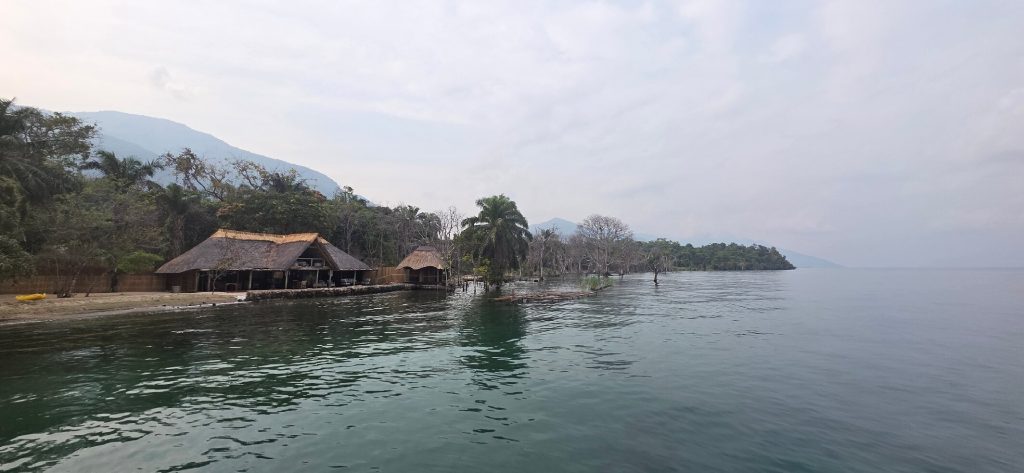
Mahale is not a neat block. It wraps around a mountain range running northwest to southeast, with the lake forming its entire western edge.
From the shoreline, the ground climbs to Mount Nkungwe at roughly 2,462 metres, then falls away eastward into drier country. That means the park spans two watersheds and two very different worlds: wet forest on the lake side, miombo woodland on the interior side.
Coordinates put the park near 6 degrees 16 minutes south and 29 degrees 56 minutes east, in the Uvinza District of the Kigoma Region, around 130 kilometres south of Kigoma town. The lake surface at the foot of the range sits at about 770 metres, so the park spans nearly 1,700 metres of vertical distance.
How Much of Mahale Visitors Actually See
This is where the size figure becomes misleading if taken at face value.
Visitor infrastructure occupies a tiny slice: two lakeside camps with sixteen rooms between them, park headquarters, some simple bandas and campsites, and the Kansyana research area. All of it sits along the western shoreline.
Trekking happens within the M group’s home range on the western slopes, which covers a small part of the total. The rest of the park holds unhabituated chimpanzee communities, the drier eastern woodland and a great deal of mountain forest that nobody walks. Even the Mount Nkungwe trek, the longest route available to visitors, follows a single line up and back.
Put plainly, you could spend a week here and cover perhaps a few percent of the park on foot.
Chimpanzee Density and What the Size Supports
The area matters most for what it holds. Tanzania National Parks puts the chimpanzee population at roughly 700 to 1,000 animals of the eastern subspecies, described as the largest protected population of that subspecies anywhere.
Compare that with Gombe, where around 95 chimpanzees live in about 35 square kilometres. Mahale’s animals have room, and the population is not pressed against its boundaries in the way small forest fragments are. Remoteness has done the rest, since the absence of roads and the difficulty of access have kept human pressure inside the park low.
Frankfurt Zoological Society counts ten primate species in the park, and Tanzania National Parks records at least 337 bird species. Both figures reflect the same underlying advantage: a large area spanning many habitats.
Forty five times the size of Gombe, with fewer than forty beds in it. That ratio is the whole reason the chimpanzees here are doing as well as they are.
The Park Within the Greater Mahale Ecosystem
The park boundary is not where the conservation story stops.
The wider Greater Mahale Ecosystem covers close to 20,000 square kilometres and forms part of the globally recognised Eastern Afromontane biodiversity hotspot. Chimpanzees live outside the park as well as inside it, which is why survey work by the Greater Mahale Ecosystem Research and Conservation Project has run across the whole area since the mid two thousands.
District and village land use plans covering nearly 6,500 square kilometres have expanded protection beyond the park, mostly as local authority forest reserves with a smaller share managed by communities. Work is also underway on restoring a wildlife corridor between Mahale and Katavi, involving Tanzania National Parks, Frankfurt Zoological Society, neighbouring districts and German development funding.
So the park is the core of something considerably larger, and its long term viability depends on that surrounding land as much as on its own boundary.
Distances Inside the Park
Since there are no roads, distances are measured in walking hours and boat minutes rather than kilometres.
Along the shoreline, camps hop between beaches by boat in minutes, while the same stretch on foot takes far longer because rocky headlands break the sand every few hundred metres. From the nearest airstrip to the camp beaches is roughly ninety minutes by boat.
Inland, a chimpanzee trek can run from forty minutes to most of a day depending on where the group has moved, which in the wet season means several hours of climbing. The Nkungwe route covers close to 1,700 metres of ascent over two or three days. Nothing inside the park is reached quickly.
How the Size Affects Planning a Mahale Safari
Two practical consequences follow from the numbers above.
First, you cannot cover the park, so do not plan to. Three nights gives two or three trekking mornings on the western slopes plus lake time, and that is a complete trip. Adding nights buys better odds on the chimpanzees and time for forest walks or the mountain, not more territory.
Second, the small bed count relative to the area means booking well ahead. Sixteen rooms across two camps, with fixed flight days limiting arrivals, is a genuine constraint in August and September.
The park being large is good news for the wildlife and largely irrelevant to your itinerary. What shapes your days is the flight rotation and where the chimps happen to be.
Best Time to Visit and Getting to Mahale
June to October is the dry season and the main window, with August through October strongest for chimpanzee sightings as the group ranges on the lower slopes. Most camps close from March to May during the long rains and the scheduled flights stop with them.
Access is by air or water only. Scheduled charters run from Arusha and the northern circuit on set days in season, typically Mondays and Thursdays, often calling at Katavi, landing at an airstrip near the boundary followed by a boat transfer of around ninety minutes. The alternative flies Dar es Salaam to Kigoma in roughly three hours, then continues south by light aircraft in forty five minutes or by speedboat in four to six hours. For forest and open plains in one trip, see our 7 day Mahale and Serengeti safari.
Mahale’s Size: Frequently Asked Questions
How much does it cost to visit a park this remote?
Fly-in packages of three or four nights commonly run between about US$5,000 and US$8,000 per person including flights, meals, park fees and daily trekking, with seven night combinations adding Katavi quoted from around US$14,000 per person for two travellers sharing. Park charges are roughly US$80 to US$95 per non-resident adult per day depending on VAT treatment, about US$35 per adult per night concession levy, and around US$150 per person for the chimpanzee trekking permit. The Kigoma route by scheduled flight and boat costs far less.
What is the exact size of Mahale Mountains National Park?
Published figures range from about 1,589 to 1,650 square kilometres, with 1,613 the most commonly quoted across Tanzanian sources. The variation comes from boundary revisions and differing mapping methods. Roughly 1,600 square kilometres is a safe way to describe it.
How does Mahale compare in size with Gombe?
Mahale is roughly forty five times larger. Gombe Stream covers about 35 square kilometres and holds around 95 chimpanzees, while Mahale spans some 1,600 square kilometres with an estimated 700 to 1,000. That difference in scale is the main reason Mahale’s population is described as the largest protected group of eastern chimpanzees anywhere.
How much of the park can you visit?
A small fraction. Visitor activity concentrates on the western shoreline and the M group’s home range on the slopes above it, plus the single route up Mount Nkungwe. There are no roads, so everything is on foot or by boat, and even a week in the park covers only a few percent of its area.
When was Mahale established as a national park?
In 1985, twenty years after chimpanzee research began at Kansyana in 1965. The action plan prepared by the Japanese researchers working there fed directly into the park’s creation, and the site has now been studied continuously for six decades. All of this sits on the shore of Lake Tanganyika, which is a destination in its own right.
Is the whole park forest?
No. The western slopes facing the lake carry rainforest and montane forest, but the park also includes alpine bamboo, montane grassland above roughly 2,300 metres, and miombo woodland on the drier eastern flank beyond the ridge. That mosaic is why species from both forest and savanna faunas occur inside one boundary.
How many visitors does Mahale get?
Very few by Tanzanian standards, with annual numbers historically recorded in the low thousands. With fewer than forty beds in the park and access limited to charter flights on fixed days or a full day of lake travel from Kigoma, the ceiling on visitor numbers is structural rather than seasonal.
Booking Your Mahale Trip
The safari companies and tour operators listed on this website put trips like this together for a living and know which camps, guides and routes actually deliver. We are an independent guide to Mahale; we do not book or sell tours ourselves.
When you are ready, arrange your safari, tour or holiday with one of the recognised operators listed here. Tell them your dates and what matters most, and a real person, not a form, will handle the itinerary, park bookings and logistics for you.