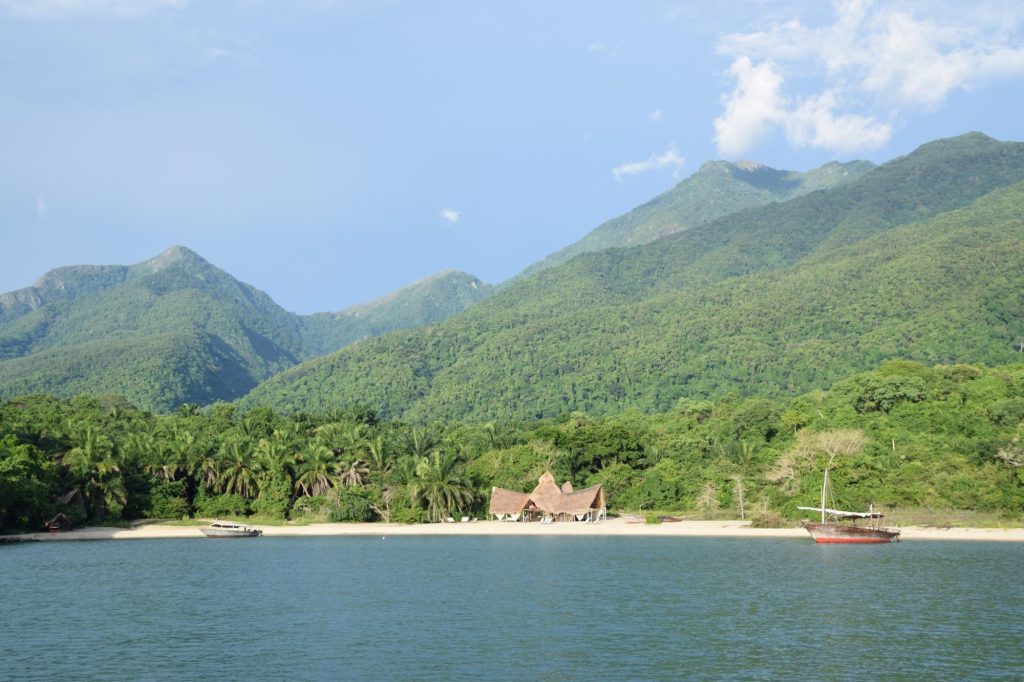
The Mahale Mountain Range
The Mahale mountain range is a chain of forested peaks running northwest to southeast through Mahale Mountains National Park in western Tanzania, topping out at Mount Nkungwe at around 2,462 metres and dropping straight into Lake Tanganyika along its western edge. Visitors walk the range on chimpanzee trekking safaris and multi-day hiking trips from lakeshore camps. The range gives the park its name and holds the largest protected population of eastern chimpanzees anywhere.
You see the whole thing from the boat coming in. The lake surface sits at roughly 770 metres, so the mountains present nearly their full height in one wall of green, cut by stream gullies and topped by grassland you can just make out on a clear morning.
Hiking Safaris in the Mahale Mountain Range
Every activity in this park happens on foot, because there are no roads inside the boundaries and none within about sixty kilometres of the lakeshore camps. That single fact makes the range unlike almost anywhere else in Tanzania. A Mahale hiking safari is not an add-on to a game drive circuit; it is the only way the park works.
Trips fall into three shapes. Short guided forest walks from camp cover the lower slopes and stream valleys, running two or three hours. Chimpanzee treks go wherever the apes are, which can mean forty minutes or most of a day on steep ground. And the full Mount Nkungwe trek climbs the range end to end over two or three days with rangers and camping.
Armed rangers accompany walking parties. Mahale is one of the few places where lions and chimpanzees share a forest, and buffalo use the upper grassland, so the escort is a working precaution rather than a formality.
On the gradient: people underestimate this range because the summit sits under 2,500 metres. Altitude is not the issue. Heat, humidity, wet rock and a slope that rarely eases are, and chimpanzee trekking here is rated among the more strenuous primate walks in Africa before you even start on the peaks.
How the Mahale Range Sits Above Lake Tanganyika
The range forms part of the eastern wall of the western branch of the East African Rift, the same tectonic tearing that opened the trough Lake Tanganyika fills. Mountains on one side, a lake 1,470 metres deep on the other, and very little flat ground between them.
Rain arrives from the west off the lake, hits the slopes and drops there, which is why the western face carries dense tropical forest while the country beyond the ridge turns to miombo woodland and drier grassland. Standing on the divide and turning around is the clearest lesson in the park’s geography anyone will give you.
Short, steep streams drain the western slope directly into the lake, cutting deep gullies and forming waterfalls where the rock steps down. Those valleys hold the wettest forest in the park and much of its wildlife.
Mount Nkungwe and the High Peaks of the Range
Mount Nkungwe is the high point, quoted variously between about 2,460 and 2,520 metres, with the older imperial figure of 8,069 feet still on park signage. It is the mountain the whole range takes its character from, and it is sacred to the Tongwe people who lived in these hills long before the park was gazetted in 1985.
Climbing it means gaining close to 1,700 metres from the beach, usually over two or three days with a night or two camping en route. The trailhead is near Kansyana or park headquarters. Above roughly 2,300 metres the forest gives out and open montane grassland takes over, and from the ridge the view runs west across the full width of the lake to the Congolese highlands when the haze allows.
Other summits in the chain are unnamed on most maps and unclimbed by visitors. The range is not a trekking circuit with numbered routes. It is one mountain most people go up and a great deal of forest nobody walks.
Vegetation Belts on a Mahale Mountains Trekking Route
Few Tanzanian mountains stack this many habitats into so little vertical distance, and the mixture is the reason the park’s biodiversity is what it is.
Lowland and riverine forest
From the shoreline upward, tall and closed canopy, cut by streams. The chimpanzees’ dry season ground and the easiest walking in the park, if the hottest.
Montane forest
Cooler and mossier through the middle slopes, with a thinner canopy and views opening back to the lake. Angolan black and white colobus live through this band.
Alpine bamboo
Dense stands across the upper slopes that narrow the trail and hold water underfoot. Atmospheric to look at and hard work to walk through.
Montane grassland
Open grass and scattered scrub above about 2,300 metres. Wind, sun, and the first proper panoramas of the trip.
Miombo woodland
Beyond the ridge on the drier eastern side, where roan and sable antelope range and the park stops looking like a rainforest at all.
Park authorities describe the range as a mosaic of overlapping rainforest, woodland, bamboo, montane forest and mountain grassland, and that overlap is what allows species from the Congo basin and species from the East African savanna to occur in the same protected area.
Chimpanzee Trekking on the Western Slopes
Chimpanzee trekking safaris work the western face of the range, where the habituated M group has been studied since 1968. Roughly 700 to 1,000 eastern chimpanzees live across the park, though only that one community is visited.
Where you walk depends on the season, because the chimps move up and down the slope with the fruiting trees. From June through October they favour the lower ground near the lakeshore, which shortens the trek. As the rains build they climb, and a morning that took ninety minutes in September can take five hours in January.
Trackers go out at first light to find the previous night’s nests and work forward from there. Groups are capped at six visitors, contact time is limited to one hour, and face masks are required near the animals. Sightings are strong at Mahale but never promised, which is why most operators want you to have two or three trekking mornings rather than one.
The range is not scenery around the chimpanzees. It is the reason they are here, and the reason nobody has been able to reach them easily for sixty years.
Wildlife of the Mahale Range Beyond the Chimpanzees
Mahale holds one of the densest primate communities in Tanzania, with somewhere around nine or ten species inside the park. Alongside the chimps you have red colobus, Angolan black and white colobus with a race found only here, red-tailed monkeys, blue monkeys, vervets and yellow baboons. Something is usually moving in the canopy on a forest walk.
On the ground the range supports bushpig, blue duiker, bushbuck, giant squirrel, brush-tailed porcupine and several mongoose species. Over the ridge in the miombo, roan and sable antelope range with buffalo, and lions live in the park’s grassland sectors, which researchers documented as a genuine predator of chimpanzees here in 1989.
Birdlife runs to well over 300 recorded species, including Albertine Rift specials and forest birds most Tanzanian itineraries never reach. Pel’s fishing owl is among the names that draw birders this far west. Sightings of the larger mammals are occasional rather than routine; the forest is thick and animals hear a walking party coming.
Tongwe Heritage in the Mahale Mountains
People lived in these mountains long before the park existed. The Tongwe occupied the range and the shoreline, and their oral history treats Nkungwe as a sacred peak rather than a viewpoint.
Parts of the trekking routes follow old forest paths and skirt former settlement areas. Guides will explain the significance of particular places if you ask, and asking is worth doing. The Tongwe Trust remains one of the partners working on conservation across the wider ecosystem today, alongside Tanzania National Parks and international organisations.
Guided Forest Walks and Waterfall Trips in the Range
Not every walk here is a chimpanzee hunt. Camps run shorter guided forest walks into the stream valleys behind the beaches, which suit anyone who wants the forest without the pace of a tracking party.
These walks go slower and see more of the small things: butterflies in the light gaps, forest birds, tool marks on ant nests, medicinal plants the chimps use. Waterfalls sit in several of the stream gullies where the slope steps down, and the shorter ones are reachable in a morning from camp.
For visitors who are not up to the steep trekking, this is where the range still opens up. You do not need to reach 2,400 metres to feel what the forest is like.
Best Season for Mahale Mountains Hiking Trips
June to October is the window. Trails firm up, streams drop, chimpanzees range lower and the camps that organise everything are open. August through October gives the most reliable chimp sightings, though October runs hot before the rains break.
The shorter drier spell from December to February also works for walking, with fewer visitors around. From March into May the long rains close most camps in the park and stop the scheduled flights, so the range is out of reach for practical purposes during those months.
Getting to the Mahale Mountain Range
Access is by air or water only. Most travellers fly Dar es Salaam to Kigoma in around three hours, then continue south by light aircraft in about forty five minutes or by speedboat in four to six hours. Slower timber boats take fifteen hours or more, and the lake steamer calls at Lagosa, also known as Mgambo, where a park boat comes out to collect passengers. For a fuller loop of the country, see our 10 day Mahale and northern Tanzania safari.
Fly-in guests bound for the lakeshore camps use scheduled charters that typically operate on Mondays and Thursdays in season from Arusha and the northern circuit, often routing via Katavi, landing at an airstrip near the park boundary and transferring by boat for an hour and a half or so along the shore.
The Mahale Mountain Range: Frequently Asked Questions
How much does it cost to visit the Mahale mountain range?
Non-resident adults pay a park conservation fee of roughly US$80 to US$95 per person per day depending on whether the quoted figure includes VAT, plus an overnight concession levy of about US$35 per adult per night inside the park. The chimpanzee trekking permit runs to around US$150 per person. Lakeshore camps are fully inclusive from about US$1,500 per person per night and usually fold the park charges into their rates. East African citizens pay substantially less on entry fees, and simple park bandas near headquarters cost a fraction of camp rates.
How high are the Mahale Mountains?
Mount Nkungwe, the highest peak, is quoted between about 2,460 and 2,520 metres, with 2,462 metres the most commonly cited figure and 8,069 feet still appearing on older park material. Since the lake at the foot of the range sits at roughly 770 metres, a climb from the shoreline involves close to 1,700 metres of ascent.
Can you drive into the Mahale mountain range?
No. There are no roads inside the national park and none within around sixty kilometres of the lakeshore camps. Everything is done on foot or by boat along the shore. A four wheel drive track improved by the park authority now reaches the headquarters area from Kigoma in the dry season, taking five or six hours, but it stops at the boundary.
How hard is hiking in the Mahale Mountains?
Harder than the modest altitude suggests. Slopes are steep, the air is humid, trails are often slick and the upper sections require pushing through bamboo and high grass. There is no technical climbing and no altitude risk. If long uphill days in heat are within your normal range you will manage; if steep descents trouble your knees, factor that in, since the way down is on the same ground.
What animals live in the Mahale mountain range?
Around 700 to 1,000 eastern chimpanzees, plus eight or nine other primate species including red colobus, an Angolan black and white colobus race found only here, red-tailed and blue monkeys, vervets and yellow baboons. The drier eastern side holds roan and sable antelope and buffalo, and lions live in the park’s grassland areas. Bird records exceed 300 species. Sightings of larger mammals are occasional rather than reliable.
How long do you need in Mahale to walk the range properly?
Three nights covers two or three chimpanzee trekking mornings plus forest walks. Adding the Mount Nkungwe climb pushes you to five or six nights, since the mountain alone takes two to three days. Because the flights are the expensive part of the trip, extra nights are proportionally cheaper than the first ones.
When is the best time to hike in the Mahale Mountains?
June to October, with August to October the strongest for chimpanzee sightings. December to February also works for walking, between the short and long rains. Avoid March to May, when the long rains close most camps and scheduled flights stop.
Booking Your Mahale Trip
The safari companies and tour operators listed on this website put trips like this together for a living and know which camps, guides and routes actually deliver. We are an independent guide to Mahale; we do not book or sell tours ourselves.
When you are ready, arrange your safari, tour or holiday with one of the recognised operators listed here. Tell them your dates and what matters most, and a real person, not a form, will handle the itinerary, park bookings and logistics for you.